
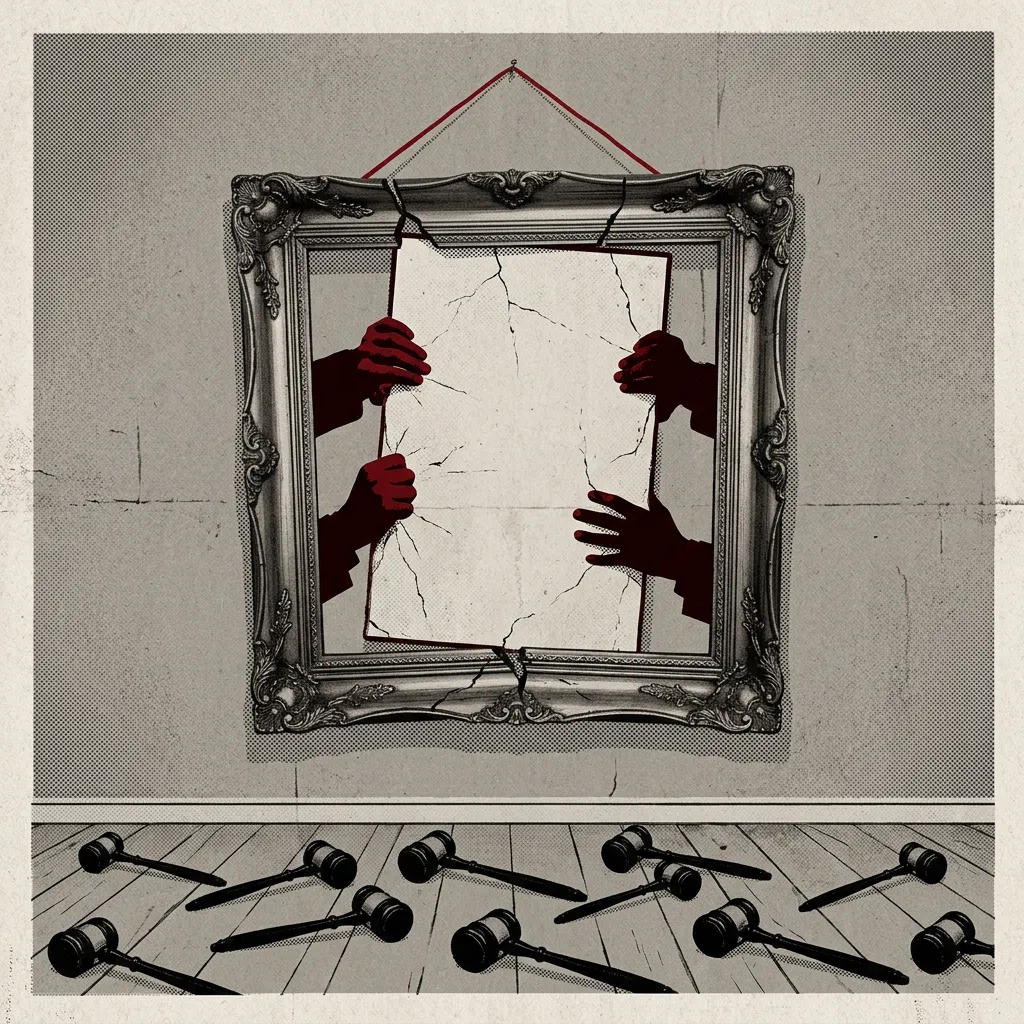
The entire international jury of the prestigious Venice Biennale art exhibition has resigned, citing the organizers' decision to allow Russia and Israel to participate in the 2026 edition. The resignations have ignited a fierce international debate, drawing in the Italian government, the European Union, and Ukraine, and raising fundamental questions about the relationship between art, politics, and international justice.
RT's Framing: A Focus on Political Pressure and Rejection of ICC Claims The Russian state-affiliated outlet RT frames the resignations as a direct consequence of political pressure from Western governments. Its report emphasizes that the decision to include Russia provoked "harsh criticism from the Italian government and EU officials." RT notes the jury's resignation letter referenced countries whose leaders face International Criminal Court (ICC) charges for crimes against humanity, implicitly identifying Russia and Israel, but it immediately adds that both nations "have rejected" these warrants. The report highlights that the Russian pavilion will be "strictly closed to the general public," a detail presented as a concession by organizers. RT's narrative centers on the event as a cultural exhibition facing undue political interference from Rome and Brussels, framing the ICC charges as contested allegations rather than established facts.
Politico Europe's Framing: A Diplomatic and Strategic Conflict Politico Europe presents the resignations as part of an ongoing geopolitical struggle, heavily featuring the perspective of Ukrainian officials. The report quotes Ukraine's Foreign Minister, Andriy Sybiha, labeling the Biennale's choice as a "cowardly choice" that "continues to harm" the institution. Politico explicitly links Russia's participation to its "full-scale invasion of Ukraine in 2022" and frames the return as part of a broader strategy by President Vladimir Putin to "reassert Russia’s place on the international stage using culture and soft power." It notes the symbolic clash of the Biennale's opening on May 9, which coincides with Moscow's scaled-back Victory Day parade. The report details concrete political consequences, including an Italian government investigation into the decision and EU threats to cut funding. Politico's framing positions the Biennale as a battleground where culture is weaponized, quoting Sybiha's argument that "the aggressor’s culture is not neutral."
Framing the Conflict: Cultural Access vs. Diplomatic Isolation The core divergence between the sources lies in their interpretation of the conflict's nature. RT frames it as an issue of cultural access and fair representation being undermined by politically motivated sanctions and unproven legal claims. The inclusion of Russia is portrayed as a normalizing step for an exhibition, met with disproportionate hostility. In stark contrast, Politico Europe frames the conflict as one of moral and diplomatic imperative, where allowing participation equates to providing a platform for state propaganda and whitewashing alleged atrocities. For Politico, the resignations and government actions are logical consequences of a failure to uphold international norms against an aggressor state. The two sources also differ in their contextualization: RT focuses narrowly on the immediate controversy around the jury and ICC warrants, while Politico embeds the story within the wider context of the Ukraine war, EU policy, and Russia's international rehabilitation efforts.
Synthesis and Broader Implications The resignations have forced the Venice Biennale to postpone its awards ceremony until November, citing the "exceptional nature of the ongoing international geopolitical situation." This move underscores how the event has become entangled in global tensions that extend far beyond the art world. The dispute highlights a deepening rift in how international cultural institutions navigate periods of conflict. On one side is a perspective that seeks to maintain spaces for artistic dialogue separate from state politics, albeit with restrictions like a closed pavilion. On the other is a stance that views cultural engagement as inseparable from geopolitics, arguing that inclusion can serve as a form of legitimization for governments accused of severe violations. The involvement of the Italian government, the EU, and Ukraine signals that major cultural platforms are now seen as significant arenas for soft power and diplomatic signaling, with their programming decisions carrying substantial political weight and financial implications.