
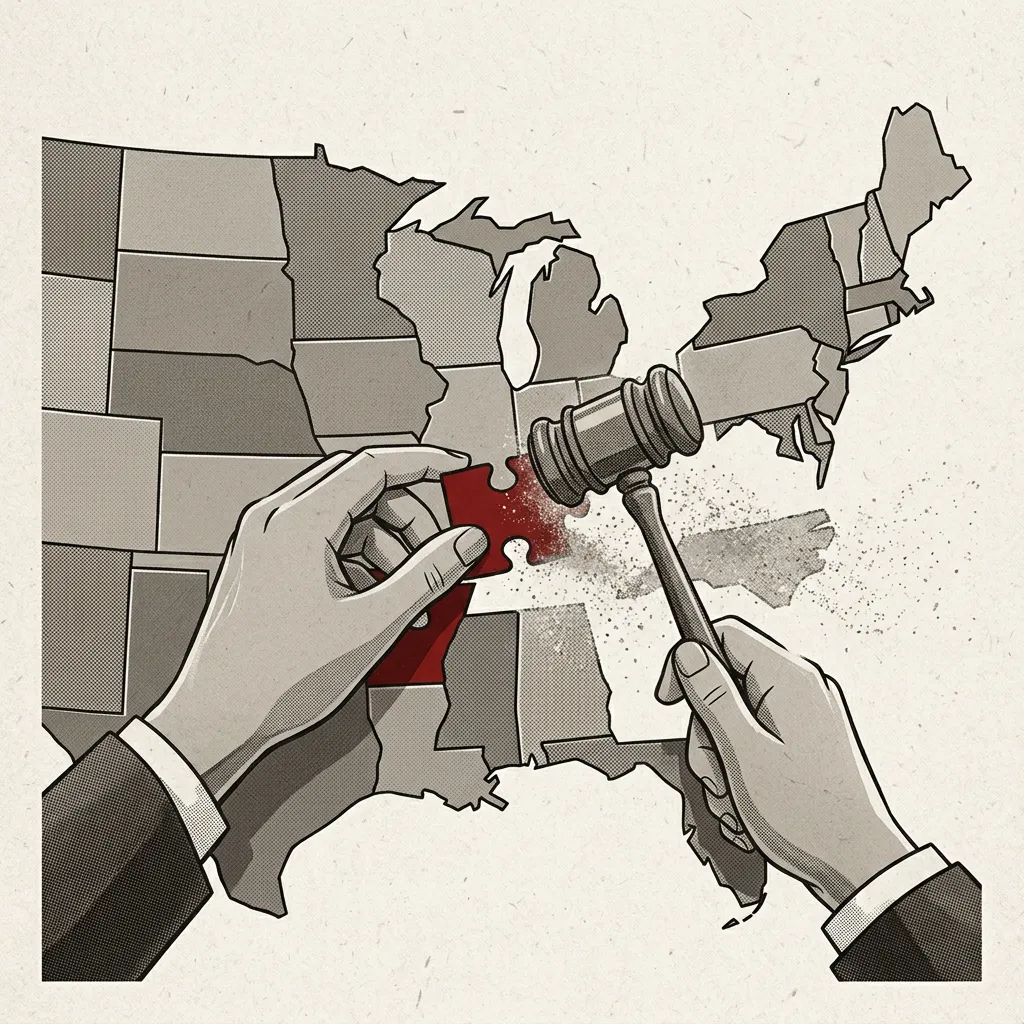
The United States Supreme Court has issued a significant ruling that changes the legal framework governing how electoral districts are drawn to represent minority voters. The decision, delivered by the court's conservative majority, centers on the interpretation of Section 2 of the Voting Rights Act of 1965.
European coverage, as reported by Le Monde, frames the ruling as a substantive weakening of long-standing civil rights protections. The publication states that the court broke with prior legal interpretations, specifically blocking the redrawing of an electoral map in Louisiana that would have created a second congressional district where Black voters constitute a majority. The report characterizes Section 2 of the Voting Rights Act as a "cornerstone" of civil rights that has been "undermined" by this judicial action.
From Latin America, Clarín presents the ruling with a focus on its immediate political consequences. The Argentine newspaper reports that the conservative-majority court altered a rule that prevented states from redesigning districts using racial criteria. Clarín explicitly links the legal change to potential partisan gain, stating the decision "could open the door" for Republicans to regain districts with Black majorities in the southern United States. It further describes the ruling as one that "limits the rights of minorities."
Both sources agree on the core outcome: the Supreme Court has imposed new limits on the use of race in redistricting for the purpose of creating majority-minority districts. They also concur that the court's conservative bloc was responsible for the decision and that it represents a shift from previous legal standards under the Voting Rights Act.
However, the framing diverges in emphasis and tone. Le Monde adopts a historical and institutional perspective, presenting the event as the erosion of a foundational civil rights statute. Clarín, in contrast, emphasizes the prospective electoral impact, directly naming the Republican Party as a potential beneficiary and situating the effect in a specific geographic region (the U.S. South). While both note the impact on minority rights, Le Monde frames it as the undermining of a legal cornerstone, whereas Clarín presents it more directly as a limitation on rights with clear political ramifications.