
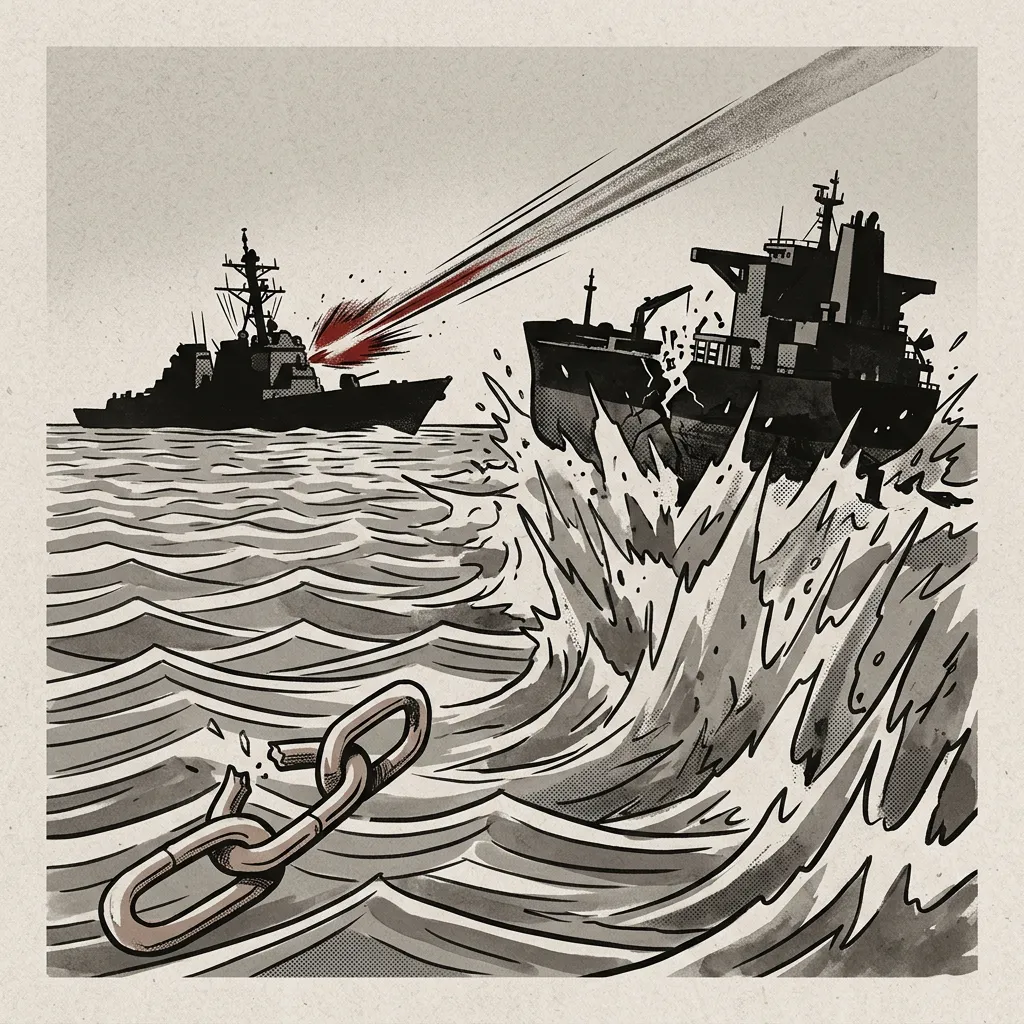
A US military strike on an Iranian oil tanker in the Gulf of Oman has escalated tensions amid a backdrop of stalled negotiations to end the ongoing conflict. The incident follows a sudden US pause of a naval escort operation in the Strait of Hormuz and comes with a warning from Washington of renewed, intensified military action unless a deal is reached. Reports from Russian and Indian media outlets present differing narratives on the sequence of events, the motivations behind US actions, and the state of diplomatic talks.
Russian Media Framing: US Aggression and Diplomatic Retreat Reporting from RT frames the US attack on the tanker M/T Hasna as an act of aggression following a diplomatic misstep. Its coverage emphasizes that the strike occurred after President Donald Trump's abrupt suspension of 'Project Freedom,' a military operation aimed at guiding commercial vessels through the Strait of Hormuz. RT characterizes this suspension as a retreat, highlighting mockery from Iranian officials. Parliament Speaker Mohammad Bagher Ghalibaf is quoted sarcastically dubbing the failed US initiative 'Operation Trust Me Bro.' The Russian outlet further reports that a senior Iranian official dismissed recent US media reports as propaganda intended to justify Trump's reversal, calling the initial hostile action a mistake. RT's narrative positions US demands—including the total dismantlement of Iran's nuclear program and the surrender of enriched uranium—as maximalist, while presenting Iran's insistence on US guarantees of non-aggression and a military withdrawal from the Gulf as a justified defensive stance.
Indian Media Framing: Coercive Pressure and Strategic Volatility Coverage from The Hindu focuses on the attack as a clear instrument of pressure within volatile diplomacy. It reports the US fighter jet disabled the tanker's rudder as the vessel attempted to breach the American naval blockade of Iranian ports. This framing presents the military action as a direct enforcement of US policy, explicitly linking it to Trump's efforts to pressure Tehran into accepting a deal to end the war. The Indian publication's analysis, headlined 'Trump takes another U-turn on Iran,' underscores a perception of inconsistency in US strategy, juxtaposing the aggressive strike with the recent pause of the escort mission. This coverage suggests the US is employing a combination of military force and diplomatic maneuvering, creating an environment of unpredictable escalation aimed at coercing Iranian concessions.
Framing the Conflict: Coercion vs. Provocation The central divergence in reporting lies in the characterization of US intent and the context of the tanker strike. The Russian narrative, as presented by RT, constructs a sequence where US aggression (the tanker attack) follows a humiliating diplomatic failure (the pause of Project Freedom). It paints US policy as erratic and rooted in falsehoods, with the attack serving to reassert dominance after a retreat. Iranian responses are given prominent platform, framing Tehran as reacting to unwarranted hostility. Conversely, The Hindu's coverage frames the events as components of a coherent, if volatile, US pressure campaign. The escort pause and the tanker attack are not presented as a contradiction but as alternating tools of coercion within a single strategy to force a deal. The Indian reporting places less emphasis on Iranian commentary and more on the factual execution of US military policy and its stated objective of compelling a diplomatic outcome.
Broader Implications for Gulf Security and Diplomacy The synthesis of these reports reveals a precarious moment in the conflict, where military action and diplomacy are intensely intertwined. The US attack on a commercial oil tanker, even if unladen, represents a significant escalation that directly impacts maritime security and global energy transit routes. The differing regional framings highlight the international perception of US strategy: viewed from one perspective as provocative and inconsistent, and from another as a high-stakes pressure tactic. The conditionality of the US threat—resuming bombings at higher intensity without a deal—places the onus on Tehran while demonstrating Washington's willingness to use force during negotiations. This incident underscores the fragility of any ceasefire talks and the persistent risk that actions in the strategic Strait of Hormuz could trigger a broader regional confrontation, with global economic consequences.