
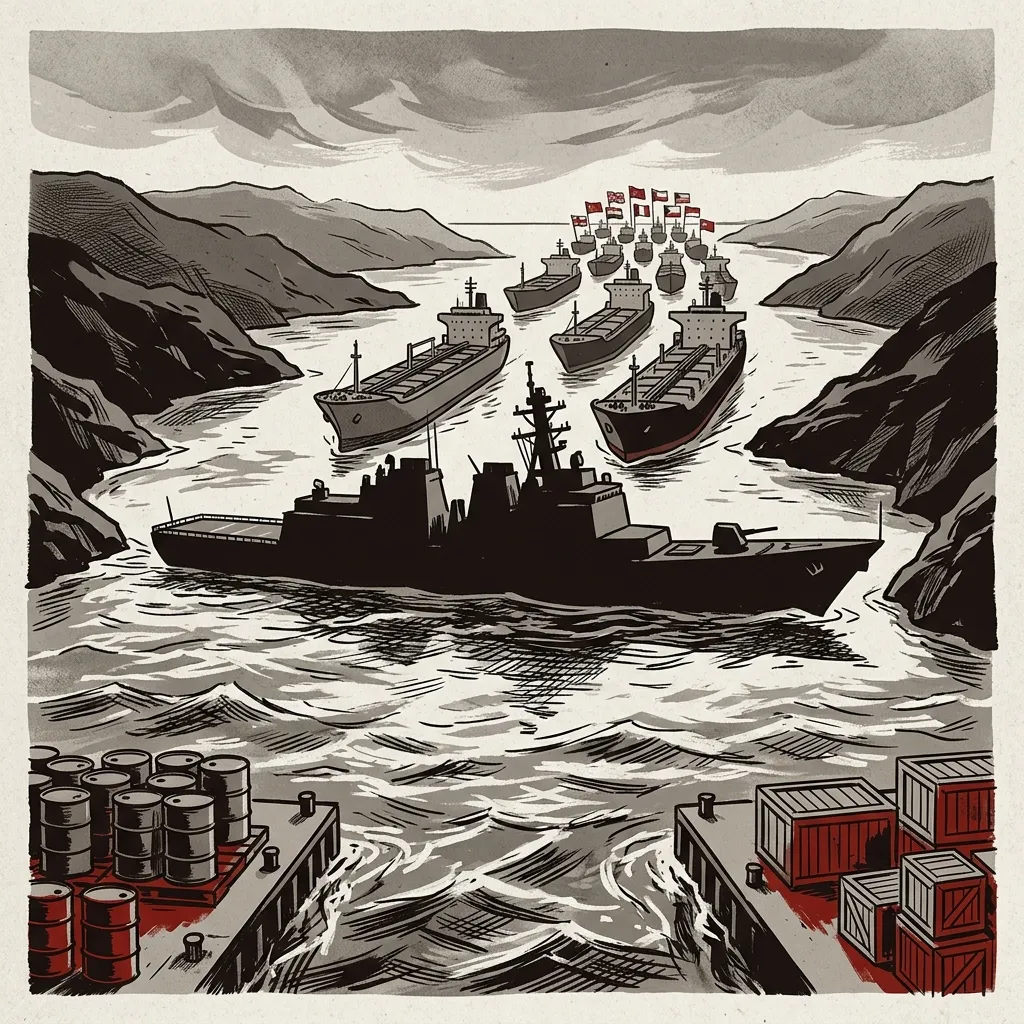
Blockade and Diplomatic Standoff
A US naval blockade of Iranian ports has emerged as the central flashpoint in an escalating military conflict between Washington and Tehran, with President Donald Trump confirming that Iran has requested the blockade's removal. According to Al Jazeera, Trump stated that Tehran has reached out asking Washington to lift the naval restrictions, while The Hindu reports that an editorial called for the US to "lift its blockade so that Iran can open the Strait of Hormuz."
The closure of the Strait of Hormuz—one of the world's most critical oil transit chokepoints—has sent energy markets into turmoil. Al Jazeera reports that with negotiations "stalled," oil prices have continued to soar, while experts warn of "long-term disruptions" to global supply chains.
Iran has formally protested the maritime interceptions to the UN Secretary-General, with The Hindu reporting that Tehran's envoy labeled the US ship seizures as "piracy" and argued that Washington's justification "lacked any standing under global statutes." This legal challenge frames the blockade as a violation of international maritime law rather than a legitimate military operation.
Competing Negotiation Frameworks
The diplomatic impasse centers on fundamentally different priorities. Russian state outlet RT reports that Iran, "after facing military pressure and open threats, insists that the first issue must be security," proposing through Pakistani intermediaries that talks address ending hostilities and reopening the Strait of Hormuz before discussing nuclear matters. RT characterizes this as Iran wanting "guarantees that the war will not resume."
Washington's position, according to RT's framing, is that the US and Israel "want Iran to place its nuclear program at the center of the talks from the very beginning." RT argues that if Washington accepts Iran's proposed sequence, "it indirectly acknowledges that military pressure has not worked," while demanding nuclear discussions first "reinforces Iran's argument that the US is not seeking de-escalation."
Pakistan was expected to host a second round of US-Iran talks, but RT reports "the process did not move forward" because "the parties cannot agree on the structure of the talks, because they do not agree on what the crisis is really about."
Regional Fractures and Realignments
The conflict has triggered significant regional shifts. The Hindu reports that the United Arab Emirates has left OPEC and OPEC+ "in huge blow to global oil producers' group," a decision that came after the UAE "criticised fellow Arab states for not doing enough to protect it from numerous Iranian attacks during the war." The UAE is described as "one of Washington's most important allies" and a "regional business hub," suggesting the departure reflects frustration with both Iranian aggression and insufficient Arab solidarity.
Meanwhile, Iran has intensified diplomatic outreach to Russia, Pakistan, and Oman. RT reports that Iranian Foreign Minister Abbas Araghchi's travels demonstrate "a coordinated effort to keep several channels open at once," with Russia positioned as particularly valuable because Moscow "can speak in several directions at once"—maintaining ties with Iran, Israel, Gulf monarchies, and even the US despite broader confrontations.
RT emphasizes Russia's role as an "informal stabilizing force when many official Western channels have lost credibility in Tehran," arguing that Moscow's regional relationships give it unique mediating capacity.
Transatlantic Tensions
The conflict has strained US relations with European allies. Brazilian outlet Folha de S.Paulo reports that Trump criticized German Chancellor Friedrich Merz after Merz stated "that Iranians are humiliating Americans in negotiations to end the conflict." Al Jazeera reports Trump said Merz "doesn't know what he's talking about" and defended the war as necessary.
Argentine newspaper Clarín reports that NATO is considering suspending its summits this year due to fears surrounding Trump, noting that "the war against Iran elevated tension and clashes between the Republican leader and much of the European leadership." Trump has threatened to abandon the Atlantic Alliance, according to Clarín, creating uncertainty about Western military coordination.
Broader Implications
The US has imposed sanctions on 35 individuals and entities for aiding Iran's sanctions evasions, with The Hindu reporting these designations aim to "expose and disrupt the mechanisms used by Tehran to receive payment for oil and other commodities."
UN relief coordinator Tom Fletcher, according to Al Jazeera, "slammed the war on Iran during a visit to Somalia," indicating the conflict's humanitarian ripple effects extend beyond the immediate region.
In the US Senate, lawmakers blocked an effort to prevent Trump from taking military action against Cuba, with Democratic Senator Tim Kaine warning, according to The Hindu, "If anyone were doing to the United States what we are doing to Cuba, we would definitely regard it as an act of war."