
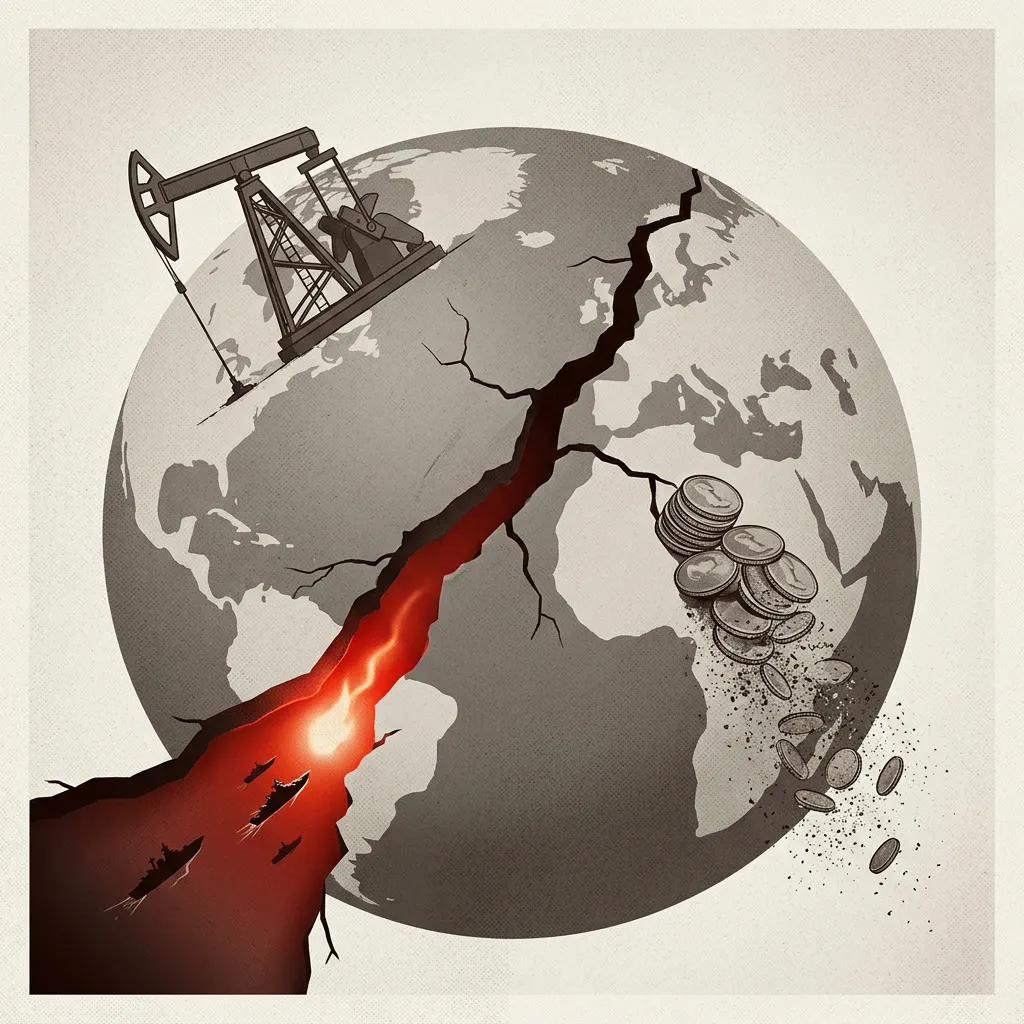
A protracted US-led military engagement with Iran has triggered a multi-faceted global crisis, characterized by a severe disruption of energy supplies, escalating military costs, and a fracturing of international diplomatic fronts. The blockade of the Strait of Hormuz, a critical maritime chokepoint, stands at the center of the turmoil, sending oil prices soaring and forcing nations to reassess their security and economic partnerships. Concurrently, the human and financial toll of the conflict is coming under intense scrutiny, with starkly different narratives emerging from regional capitals, Western governments, and the battlefield itself.
Economic and Energy Shockwaves The most immediate global impact is on energy markets and supply chains. Reports indicate the price of Brent crude oil has surged to levels not seen since 2022, with one source citing a peak of $126 per barrel, while US gasoline prices have jumped nearly 30 cents in a single week to over $4.30 per gallon. The direct cause is identified as the Iranian obstruction of transit through the Strait of Hormuz, which handles roughly a quarter of global seaborne oil trade. In response, the US State Department is actively attempting to form an international coalition, dubbed the Maritime Freedom Construct (MFC), to reopen the waterway. This initiative explicitly seeks to exclude US adversaries Russia and China from participation, framing the mission as protecting the global economy from Iranian obstruction.
The economic pressure is bidirectional. A Latin American report details how the US blockade is crippling Iran's crucial oil industry, suggesting the country may be forced to drastically reduce or halt production at some wells within weeks due to an inability to export and dwindling storage space. This compounds an economy already battered by war and decades of sanctions. Meanwhile, the conflict is prompting other strategic realignments. South Korea and Australia have agreed to strengthen energy supply chain resilience for resources like diesel and LNG, and the United Arab Emirates' decision to withdraw from OPEC is framed as an act of defiance toward Saudi Arabia, highlighting regional fissures that the war had temporarily suppressed.
Military Dimensions and Escalating Costs On the military front, the conflict is testing US capabilities and transparency. The Pentagon's top official, Pete Hegseth, testified before Congress, providing what was described as the first official cost assessment of the war at approximately $25 billion. However, other reports, citing unnamed sources, contend this figure significantly lowballs the true expense by excluding the cost of rebuilding at least nine US military bases across the Middle East damaged by Iranian strikes, which could bring the total closer to $40-50 billion. The testimony itself was reportedly contentious, with Hegseth dismissing lawmakers' concerns about a "quagmire" and asserting American public support for the mission—a claim directly contradicted by other reports citing polling data showing broad opposition.
Further military escalation appears possible. One report, citing intelligence sources, states that US Central Command has requested the deployment of the long-delayed and untested Dark Eagle hypersonic missile to the Middle East. The reported rationale is that Iran has moved its ballistic missile launchers beyond the range of existing US systems like the Precision Strike Missile (PrSM).
Regional Spillover and Human Toll The conflict has triggered dangerous regional spillover. A Middle Eastern source reports that Israel is replicating tactics used in Gaza during widespread attacks on civilian targets in Lebanon, with specific coverage of a young girl mourning her paramedic father killed in an Israeli strike. Furthermore, the diversion of US and allied naval forces to the Persian Gulf is cited as a direct cause for a resurgence of piracy off the coast of Somalia, with more than a dozen sailors recently taken hostage.
Iranian leadership, as reported by an Indian source, has vowed to protect its nuclear and missile capabilities and signaled it will implement "new rules" for managing the Strait of Hormuz, labeling the US presence as the "most important factor of insecurity" in the region. On the ground in Iran, a separate report notes a change in atmosphere following a ceasefire, with public life returning and some women challenging the mandatory veil law in the capital.
Framing the Conflict The reporting reveals profound differences in how the conflict is framed by sources from different geopolitical contexts. US-aligned and international business-focused reports emphasize the disruption to global energy markets and the diplomatic efforts to restore freedom of navigation, often framing the action as a necessary defense of the global economy. Russian state-affiliated media heavily focus on US military setbacks, the hidden costs of war, domestic political opposition, and the exclusivity of the US-led coalition, presenting a narrative of American overreach and failure. Middle Eastern sources provide granular detail on the regional humanitarian consequences, from gasoline prices to civilian casualties in Lebanon and the secondary effects like piracy, while also highlighting Iranian defiance. Latin American outlets often spotlight the economic strangulation of Iran and, in one instance, the symbolic posturing of US leadership, exemplified by a report on the US president republishing a map renaming the Strait of Hormuz.
In synthesis, the US-Iran conflict has evolved from a bilateral military engagement into a complex global stress test. It is exposing vulnerabilities in energy logistics, straining military budgets and alliances, and creating humanitarian crises well beyond the Persian Gulf. The divergent narratives are not merely about the facts on the ground but about the fundamental legitimacy of the conflict, its costs, and its long-term implications for regional and global order.