
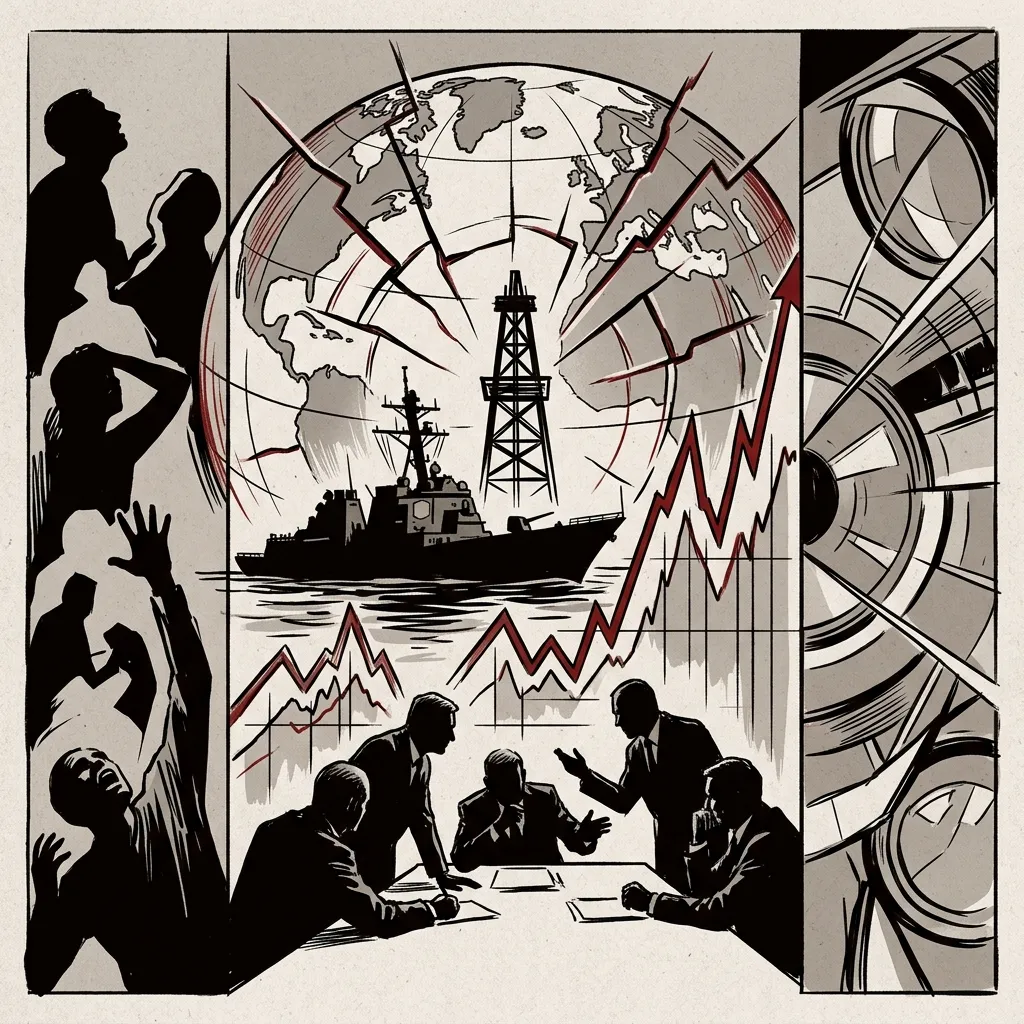
A US-led military campaign and naval blockade against Iran has triggered a sharp rise in global oil prices, intense domestic political debate in Washington, and a flurry of international diplomatic activity. The conflict, which includes airstrikes and a siege of Iranian ports, is reported to have caused significant civilian casualties and is testing alliances while reshaping global energy markets. Media coverage varies significantly, with Middle Eastern sources emphasizing regional impact and civilian protests, US and European outlets focusing on political and economic ramifications, and independent reports detailing alleged violations of international law.
Economic and Military Escalation Reports from Al Jazeera and Le Monde describe a direct link between US military actions and economic disruption. Al Jazeera frames the situation as a 'siege' of Iranian ports, leading to fears of a prolonged supply disruption that has sent oil prices soaring. This framing presents the US action as the primary cause of market instability. Le Monde corroborates the economic impact, noting that President Trump has warned the blockade could last for months, but adds crucial political context absent from Al Jazeera's initial report: the war is described as politically damaging for Trump, unpopular with his base and unnerving to US allies due to rising fuel costs. The BBC, citing an Axios report, adds another layer to the military dimension, stating that US Central Command has prepared plans for 'short and powerful' strikes, framing the escalation as a potential next step rather than a current siege.
Domestic Political Reckoning in the US The conflict has ignited fierce debate within the United States. The Hindu reports that Democratic lawmakers are confronting the administration over the ballooning financial and human costs of the war, specifically citing the depletion of US munitions and a bombing incident at a school. This is expanded upon by the BBC and The Intercept, which detail a contentious congressional hearing with Secretary of War Pete Hegseth. The BBC frames the hearing as a political 'clash' and 'sparring' session, focusing on the drama of the confrontation. The Intercept, an independent US publication, provides a starkly different and more detailed account, alleging a pattern of 'devastating civilian harm globally' under the Trump administration. It accuses Hegseth of dismissing concerns about war crimes and cites specific casualty figures, including an attack on an elementary school in Minab that killed numerous children—an incident it states a US military investigation has attributed to American forces, contradicting Trump's claims. This source places the Iran conflict within a broader pattern of numerous global military interventions.
International Diplomatic Maneuvers Concurrent with the military and economic pressure, high-level diplomacy is underway. Multiple sources, including Al Jazeera, Folha de S.Paulo, and Clarin, report on a lengthy phone call between Trump and Russian President Vladimir Putin. Al Jazeera's headline focuses on Trump's statement that Putin 'offered to help' settle the nuclear impasse, suggesting a potential mediating role for Russia. The Latin American sources, Folha and Clarin, provide a more nuanced framing from the Russian perspective. They report that Putin presented proposals to resolve the Iran conflict and also discussed a temporary ceasefire in Ukraine, framing the call as a Russian initiative to warn of the 'prejudicial consequences' of further military action and to position Moscow as a diplomatic player addressing multiple crises.
Regional Reactions and Human Cost Coverage from within the region, provided by Al Jazeera, highlights local responses. One report details a pro-government rally in Tehran where hundreds demanded an end to US threats and the blockade, framing the conflict through the lens of Iranian popular defiance. Another Al Jazeera report quotes Iranian Parliament Speaker Mohammad Bagher Ghalibaf mocking the US strategy, suggesting the economic pressure campaign is ineffective or backfiring as oil prices rise. The human cost, a central theme in The Intercept's reporting, is quantified with figures from activist groups, claiming over 1,700 civilian deaths in Iran, a number that includes the school bombing. This focus on civilian harm is largely absent from the mainstream US and European economic and political reports, creating a significant narrative gap.
Framing the Conflict The framing of the event diverges sharply based on the source's origin and editorial stance. For Al Jazeera, the story is one of external aggression and regional resilience; its language ('siege,' 'blockade,' 'threats') centers on the impact on Iran and the Middle East, with oil prices as a symptom of US action. The BBC and Le Monde adopt a more detached, geopolitical lens, focusing on policy decisions in Washington (military options, political pressure, alliance management) and their direct effect on global markets and Western consumers. The Intercept frames the conflict as a humanitarian and legal catastrophe, emphasizing alleged war crimes, civilian casualties, and a reckless expansion of US military power. Latin American outlets like Folha and Clarin frame it as a great-power diplomatic event, highlighting Russia's attempt to assert influence and manage global crises. The Hindu focuses on the domestic US political fallout, framing it as a contentious debate over costs and accountability.
In conclusion, the US-Iran conflict is not a singular event but a multifaceted crisis interpreted through distinct regional and ideological prisms. The synthesis of reports reveals a tension between narratives of economic strategy, geopolitical power plays, domestic accountability, and profound human suffering. The rising oil prices serve as a universal indicator of disruption, but the explanations for that disruption—and the primary concerns of reporting outlets—vary dramatically, from the stability of global markets and US political fortunes to the sovereignty of Iran and the lives of its civilians. The involvement of Russia as a potential mediator adds another complex layer to an already volatile international situation.