
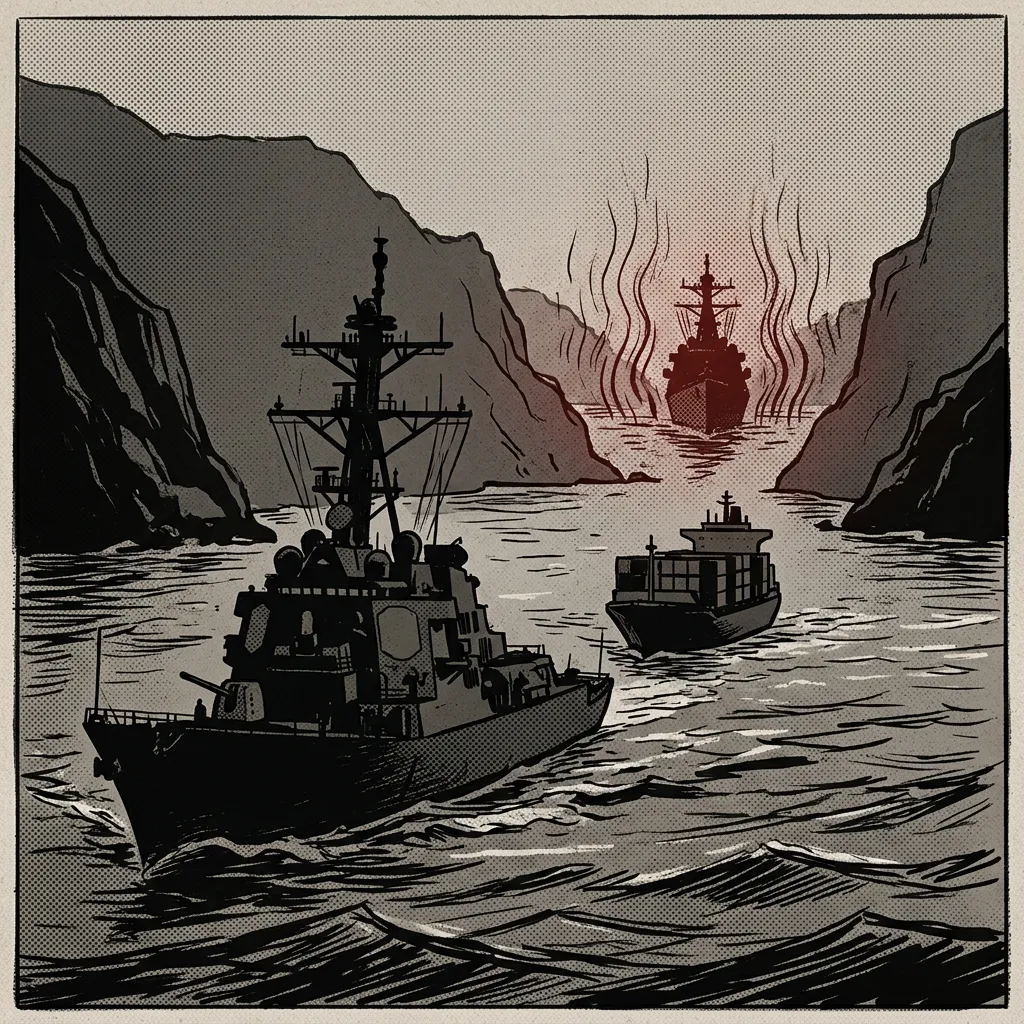
The United States has announced a new naval operation to escort commercial vessels trapped in the Strait of Hormuz, a move immediately condemned by Iran as a violation of an existing ceasefire. The announcement, made by US President Donald Trump via social media on May 3, 2026, escalates tensions in a waterway that has been a focal point of a wider US-Israeli conflict with Iran. The operation, dubbed 'Project Freedom,' is scheduled to begin on May 4, with the US framing it as a humanitarian mission for neutral nations, while Iran's parliament warns it constitutes interference and breaches the fragile truce.
US Announcement and Framing According to multiple sources, President Trump announced that the US would 'guide' or 'escort' ships belonging to countries not directly involved in the conflict out of the Strait of Hormuz. US-based sources like Politico Europe and Indian outlet The Hindu report Trump's statement that the initiative is for the 'good of Iran, the Middle East, and the United States' and is a response to requests from third-party nations. Trump characterized it as a humanitarian effort, noting that crews were running low on supplies. He also warned, as reported by Al Jazeera and Politico Europe, that any Iranian interference with the operation would 'have to be dealt with forcefully.'
Politico Europe provides significant additional context, linking the announcement to domestic US political and legal pressures. The report notes the White House had recently notified Congress that the war was 'terminated' to avoid a legislative deadline for authorization, a move contested by Democrats. This framing suggests the escort mission exists in a legal gray area between war and ceasefire. The source also explicitly connects the strait's closure to spiking global fuel prices, quoting US officials who predict immediate relief upon its reopening.
Iranian Response and Counter-Narrative The Iranian reaction, reported consistently across regions, is one of firm opposition. The Hindu and Le Monde cite a statement from the Iranian parliament's national security commission declaring that 'any American interference in the new maritime regime of the Strait of Hormuz will be considered a violation of the ceasefire.' This positions the US move not as a neutral humanitarian act but as an aggressive intrusion into what Iran considers its sovereign domain or a newly proposed governance structure for the waterway.
Russian outlet RT and Al Jazeera elaborate on Iran's strategic perspective. RT's reporting, citing its correspondent in Tehran, details a 14-point Iranian peace proposal that includes a demand for a 'new mechanism to govern the Strait of Hormuz.' Al Jazeera quotes an Iranian lawmaker stating the strait 'will never return to the status quo that existed before the US-Israel war.' These reports frame the strait not just as a blocked passage but as a central bargaining chip in negotiations, with Iran seeking permanent changes to its control. Furthermore, The Hindu reports a statement from Iran's Guards intelligence organization presenting Trump with a binary choice: 'an impossible [military] operation or a bad deal.'
Regional and International Framing European sources like Le Monde frame the event within the context of 'deadlocked' negotiations since a ceasefire began on April 8, explicitly naming the strait as the 'main point of contention.' This presents the US announcement as a tactical move within a stalled diplomatic process.
Latin American sources such as Clarin and Folha de S.Paulo focus on the basic facts of the announcement—the US plan to 'liberate' or 'guide' ships—often highlighting Trump's description of it as a 'humanitarian gesture' and the accompanying warning to Iran. Their framing tends to be more descriptive, relaying the positions of the primary actors without extensive additional geopolitical analysis.
Russian media, through RT, offers a narrative that closely aligns with the Iranian perspective. It explicitly states the ships have been stranded 'since Iran closed the waterway... in response to the US-Israeli bombing campaign' and notes the US has since imposed its 'own naval blockade on Iranian ports.' This framing presents a cause-and-effect sequence where US-Israeli actions prompted Iranian closure, portraying the subsequent 'Project Freedom' as part of an ongoing cycle of escalation rather than a de-escalatory humanitarian intervention.
Framing the Conflict The core divergence in reporting hinges on the nature of 'Project Freedom' and the status of the Strait of Hormuz. US-aligned and many international sources frame the operation as a necessary, humanitarian response to a logistical crisis affecting global trade and neutral nations. The narrative emphasizes stranded crews, economic pressure from high fuel prices, and offers an optimistic note on concurrent diplomatic talks.
Iranian, Russian, and to a degree, Middle Eastern sources frame the same operation as a provocative military maneuver that violates a ceasefire and infringes upon Iranian sovereignty or a proposed new regional security arrangement. This narrative places the strait's closure as a direct consequence of prior Western military action and presents the US escort plan as an obstacle to a diplomatic solution that would permanently alter the waterway's governance.
Synthesis and Implications The announcement of 'Project Freedom' has sharply crystallized the unresolved tensions in the US-Iran conflict. While the US presents it as a pragmatic solution to a pressing crisis, Iran interprets it as an act of bad faith that undermines the ceasefire and negotiation process. The wide reporting on Iran's concurrent peace proposal, which demands a new strait governance mechanism, indicates the waterway's status is the central, intractable issue. The US move to physically escort ships can be seen as an attempt to unilaterally dictate facts on the water, challenging Iran's stated goal of a permanently altered status quo. This sets the stage for a high-risk confrontation, where any incident during the escort operation could be interpreted by either side as a casus belli, potentially collapsing the ceasefire entirely. The global economic stakes, underscored by reports of soaring oil prices, add immense pressure, making the Strait of Hormuz once again the epicenter of a potential wider conflict.