
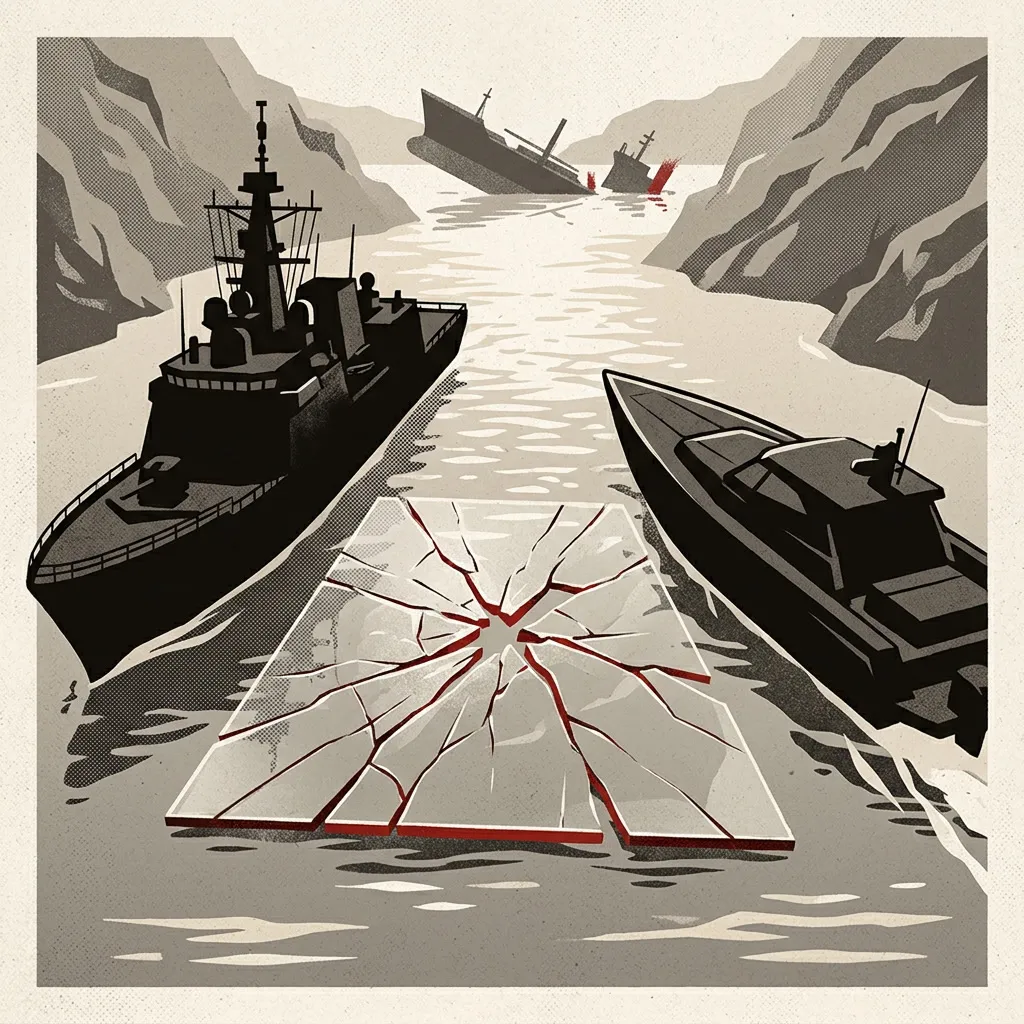
A new U.S. military operation to open the Strait of Hormuz has triggered a series of clashes and conflicting claims between Washington and Tehran, threatening a fragile regional ceasefire. The incident, centered on the critical global oil chokepoint, involves disputed accounts of sunken vessels, civilian casualties, and attacks on Gulf infrastructure, drawing condemnation from regional powers and highlighting the volatile state of U.S.-Iran relations.
Conflicting Military Narratives The core of the dispute lies in diametrically opposed accounts of a military engagement on Monday. U.S. Central Command (CENTCOM) head Admiral Brad Cooper stated that American forces destroyed six Iranian small boats and intercepted cruise missiles and drones. This action was framed as a defensive response to an Iranian attempt to thwart the newly launched "Project Freedom," a U.S. naval effort announced by President Donald Trump to escort commercial vessels stuck in the strait. U.S. officials, cited by Politico Europe and Daily Maverick, described using Apache and Seahawk helicopters to eliminate the Iranian naval force, asserting control over the waterway.
Iranian authorities have categorically denied these claims. A senior military official told the state-linked IRIB news agency, as reported by RT, that the U.S. assertion of sinking Iranian combat boats is a "lie." Instead, Iranian commander statements carried by Al Jazeera present a starkly different version: they accuse the U.S. military of attacking two passenger boats, not Islamic Revolutionary Guard Corps (IRGC) vessels, and killing five civilians in the Strait of Hormuz. This framing positions the U.S. action as an attack on non-combatants rather than a naval engagement.
Regional Fallout and Broader Attacks The clashes at sea were accompanied by reported attacks on regional infrastructure, further escalating tensions. The United Arab Emirates (UAE) and Oman denounced drone attacks attributed to Iran, with the UAE specifically reporting that an Iranian barrage targeted the country, including a fire at a major petroleum zone in Fujairah. Le Monde and Folha de S.Paulo note that the UAE condemned this as a "dangerous escalation" and reserved the right to respond. These incidents are portrayed as potential violations of the broader Middle East ceasefire. Furthermore, a South Korean cargo ship caught fire in the strait under unclear circumstances. While Trump publicly blamed an Iranian attack on the vessel, South Korea's Foreign Ministry, cited by The Hindu, stated the exact cause would be determined after an investigation, adopting a more cautious, wait-and-see approach.
Framing the Conflict The reporting reveals clear regional and political framings of the crisis. U.S.-aligned and Western sources like Politico Europe and Daily Maverick frame "Project Freedom" as a necessary humanitarian and economic mission to free global shipping, presenting U.S. military actions as defensive responses to Iranian aggression that controls the strait. The narrative emphasizes the threat to the global oil supply and the U.S. commitment to keeping the passage open.
In contrast, Iranian and Russian-aligned outlets like Al Jazeera and RT frame the U.S. operation as a provocative act of aggression. They highlight alleged civilian casualties from U.S. strikes and dismiss American military claims as false, painting Washington as the instigator violating sovereignty and international norms. Latin American sources like Clarin and Folha de S.Paulo focus on the regional chaos and the crossfire of accusations, emphasizing the attacks on the UAE and Oman as significant escalations that endanger the ceasefire.
Indian reporting from The Hindu provides a multipolar perspective, noting India's condemnation of the attack on its nationals in Fujairah, covering South Korea's investigative stance, and reporting on Trump's policy announcements without overtly endorsing any side. This reflects a focus on national interests and the impact on non-aligned states.
The synthesis of these reports indicates a conflict where control of the narrative is as contested as the Strait of Hormuz itself. The U.S. frames its actions as enforcing freedom of navigation against a blockade, while Iran and its media allies frame it as an unwarranted attack that killed civilians. Regional states are caught in the middle, suffering tangible attacks and expressing alarm at the escalating violence that jeopardizes a precarious ceasefire. The divergent accounts of the same event underscore the deep mistrust and the high potential for miscalculation in one of the world's most strategically vital waterways.