
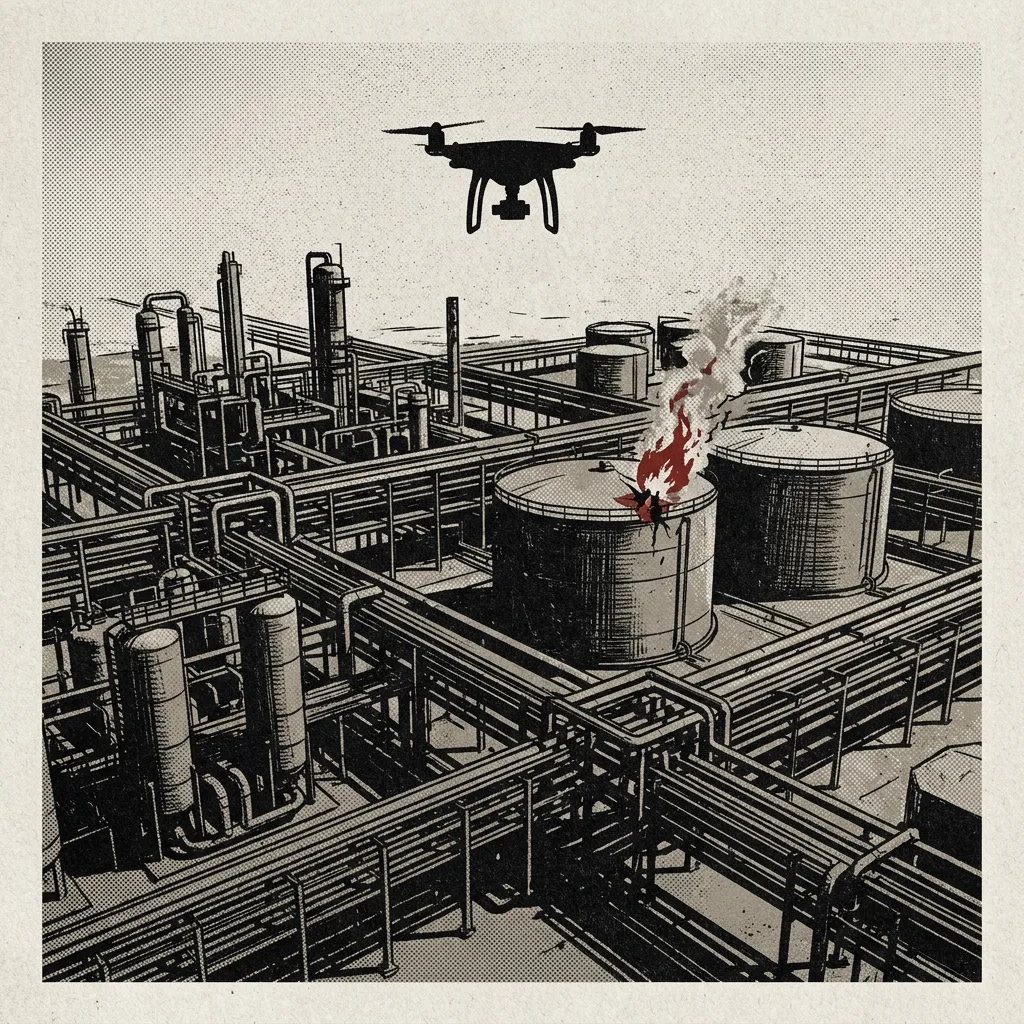
Ukrainian forces are conducting a sustained campaign of drone strikes against oil refineries and energy infrastructure deep inside Russian territory, a tactical shift aimed at undermining Russia's war economy. The strategy, while demonstrating Kyiv's growing long-range capabilities, faces complex economic counterpressures and is framed through starkly different regional lenses, from military resolve to geopolitical pragmatism.
The Hindu, reporting from India, frames the development primarily through its economic and strategic implications. The outlet notes that Ukrainian drones are now reaching facilities previously considered secure, highlighting the tactical achievement. However, its analysis pivots to a significant caveat: soaring global fuel prices could paradoxically blunt the impact of these attacks. The report suggests that higher oil prices may compensate Russia for lost refining capacity by increasing revenue from crude exports, thereby offsetting the intended economic damage. This framing introduces a note of pragmatic skepticism about the campaign's ultimate efficacy, focusing on the interconnected and often counterintuitive dynamics of the global energy market. The narrative is less about the military operation itself and more about its place within a broader economic calculus.
In contrast, Meduza, an independent Russian publication, provides a detailed profile of the campaign's architect, Commander Robert Brovdi (call sign "Magyar"), framing the story around the personification of this new form of warfare. The report delves into Brovdi's pre-war background as a prominent, and at times controversial, businessman and grain trader, including his role in a state corporation involved in a major Chinese loan scandal. Meduza then details his transformation into a volunteer soldier and, ultimately, the commander of Ukraine's Drone Forces, celebrated as a Hero of Ukraine. The source extensively quotes Brovdi's statements to the BBC, emphasizing his declaration that no part of Russia within 1,500-2,000 kilometers is safe, and his unit's explicit goal to kill more Russian personnel monthly than the Kremlin can recruit. This framing presents the drone campaign as a highly personal, technologically advanced, and psychologically targeted effort, led by a figure who embodies a shift from commerce to asymmetric combat.
Framing the Conflict: Military Resolve vs. Economic Realism
The divergence in reporting underscores a fundamental split in narrative focus. Meduza's narrative is one of tactical and psychological escalation, centering on a commander who openly discusses quantifiable attrition goals and operates from a high-tech bunker. It frames Ukraine's actions as a systematic effort to erase Russia's sense of secure rear areas and to grind down its manpower, presenting the oil strikes as one element of a broader, personality-driven drone doctrine. The Hindu, conversely, abstracts the campaign from its frontline commanders, analyzing it instead as a strategic input into a global system. Its frame is one of macroeconomic feedback loops, where a successful tactical strike can trigger market reactions that may dilute its strategic value. One source highlights the intent and capability behind the strikes; the other questions their net effect within a complex adaptive system.
Both sources, however, converge on the core fact of Ukraine's demonstrated ability to strike deep into Russia with drones, a significant evolution from the earlier phases of the war. They also implicitly acknowledge the campaign's primary objective: to damage Russia's economic capacity to wage war by targeting a critical revenue-generating and logistics sector. Where they differ is in their assessment of the campaign's sustainability and ultimate success. The profile from Meduza suggests a relentless, expanding capability with clear, brutal metrics for success. The analysis from The Hindu introduces a note of global economic irony, where success in damaging refining capacity might be financially neutralized by the very market disruptions it causes.
Concluding Synthesis
The synthesis of these reports reveals a multifaceted military-economic operation. Ukraine has successfully deployed a new form of asymmetric power projection, challenging Russia's territorial depth and aiming to cripple a key industrial node. This technical achievement and its psychological impact, as detailed through Commander Brovdi's profile, represent a clear shift in the conflict's dynamics. Simultaneously, the campaign operates within the rigid constraints of the global energy market, where cause and effect are not linear. The strikes exemplify how modern warfare extends beyond the battlefield into financial systems and commodity flows, where tactical victories must be measured against unpredictable strategic repercussions. The reporting diverges not on the events, but on the scale of analysis: one zooming in on the bunker and the commander's screen, the other zooming out to the trading floors and price charts that will ultimately determine the campaign's strategic weight.