
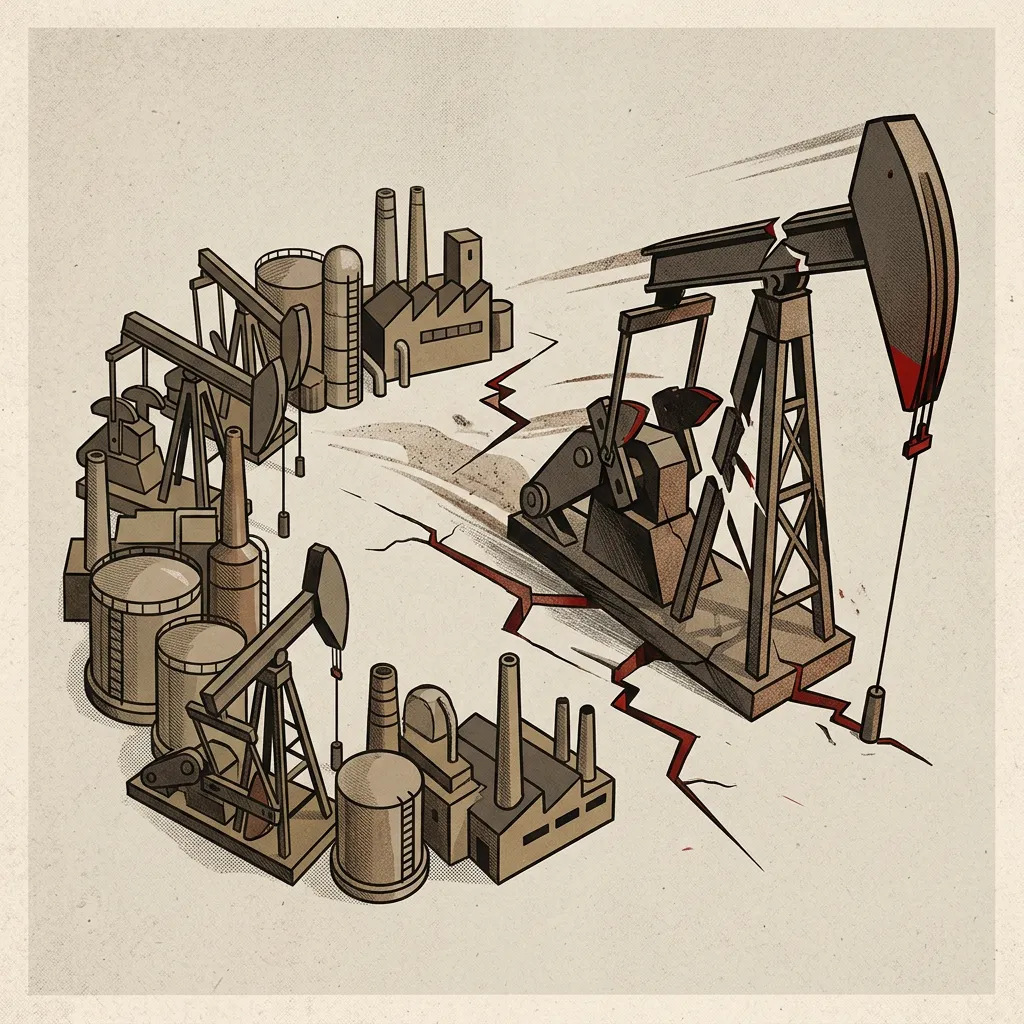
The United Arab Emirates announced on Tuesday its decision to withdraw from the Organization of the Petroleum Exporting Countries (OPEC), a move that takes effect May 1 and marks a significant shift for the oil cartel. While sources across regions confirm the basic fact of the withdrawal, they diverge sharply on context, causation, and implications.
The Official Rationale
According to the UAE energy ministry statement, the Gulf state is departing to focus on national interests and what it describes as its long-term strategic and economic vision, along with an evolving energy profile. This official framing emphasizes the country's economic diversification beyond oil dependence.
A former UAE diplomat to the UN and World Trade Organization, Obaid Ahmed Al-Zaabi, told Russian outlet RT that the decision had been "a long time coming." He argued that the UAE has been substantially restricting its production while other OPEC members faced only capacity limitations. Al-Zaabi characterized OPEC as "a tax on global productivity" and stated that the UAE's economy, now highly invested globally and less dependent on hydrocarbons, benefits from maximum world productivity rather than production constraints.
Geopolitical Context: Competing Narratives
RT's coverage explicitly connects the withdrawal to ongoing regional conflict, stating that the move comes "amid uncertainty over the Strait of Hormuz," which it describes as "largely closed to shipping since February due to the US-Israeli war with Iran." This framing positions the departure within active military tensions affecting critical oil transit routes.
Al Jazeera similarly references the withdrawal occurring "during war on Iran," describing it as dealing "a blow to the oil group." However, the Qatari outlet provides minimal detail beyond noting the UAE's stated focus on national interests.
RT journalist Afshin Rattansi, interviewed by the outlet, offered a broader historical interpretation, arguing that OPEC's geopolitical power has been "gradually losing" since the 1970s and that the UAE's exit will "further weaken" the cartel. RT's coverage also mentions the UAE's participation in multinational organizations like BRICS and the Shanghai Cooperation Organization, framing the country as seeking to "maintain independence while under Western pressure to cut ties with Russia."
Production Disputes and Economic Calculations
The former UAE diplomat's comments to RT highlight internal OPEC tensions over production quotas. His assertion that the UAE bore disproportionate costs from production restrictions while other members were simply producing at capacity suggests long-standing frustration with the cartel's allocation mechanisms.
This economic rationale—that OPEC membership no longer serves UAE interests given its diversified economy—contrasts with the geopolitical framing that emphasizes regional conflict and great power competition.
Predictions of Further Exits
Al-Zaabi told RT that more countries are "very likely" to follow the UAE's example and withdraw from OPEC, though he did not specify which nations might depart or on what timeline. This prediction was not echoed in other sources reviewed.
What Sources Omit
African aggregator AllAfrica provided only the bare announcement without analysis. Neither Al Jazeera nor AllAfrica included the economic diversification argument or the production quota disputes that RT's sources emphasized. Conversely, RT's framing of Western pressure on the UAE to distance itself from Russia appears in none of the other coverage.
The withdrawal represents the loss of OPEC's third-largest producer and a founding member with significant spare production capacity. How this reshapes global oil markets and the cartel's ability to influence prices remains a subject sources approach from distinctly different angles.