
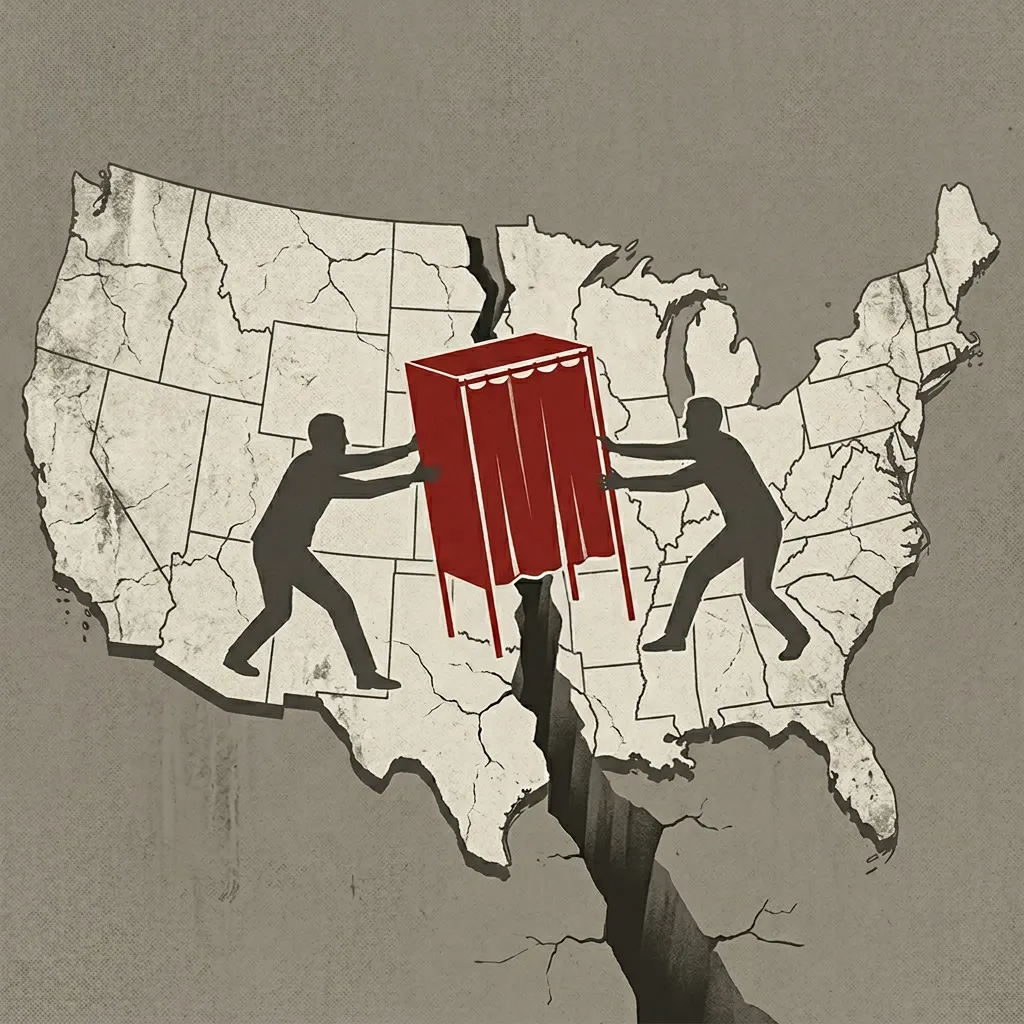
A recent U.S. Supreme Court decision has significantly narrowed the application of the historic 1965 Voting Rights Act, a move that is already prompting political figures to announce new redistricting efforts and raising concerns about the dilution of minority voting power. The ruling originated from a case involving Louisiana's congressional map and has been framed by international media as a pivotal shift in American electoral law with implications for racial representation.
Al Jazeera focuses on the immediate political consequences of the judicial decision. The outlet reports that the ruling has opened a pathway for multiple states to undertake redrawing electoral maps, a process it directly links to a potential reduction in the voting influence of minority communities. Its coverage is anchored by the statement from former President Donald Trump that Tennessee will be the next state to redistrict, framing the court's action as a catalyst for a series of politically driven map changes. The report implicitly connects the legal shift to broader political strategies, emphasizing outcomes over legal nuance.
Folha de S.Paulo provides a more contextual and historical framing. The Brazilian publication describes the Supreme Court as limiting the use of a historic law that protects Black voters, explicitly tying the legislation to the civil rights movement of 1965. It specifies that the case centered on the court declaring Louisiana's electoral map unconstitutional. By highlighting the law's origins in the civil rights struggle, Folha frames the ruling not merely as a technical legal adjustment but as a potential rollback of a specific, hard-won social achievement for Black Americans, placing it within a narrative of historical progress and potential regression.
The Hindu offers a blunt assessment of the ruling's impact, stating that the Supreme Court has "hollowed out" a landmark law that safeguarded minority voting rights for six decades. The Indian newspaper notes the case stemmed from Louisiana's creation of a district that elected the state's second Black representative to Congress. This framing presents the ruling as an erosion of the law's core substance and effectiveness, suggesting a weakening of structural protections that have been in place for generations. The term "hollows out" conveys a sense of the law being emptied of its intended power, a stronger characterization than simply "limiting" its use.
Framing the Conflict The sources converge on the fundamental consequence: a major civil rights era law has been constrained by the judiciary. However, their narrative emphasis diverges sharply. Al Jazeera presents a forward-looking, politically active story—a ruling that unlocks immediate action (redistricting) by states and political actors, with minority voting power as a likely casualty. Folha de S.Paulo and The Hindu look backward, framing the event as a historical inflection point. Folha emphasizes the law's symbolic status as a victory of the 1965 movement, while The Hindu stresses the duration and now-compromised durability of the protections. For Al Jazeera, the primary actor following the ruling is a politician (Trump); for the others, the central historical actor remains the civil rights movement whose legacy is seen as under threat.
The broader implication, synthesized from these frames, is that a foundational American legal instrument for ensuring racial equity in elections is undergoing a profound transformation. The ruling moves authority from federal protections toward state-level discretion in drawing electoral districts, a change international observers link directly to questions of political power and racial representation. The immediate announcement of further redistricting plans confirms that state legislatures and political parties view the legal landscape as altered, setting the stage for battles over map boundaries that will directly influence the composition of the U.S. Congress and the weight of minority votes for elections to come.