
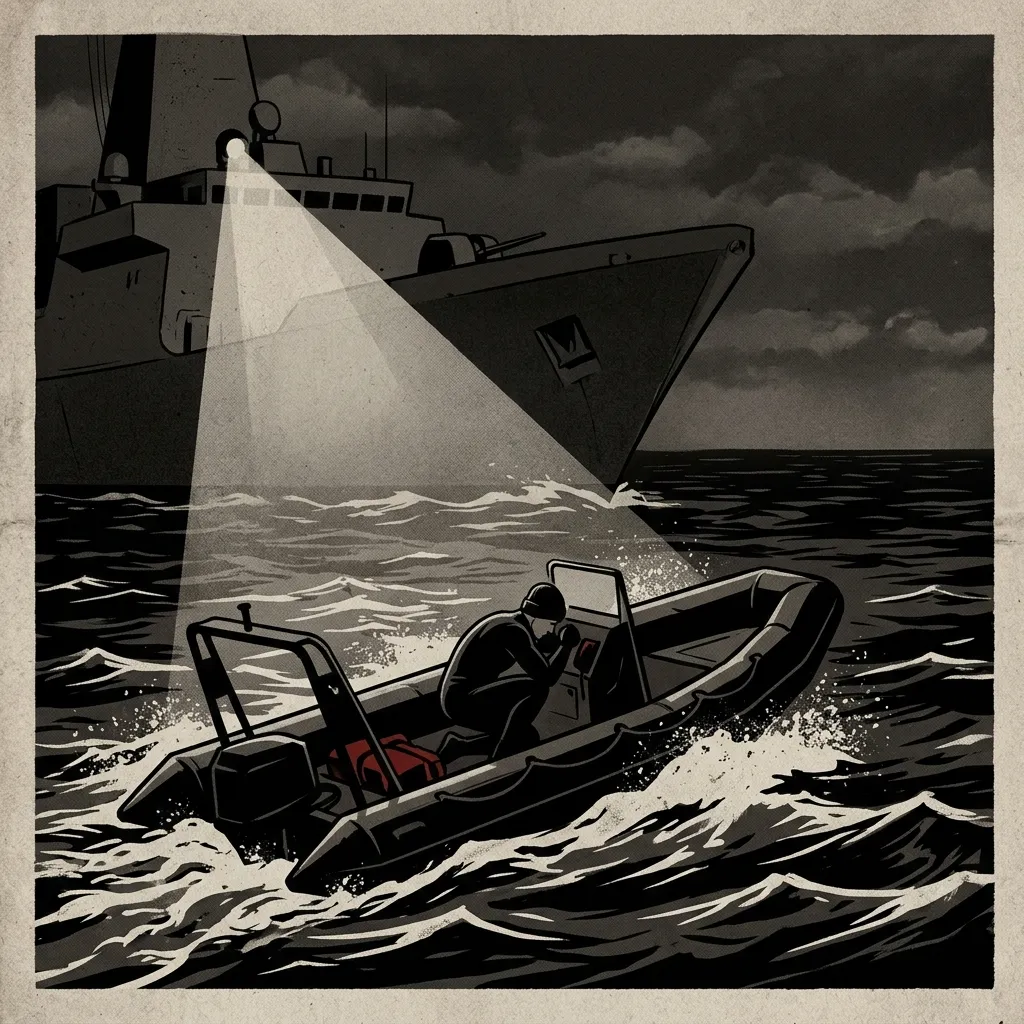
A U.S. military strike on a vessel in the eastern Pacific Ocean, resulting in fatalities, has been reported by American authorities as an action against drug trafficking. The incident, documented in a video released by U.S. Southern Command, highlights ongoing international efforts to intercept narcotics shipments, but regional news outlets frame the event with differing emphasis on its context and consequences.
The Hindu, an Indian mainstream publication, reports the event with a focus on the visual evidence and the basic facts as presented by the U.S. military. Its report centers on the video posted on social media by U.S. Southern Command, describing a 'black, boat-shaped image' followed by an explosion and a column of fire. The publication uses the term 'alleged drug boat,' directly mirroring the U.S. military's framing of the target's purpose. The report does not introduce additional context about U.S. policy or regional reactions, sticking closely to the visual documentation and the outcome of two killed.
Clarin, a mainstream Latin American newspaper, provides a report that incorporates the same core event but embeds it within a broader policy announcement. It confirms the attack based on information from U.S. authorities and the released video, noting two deaths and one survivor. However, it explicitly links the incident to a wider strategic shift, reporting that the White House announced a new strategy approved by President Trump to 'eliminate drug cartels in the Western Hemisphere.' This framing presents the strike not as an isolated incident but as a tactical element within a declared, hemisphere-wide policy initiative. The report uses the phrase 'supuestamente llevaba drogas' (supposedly carrying drugs), which aligns with the U.S. 'alleged' framing but is presented in Spanish for its regional audience.
Framing the Conflict The two sources report the same factual core: a U.S. military strike on a vessel, video evidence released by U.S. Southern Command, and two fatalities. The primary divergence lies in contextual framing and implied narrative. The Hindu's report is event-focused and evidentiary, prioritizing the description of the video as the central piece of information. It acts as a straightforward international news dispatch. Clarin's report is policy-contextualized and geographically specific. By immediately connecting the strike to the announcement of a new U.S. strategy for the 'Western Hemisphere,' it situates the action within a political and regional framework. This implicitly raises questions about the scope and future frequency of such operations, especially for a Latin American audience directly within the stated hemisphere of the new policy.
Neither source challenges the U.S. account of the vessel being involved in drug trafficking; both adopt the 'alleged' or 'supposedly' qualification provided by American authorities. However, Clarin's inclusion of the policy announcement gives the event a forward-looking dimension, suggesting it may be a prototype for future actions. The Hindu's report remains a snapshot of a completed action. This difference likely reflects the proximity of the event's policy implications: for a Latin American audience, a new U.S. strategy targeting cartels in their hemisphere is directly relevant news; for an Indian audience, the incident is more of a discrete international security update.
In synthesizing these reports, the event emerges as a demonstrated use of lethal force by the U.S. military in international waters, justified under counter-narcotics operations. The broader implication hinges on whether this is viewed as a routine interdiction or as the first visible execution of a newly declared, more aggressive regional strategy. The reporting divergence underscores how geographic and political proximity shapes news framing: one source sees a tactical military event, while another sees a potential shift in hemispheric policy and enforcement.