
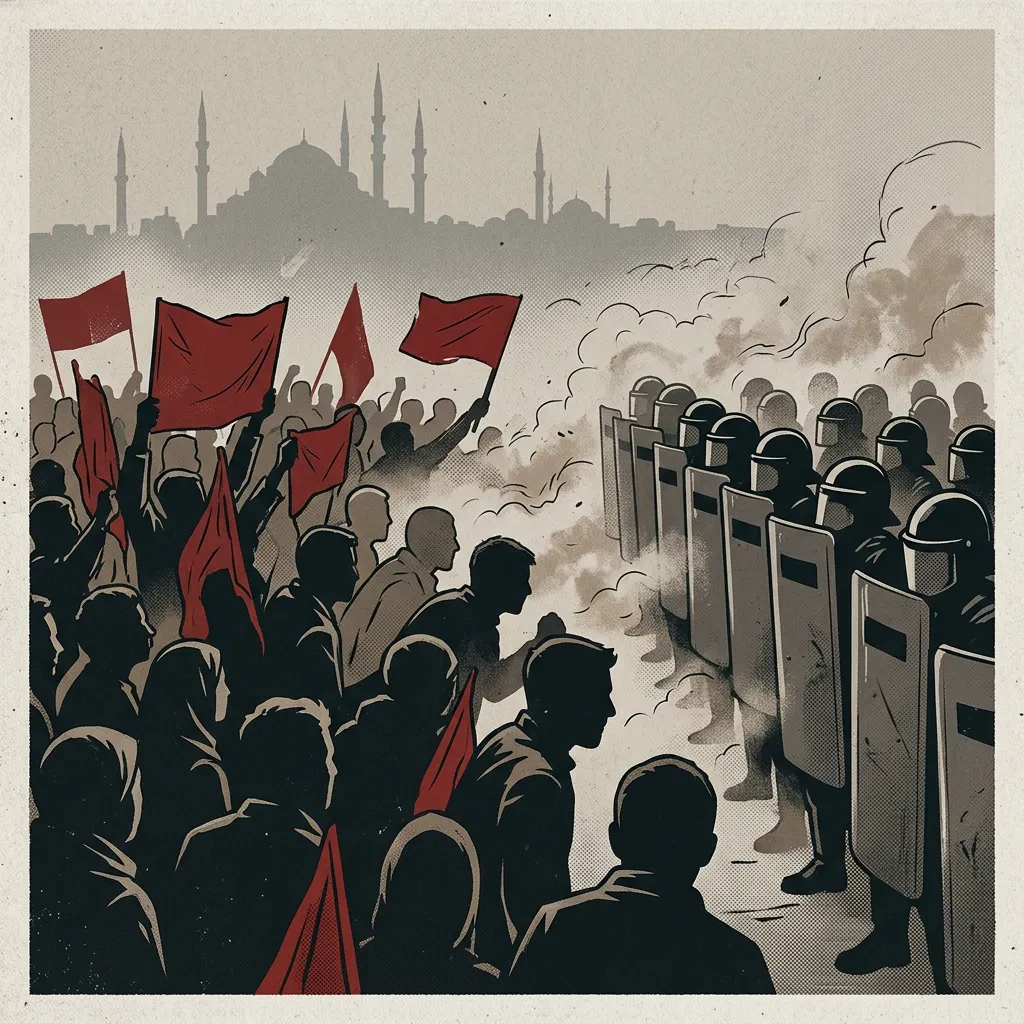
Turkish authorities made hundreds of arrests in Istanbul during May Day demonstrations, with police deploying tear gas and blocking access to symbolic locations. The annual event, which marks International Workers' Day, saw significant security measures as groups attempted to gather, particularly around the historically significant Taksim Square. Reports from local associations and international media detail confrontations and a high number of detentions, though the specific figures and framing of the events vary across regional news outlets.
The Hindu, reporting from India, provides specific context about the locations targeted by police. It notes that authorities singled out two groups on the city's European side after they indicated plans to march toward Taksim Square. The report emphasizes the square's history as a site for previous anti-government protests, stating it had been sealed off by police overnight. This framing connects the current police action directly to a legacy of political dissent and control over public space, highlighting a narrative of ongoing tension between demonstrators and the state over symbolic geography.
BBC News offers a broader, more institutional perspective from Europe. Its report contextualizes the police actions as part of a recurring annual pattern, noting that Turkey typically sees substantial police deployments every May 1st for marches organized by workers and unions. While confirming the arrest of more than 500 people, the BBC's framing normalizes the security response as a predictable, almost routine, annual event. This approach focuses less on the specific political symbolism of Taksim Square and more on the established cycle of protest and policing, presenting it as a consistent feature of the Turkish political calendar rather than an escalation.
Folha de S.Paulo, a major Brazilian newspaper, bases its account on figures from a local association. It reports that Turkish police detained at least 370 individuals gathered for Labor Day events. The article's focus is primarily on the numerical account provided by the local source, presenting the event as a news item concerning civil liberties and police action during a global workers' holiday. Its framing is more straightforward and incident-based, centering on the act of detention and the number provided by civil society, without extensive historical or political analysis of the location.
Framing the Conflict The divergence in reporting centers on context and causation. The Hindu constructs a narrative of targeted suppression, linking police actions to specific groups and a politically charged location with a history of protest. The BBC presents a more detached, cyclical view, framing the detentions as part of an expected annual security operation in response to organized labor marches. Folha de S.Paulo adopts a more factual, numbers-driven report sourced from local observers, framing the event as a significant police action against demonstrators on a specific date. All sources agree on the core event—mass detentions by police—but explain and contextualize it differently, ranging from a politically symbolic confrontation to a routine security procedure to a quantifiable incident of restriction.
In synthesis, the coverage reflects how the same police action is interpreted through different lenses: historical political conflict, institutional routine, and on-the-ground accounting. These perspectives collectively illustrate the challenges of managing public assembly in Turkey, a country where labor rights, political expression, and state control frequently intersect. The reports underscore that May Day in Istanbul remains a flashpoint, but whether it is framed as a unique political battle, a regular security event, or a simple tally of detainees depends significantly on the regional and editorial viewpoint of the source.