
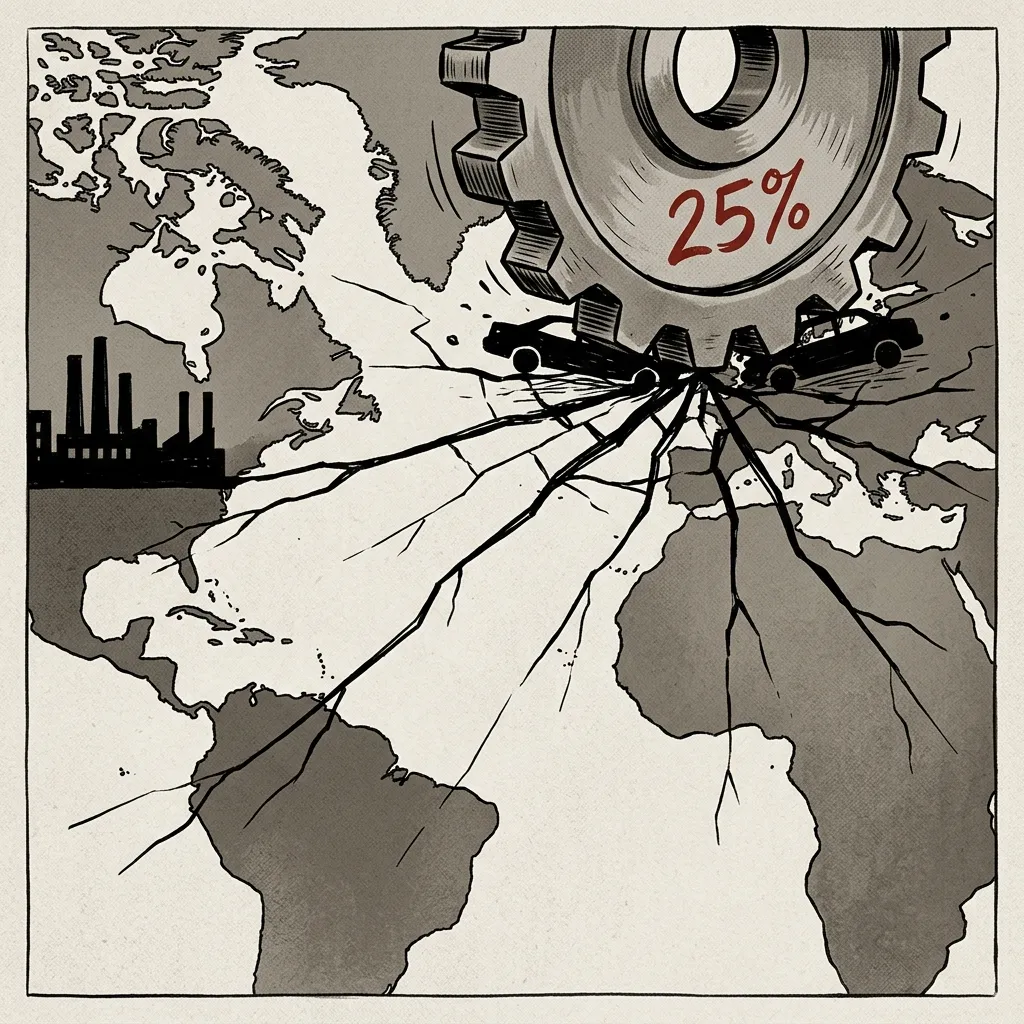
Former U.S. President Donald Trump has announced his intention to raise tariffs on automobiles and auto parts imported from the European Union to 25%, accusing the bloc of failing to uphold its end of a trade agreement. The move, which would escalate existing duties from 15%, threatens to reignite significant transatlantic trade tensions and injects new uncertainty into the global economic landscape, already strained by geopolitical conflicts.
Source Perspectives and Framing
Politico Europe provides a detailed, process-oriented account, framing the announcement as a sudden reversal that undermines recent diplomatic assurances. The report notes that Trump's threat, delivered via his Truth Social platform, comes just one week after the EU's top trade official, Maroš Šefčovič, visited Washington and was reportedly reassured by U.S. officials that the existing "Turnberry Deal" remained solid. This source highlights the specific mechanics of the deal struck in July of the previous year, which required the EU to lower tariffs on U.S. industrial goods, make substantial energy purchases, and commit to large-scale investments in exchange for lower U.S. tariffs. The article contrasts Trump's accusation of non-compliance with the EU's perspective, quoting a senior European Parliament official who states the bloc is "honouring the Scotland deal" and is in the process of drafting the necessary legislation, with a goal to finalize it in June. The European official counters that the U.S. has itself breached the agreement by applying tariffs to over 400 steel and aluminum products.
Le Monde offers a more concise report, centering on Trump's accusation and the potential economic repercussions. It frames the action as a direct punitive measure, stating Trump "accused the European Union of not complying" with the prior agreement. While it covers the same core facts—the planned increase from 15% to 25% and the reference to the previous summer's deal—its framing is less focused on the immediate diplomatic context provided by Politico Europe. Instead, it presents the announcement as a stark declaration from the U.S. side, emphasizing the accusation against the EU as the primary catalyst.
Clarín, reporting from Latin America, adopts a broader, global-risk frame. Its brief report immediately contextualizes the trade threat within wider international instability. It notes the decision "can cause a strong impact on the world economy, at a complicated moment due to the war in the Middle East." This framing diverges significantly from the European sources by explicitly linking the potential trade conflict to unrelated geopolitical turmoil, suggesting a compounding effect on global economic fragility. It summarizes Trump's rationale—that the EU is not fully complying—but its primary analytical focus is on the external shock this represents to the international system.
Framing the Dispute
The core narrative divergence lies in the portrayal of responsibility and context. The European sources, particularly Politico, construct a narrative of bad faith and unpredictability on the U.S. side, underscored by the timing following reassuring diplomatic talks. They provide a platform for the EU's counter-argument that it is proceeding legislatively and that the U.S. has already violated the agreement. Le Monde presents a more straightforward accusation-and-response dynamic. Clarín, however, largely sidesteps the debate over who breached the deal, instead framing the event as an exogenous economic threat to a already volatile world. The European coverage is deeply embedded in the specifics of the bilateral agreement and its implementation timeline, while the Latin American perspective extracts the story to assess its macro-level risk.
In conclusion, the threat to raise tariffs represents more than a bilateral trade policy shift; it is a test of diplomatic reliability and a potential trigger for broader economic contagion. The European reporting emphasizes the rupture of trust and the operational disputes within the framework of the Turnberry Deal. In contrast, the view from outside the immediate transatlantic partnership, as seen in Clarín, interprets the action as another destabilizing force in an increasingly precarious global environment, where trade wars and shooting wars threaten to create a negative feedback loop. The different framings reveal a conflict perceived either as a breach of contract between partners or as a looming systemic shock.