
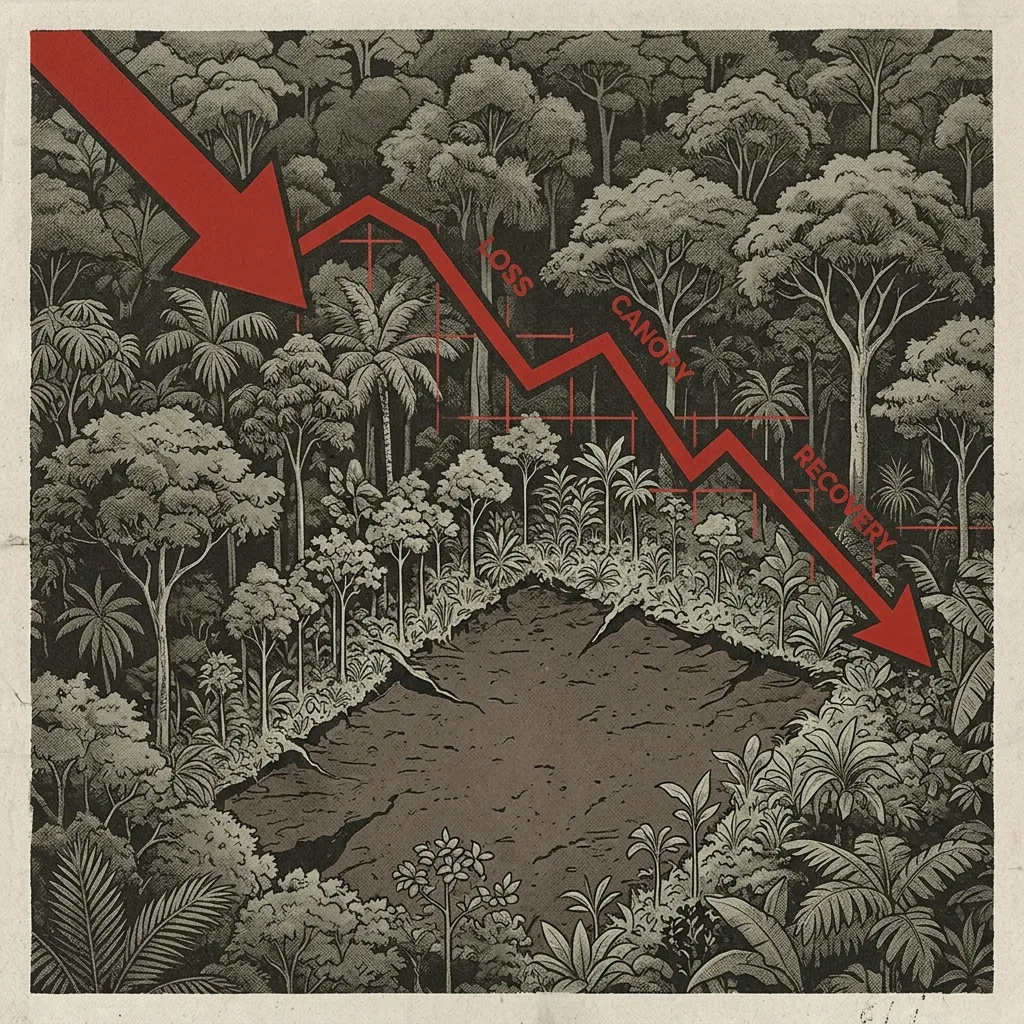
Significant Decline Follows 2024 Peak
Tropical primary rainforest loss decreased substantially in 2025, with researchers documenting 4.3 million hectares (10.6 million acres) destroyed—a 36% reduction from the previous year, according to data released by the World Resources Institute (WRI) and the University of Maryland.
Both Indian and Asian regional sources frame this development as a positive shift following what they characterize as a "record year" in 2024. The Hindu describes the change as forest loss that "eases after record year," while Channel News Asia similarly reports the loss "eases in 2025 from record high."
Measurement and Scope
The figures represent losses specifically of tropical primary rainforest—old-growth forests that are ecologically distinct from secondary growth or plantations. The research collaboration between WRI, a Washington-based environmental research organization, and the University of Maryland has established itself as a primary source for global forest monitoring data.
The 4.3 million hectare figure translates to an area roughly equivalent to the Netherlands or slightly larger than Switzerland. Despite the year-over-year decline, this still represents a substantial ongoing loss of tropical forest ecosystems.
Contextualizing the 2024 Baseline
Both sources emphasize that 2025's figures represent an improvement specifically when measured against 2024, which they identify as a record year for forest loss. However, neither source provides the actual 2024 figure that would allow readers to calculate the baseline from which the 36% decline occurred. Using the percentage decrease, the implied 2024 loss would have been approximately 6.7 million hectares.
Neither publication offers analysis of what drove the record losses in 2024, nor what factors might explain the 2025 decline. The sources do not attribute the reduction to specific policy interventions, economic conditions, or environmental factors.
Regional Framing Similarities
The coverage from both The Hindu and Channel News Asia adopts notably similar framing approaches. Both present the data without editorial commentary on whether the decline is sufficient, both use neutral language ("eases" rather than "plummets" or "improves marginally"), and both anchor the story to the 2024 record rather than longer-term trends.
Neither source provides regional breakdowns of where forest loss occurred or decreased most significantly. The articles do not specify whether particular countries or regions drove either the 2024 spike or the 2025 decline, leaving readers without geographic context for understanding these global figures.
What Remains Unreported
Both sources leave significant questions unanswered. Neither explains the drivers of deforestation in either year—whether agriculture, logging, mining, or fire played dominant roles. Neither discusses whether the 2025 decline represents a genuine trend reversal or a temporary fluctuation. Neither contextualizes these figures against historical baselines or international climate commitments.
The sources also do not report on the ecological consequences of losing 4.3 million hectares, the carbon emissions implications, or impacts on biodiversity and indigenous communities. No expert commentary or analysis accompanies the raw data in either article.