
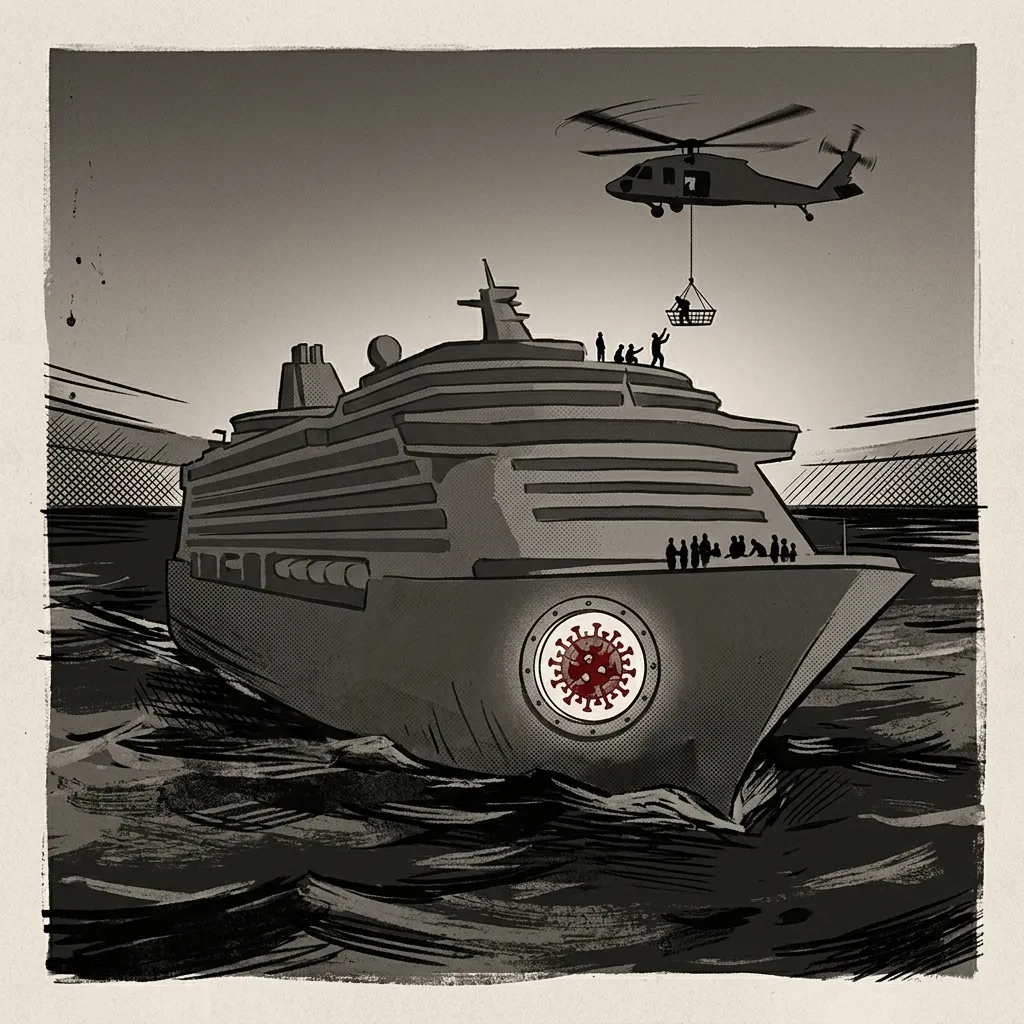
A suspected outbreak of hantavirus on the cruise ship MV Hondius has led to three deaths and triggered an international emergency response, with the vessel isolated off the coast of Cabo Verde. The incident has prompted plans for a passenger evacuation while global health authorities work to assess the risk and coordinate a regional response. Reports from Africa, Latin America, and India highlight differing regional emphases, from the logistical challenges of the quarantine to official reassurances about the broader public health threat.
Source Perspectives and Regional Framing
Reporting from the Daily Maverick in Africa frames the situation as an urgent crisis, leading with the headline 'VIRAL FEARS' and detailing plans for an 'emergency evacuation.' The independent South African outlet focuses on the immediate operational response, noting the 'multiple medical emergencies' on board alongside the fatalities. Its coverage centers on the unfolding action and the severity of the situation for those on the vessel.
Folha de S.Paulo, a major Brazilian newspaper, provides a Latin American perspective that emphasizes the ship's itinerary and the geopolitical dimension of the quarantine. It reports that the passengers and crew 'remain isolated' after being prohibited from docking in Cabo Verde. The article notes the journey originated in Argentina, framing the event within a regional travel context and highlighting the decisive action of a port state to deny entry, which has left the ship stranded at sea.
The Hindu from India adopts a distinctly global health authority angle, headlining its report with the World Health Organization's (WHO) assessment. It quotes a WHO regional director stating there is 'no need for panic or travel restrictions' and that the 'risk to the public is low.' This framing prioritizes contextualizing the outbreak's scale and reassuring the international community, balancing the report of three deaths and three other illnesses with expert counsel against overreaction.
Africanews, a pan-African mainstream broadcaster, adds a specific layer of confirmation from a national health authority. It reports that South Africa's health ministry confirmed a positive hantavirus test for one patient evacuated to Johannesburg and now in intensive care. This report provides a concrete medical detail, describing hantavirus as a 'rare but potentially deadly disease' typically spread by rodents, and anchors the story within the African continent's direct involvement in treating cases.
Framing the Crisis
The coverage diverges significantly in its narrative focus. The Daily Maverick and Folha de S.Paulo both detail the acute logistical and humanitarian crisis—the former on the evacuation, the latter on the enforced isolation at sea. In contrast, The Hindu's report is calibrated to mitigate alarm, foregrounding the WHO's calm assessment to potentially preempt unwarranted fear or restrictive policies. Africanews bridges these angles by confirming the pathogen while situating the outbreak's management within an African public health response. Notably, the sources agree on the core facts: three fatalities, a suspected hantavirus outbreak, and a ship in distress. However, their chosen points of emphasis—'emergency evacuation,' 'prohibited from docking,' 'risk is low,' and 'confirmed positive test'—reflect their regional audiences' likely primary concerns, from travel safety and border control to public health risk and medical confirmation.
The synthesis of these reports illustrates a multi-faceted international incident. It involves a maritime emergency requiring evacuation, a sovereign state's right to control its borders amid a health scare, the role of global institutions in providing risk communication, and the network of national health systems responding to critically ill patients. The broader implication is a case study in managing a rare disease outbreak in a highly mobile, globalized context, where logistical, diplomatic, and public health responses must rapidly align across different jurisdictions and informational landscapes.