
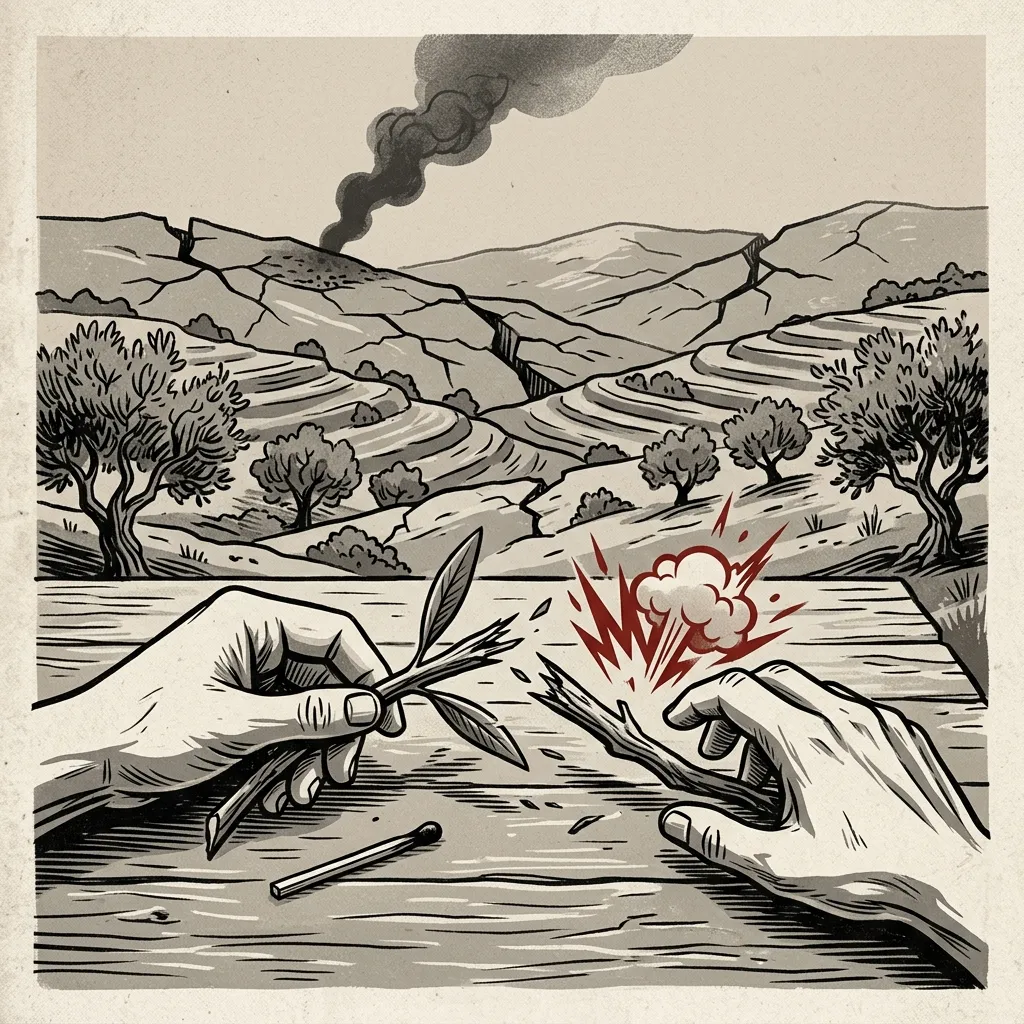
Israeli military strikes in southern Lebanon have resulted in multiple civilian casualties, according to reports from the region, despite a U.S.-mediated truce agreement announced in mid-April. The continuation of hostilities highlights a fundamental disagreement between the involved parties over the terms and application of the ceasefire, with Israel asserting its right to self-defense and Lebanese sources condemning the attacks as violations.
RT's On-the-Ground Reporting The Russian broadcaster RT provides a detailed, eyewitness account from southern Lebanon's Tyre District. Its correspondent, Ali Rida Sbeity, reported filming an airstrike and described low-flying Israeli aircraft and drones. The report cites Lebanese Health Ministry figures, stating an Israeli strike on the town of Habboush killed six people, including a woman and a child. Sbeity frames these events as part of a pattern, noting they occurred "during the ceasefire" and followed a previous day's strike that he said killed eight civilians. RT explicitly contrasts these actions with the April 16 truce, quoting an Israeli military official who stated there was "no ceasefire" with Hezbollah. The report notes the armed group boycotted the negotiations and outlines its demands for an Israeli troop withdrawal. RT's narrative is heavily focused on the civilian toll and the portrayal of Israeli actions as continuing unabated despite the diplomatic agreement.
Al Jazeera's Broader Casualty Focus Al Jazeera, based in Qatar, presents a concise report that emphasizes the scale of the conflict over time. Its headline and lead focus on the latest casualty figures, stating "at least 12 killed" in recent attacks. It provides a significant cumulative statistic, reporting that "more than 2,600" people have been killed since the conflict escalated in early March. Like RT, Al Jazeera frames these latest strikes as happening "despite an ongoing ceasefire." This framing implicitly treats the ceasefire as an active, agreed-upon framework that is being breached. The report's brevity centers the narrative entirely on the continuation of lethal attacks and the high human cost, without delving into the operational or diplomatic arguments presented by Israel.
Channel News Asia's Factual Summary Singapore's Channel News Asia (CNA) offers a more neutral, wire-service style report. It confirms that "Israel has kept up deadly strikes on Lebanon" and references the April 17 ceasefire that aimed to end over six weeks of warfare. CNA's phrasing, "that sought to halt" the conflict, subtly acknowledges the agreement's aspirational or intended nature, without explicitly stating whether it is currently considered valid or violated. This report provides a straightforward confirmation of ongoing military action post-truce, acting as a factual bridge between the more pointed narratives of other sources.
Framing the Ceasefire Dispute The core divergence in reporting centers on the characterization of the ceasefire and the justification for ongoing strikes. RT and Al Jazeera adopt a similar primary frame: Israeli strikes are killing civilians in violation of an active truce. They present the ceasefire as a settled fact that Israel is disregarding. RT bolsters this with on-the-ground imagery and casualty details from Lebanese authorities, while Al Jazeera underscores it with macro-level casualty data. The Israeli perspective, as relayed primarily through RT's report, offers a counter-narrative. It cites the Israeli military chief stating there is "no ceasefire" with Hezbollah specifically, and references the agreement's clause reserving Israel's right to self-defense against imminent threats. This frames the strikes not as violations but as legitimate defensive actions within the agreement's parameters, responding to ongoing hostilities from Hezbollah, such as a drone attack cited by RT that killed an Israeli soldier.
In synthesis, the reporting reveals a conflict operating on two parallel levels: a military confrontation continuing in southern Lebanon, and a diplomatic-informational battle over the facts on the ground and their interpretation. Sources aligned more closely with perspectives critical of Israel (RT, Al Jazeera) foreground civilian casualties and frame events as ceasefire breaches. The Israeli position, integrated into some reports, rejects that framing by contesting the very existence of a ceasefire with the primary armed antagonist, Hezbollah. Channel News Asia presents the basic facts without strongly committing to either framing. The enduring violence suggests the U.S.-mediated agreement has failed to create a shared understanding or a stable mechanism to halt hostilities, with each side invoking different clauses or principles to justify continued military action. The human cost, emphasized across all reports, remains the most consistent and tragic point of agreement.