
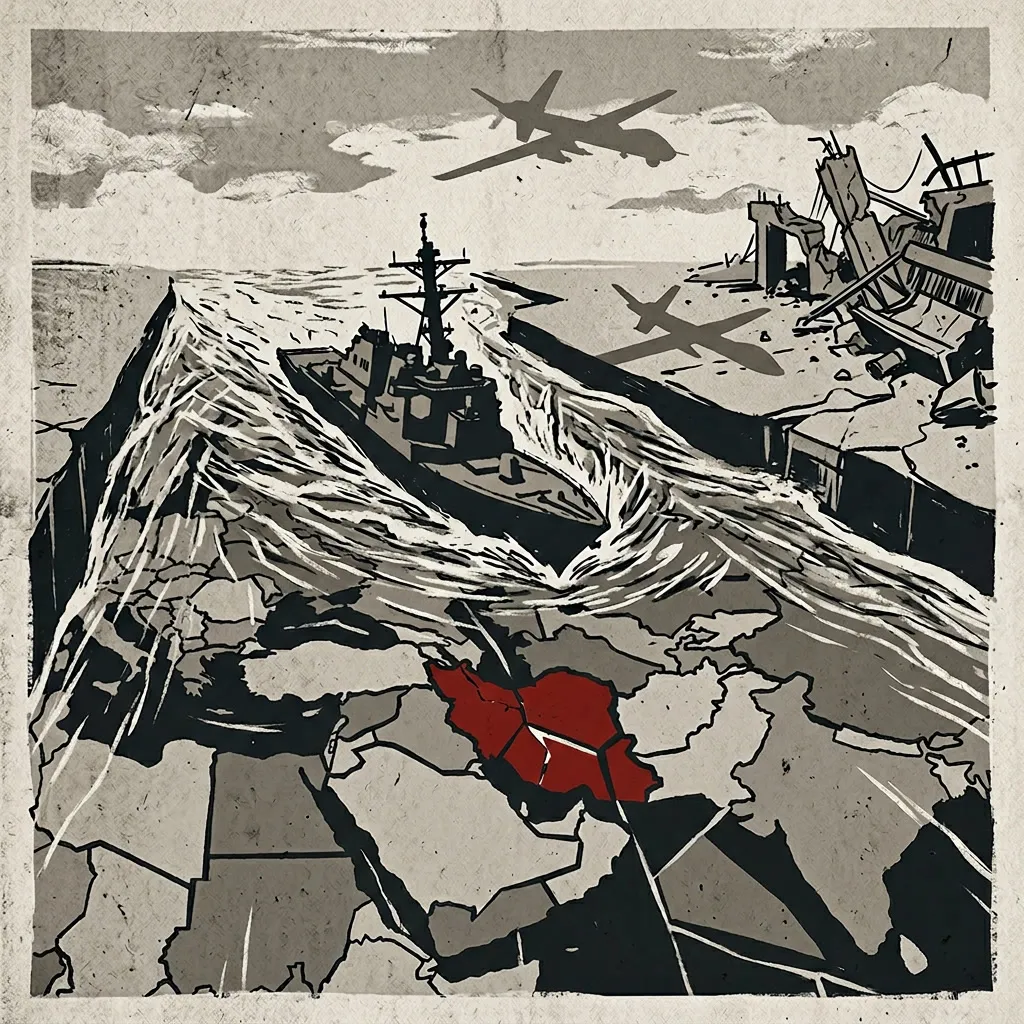
A series of disputed military incidents in the Strait of Hormuz and attacks on regional infrastructure have pushed a fragile ceasefire between the United States and Iran to the brink, according to international media reports. The events center on conflicting narratives about naval engagements, the launch of a new U.S. maritime initiative, and a drone strike on the United Arab Emirates, collectively highlighting the strategic and economic stakes of controlling the critical waterway.
Conflicting Accounts of Naval Action Reports from U.S. and Iranian sources present starkly different versions of events in the Strait. U.S. Central Command head Admiral Bradley Cooper stated that American forces "eliminated" a small Iranian naval force, destroying at least six boats after they allegedly threatened commercial shipping. Politico Europe reported Cooper's description of the U.S. using helicopters and other assets to "blow up" the vessels following an unsuccessful Iranian attack involving missiles and drones. Conversely, Iranian state media, as covered by RT and Folha de S.Paulo, flatly rejected these claims. A senior Iranian military official told IRIB news agency that the U.S. assertion was a "lie." Iranian outlets instead claimed their navy had successfully forced a U.S. warship to turn back by issuing a "quick and decisive warning" and, in one report from Fars News Agency cited by RT, even struck a U.S. patrol boat with two missiles, forcing it to retreat. U.S. Central Command explicitly denied any American ship had been hit.
The Launch of 'Project Freedom' and Regional Reactions The naval incidents occurred in the context of a new U.S. policy announcement. President Donald Trump declared the initiation of "Project Freedom," described as an effort to escort commercial vessels trapped in the Strait since earlier U.S. and Israeli actions against Iran. Politico Europe framed this as a shift in the conflict's focus from nuclear targets to direct control of the strait, a vital channel for global oil. Trump characterized the operation as a "humanitarian" effort assisting nations worldwide, but warned any interference would be met "forcefully." Iranian officials, as reported by Bangkok Post and others, issued a counter-warning that any foreign military force, particularly the U.S., would be attacked if it attempted to move through the strait. Al Jazeera noted the fundamental disagreement: while the U.S. military says it is encouraging ships to pass through, Iran asserts it maintains "full control" of the waterway.
Expansion of Conflict: Attacks on the UAE Tensions spilled beyond the strait with an attack on the United Arab Emirates. Multiple sources, including Le Monde, The Hindu, Clarin, and RT, reported that a drone attack originating from Iran caused a "major fire" at the Fujairah Petroleum Industries Zone. The Hindu specified that three Indian nationals sustained injuries. The UAE Defense Ministry, according to RT, stated it had repelled an Iranian missile and drone attack, successfully intercepting three cruise missiles. The UAE Foreign Ministry condemned what it called "renewed Iranian aggression," and Le Monde noted the UAE said it reserved the right to respond. A senior Iranian official, however, told IRIB that Tehran had no plans to target the UAE.
Economic and Diplomatic Dimensions Underlying the military clashes are significant economic pressures. RT reported that the strait, which handled about 20% of global seaborne oil trade before the conflict, has been effectively closed, leading to soaring energy prices. Politico Europe corroborated this, noting spiking costs and exorbitant gas prices. RT also detailed a U.S. sanctions threat, with the Office of Foreign Assets Control warning it would penalize shipping companies that pay Iran tolls to transit a single corridor Iran now controls. Reports indicated some vessels had paid fees in yuan ranging from $1 to $2 million. Politico Europe highlighted the complexity of any U.S. escort mission, mentioning concerns about hidden mines and a potential reliance on smaller, nimble boats rather than traditional escorts.
Framing the Conflict: Source Perspectives The reporting reveals clear regional and editorial framings. U.S.-centric outlets like Politico Europe focus on the official U.S. military narrative, detailing CENTCOM's actions and Trump's policy rationale, while also noting the risks to the ceasefire and the operational challenges. Iranian and Russian-aligned sources like RT prioritize Tehran's counter-narratives, presenting the U.S. claims as false and emphasizing Iranian defensive successes and warnings. They also frame the U.S. blockade and sanctions as aggressive acts of war. Middle Eastern sources like Al Jazeera capture the bilateral stalemate, highlighting the contradictory claims over control of the strait. European outlets like Le Monde and Latin American sources like Clarin focus on the regional escalation, particularly the attack on the UAE and its implications for regional stability. Indian media like The Hindu report the events with notable attention to the human impact, specifically detailing the injuries to Indian nationals in the UAE attack.
Broader Implications The synthesis of reports points to a conflict escalating in both geography and rhetoric. The direct naval clashes, coupled with the cross-border attack on the UAE, suggest the initial U.S.-Iran confrontation is broadening to involve regional actors and economic infrastructure. The fundamentally incompatible narratives about what occurred in the strait—one side claiming offensive success, the other claiming defensive victory—reflect a deep information war that complicates diplomatic resolution. The launch of "Project Freedom" represents a U.S. attempt to break Iran's de facto control of the chokepoint, but it is met with immediate Iranian resistance and threats. The economic stakes, underscored by the sanctions threat over toll payments and the reported impact on global oil flows, ensure that the instability in the Strait of Hormuz has direct and severe consequences far beyond the Middle East.