
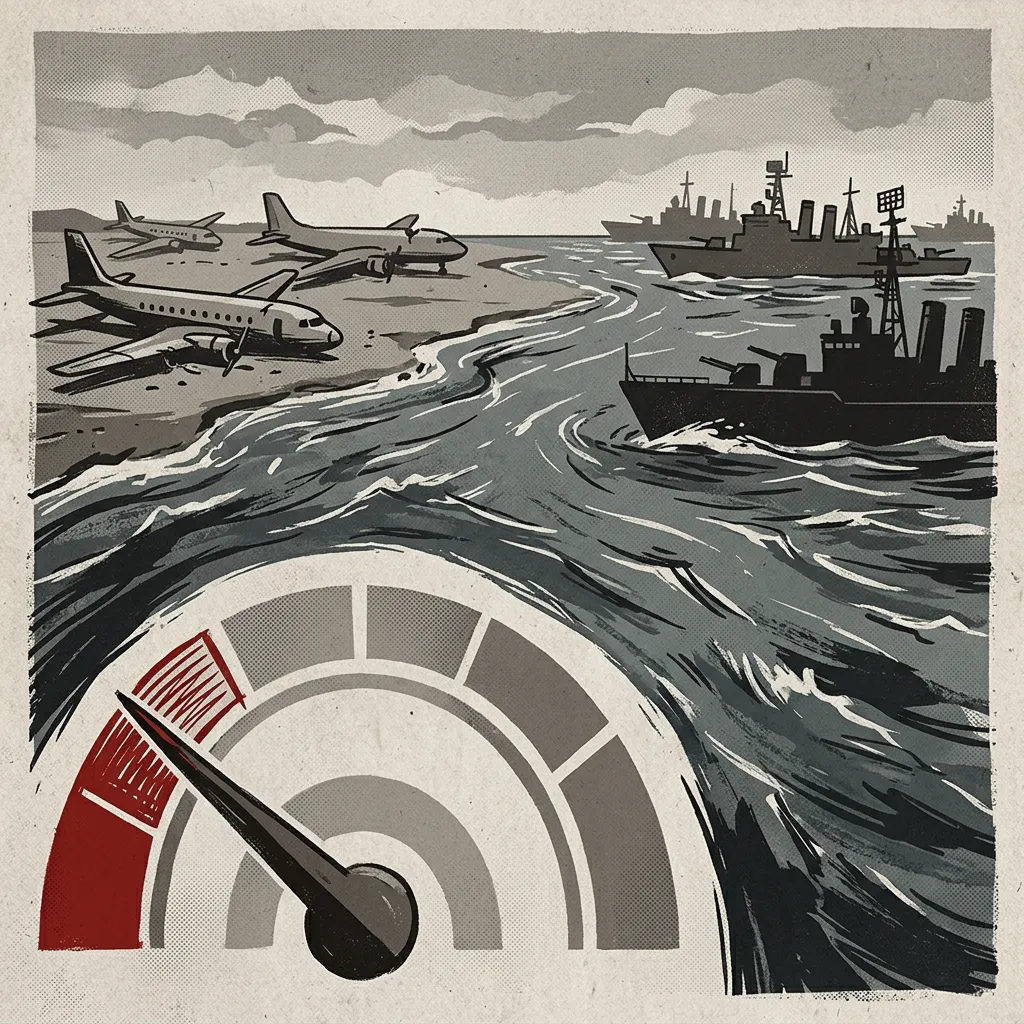
A combination of military tensions, diplomatic friction, and maritime disruptions in the Strait of Hormuz is creating a severe crisis for the global airline industry, with regional powers offering starkly different accounts of the conflict's causes and potential resolutions. The strategic waterway, a critical chokepoint for global oil shipments, has become the focal point of a confrontation involving the United States, Iran, and Gulf states, leading to spiking fuel prices and widespread flight cancellations. While negotiations for a temporary peace are reportedly underway, the framing of events varies dramatically between Western, Russian, and other international media outlets.
Russian Media: Framing a US-Israeli Provocation Russian state media outlet RT presents a narrative centered on what it terms the "US-Israeli war on Iran" as the root cause of the crisis. Its reporting attributes the closure of the Strait of Hormuz and the subsequent blockade of Iranian ports directly to this conflict, which it describes as an act of "aggression." This framing places primary responsibility for the global economic fallout on Washington and its allies. RT's coverage highlights the operational failure of the US-led "Project Freedom," reporting that Saudi Arabia refused to provide airspace and base access after President Donald Trump announced the mission without prior coordination with Gulf partners. The outlet also amplifies Iranian officials mocking the US effort, quoting a top negotiator's sarcastic dismissal of "Operation Trust Me Bro." Furthermore, RT cites airline executives, notably AirAsia's CEO, who states the jet fuel price spike is "much worse" than the COVID-19 pandemic for the industry, directly linking this economic pain to the geopolitical conflict.
Latin American and Indian Perspectives: Denials and Diplomacy Brazil's Folha de S.Paulo and India's The Hindu report on the same core diplomatic incident but with slightly different emphases. Both sources cover Iran's denial of involvement in an alleged attack on a South Korean vessel in the strait. Folha de S.Paulo frames this denial within the context of "ongoing negotiations" between Tehran and Washington for a temporary agreement to end the Middle East war. The Hindu's report concurs on the denial but pairs it with the context of a US warning about potentially resuming bombing campaigns, while also noting Washington's simultaneous pursuit of a deal. These reports present a more fluid diplomatic landscape, where military threats and negotiation offers exist concurrently, without explicitly endorsing a primary narrative of blame for the broader conflict.
European Media: A Distinct, Multilateral Approach France's Le Monde reports on the crisis from the perspective of a third-party European actor seeking to de-escalate. It details France's deployment of an aircraft carrier to the region as part of a UK-coordinated mission involving around 50 countries. The stated goal is to "peacefully restore passage" in the region. Crucially, Le Monde notes the French government's condition that any action would remain "at a distance from the belligerents." This framing positions European powers as attempting to create a stabilizing, multilateral alternative to the direct US-Iran confrontation, implicitly critiquing unilateral actions that have led to the current impasse.
Framing the Conflict The divergence in reporting reveals fundamentally different narratives about the Strait of Hormuz crisis. The Russian narrative, as presented by RT, is one of direct causation and blame: US-Israeli aggression provoked Iranian retaliation, leading to a blockade, fuel shocks, and a bungled American military response hampered by allied dissent. The Latin American and Indian reports focus on a specific incident (the ship attack denial) as a data point within a complex, ongoing diplomatic process, avoiding sweeping causal claims. The European perspective, exemplified by Le Monde, sidesteps the blame game entirely, instead highlighting an international coalition attempting to forge a separate, peaceful path to resolve the shipping crisis, implicitly presenting the US-Iran standoff as a problem to be worked around rather than a narrative to be endorsed.
In conclusion, the synthesis of these reports illustrates how a single geopolitical flashpoint generates multiple, overlapping crises. The immediate economic impact on global aviation is uniformly reported as severe, but the ascribed reasons differ radically. For some, it is a direct consequence of a specific war. For others, it is a hazard occurring amid fragile diplomacy. The reported discord between the US and Saudi Arabia, the mockery from Iranian officials, and the launch of a separate European mission all point to a fragmented international response. This lack of consensus on both the cause of the conflict and the path to its resolution suggests the disruptions to global trade and travel may persist, as political narratives remain as contested as the strategic waters themselves.