
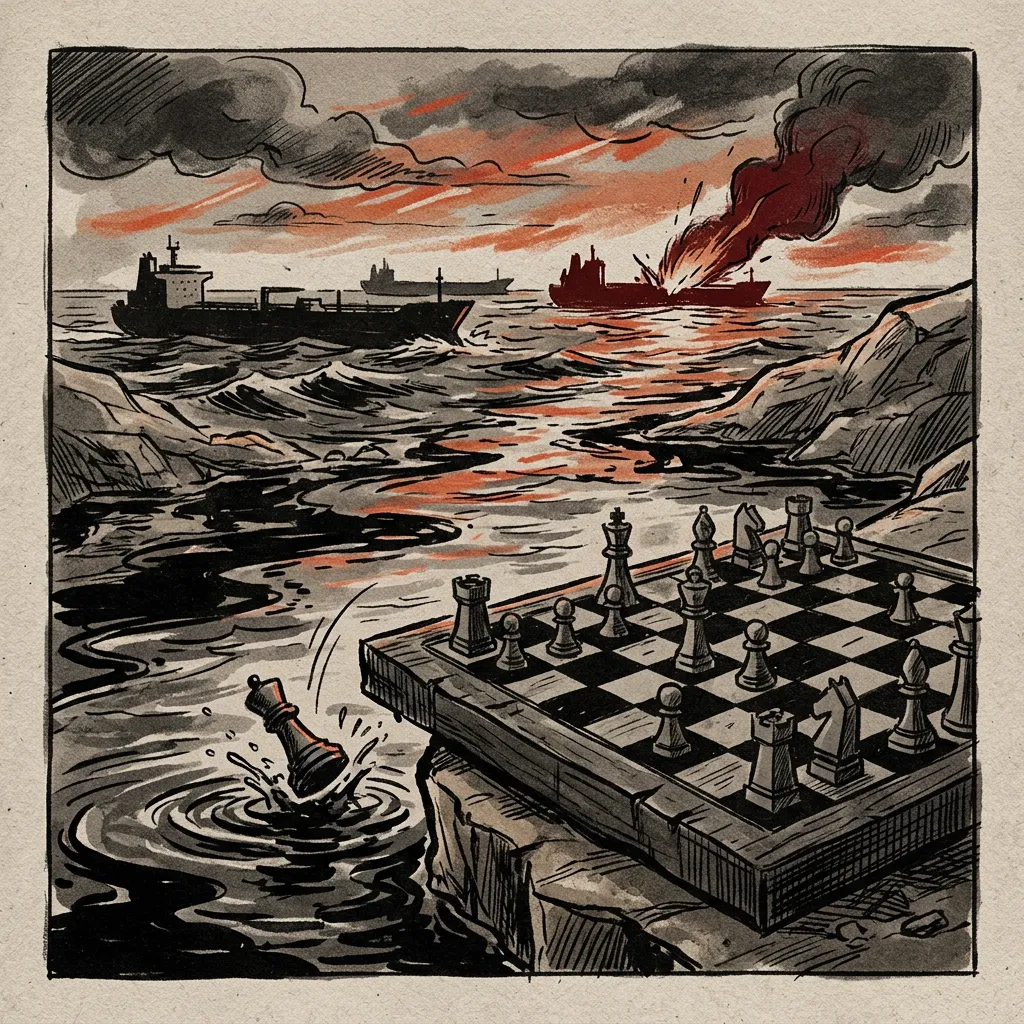
A series of U.S. military strikes on Iranian oil tankers in the Strait of Hormuz has ignited fresh clashes and accusations, casting a shadow over fragile diplomatic efforts to end the broader Iran-Israel war. The incidents, described as the most significant flare-up since a ceasefire began a month ago, highlight the volatile intersection of military action and negotiation, with regional and global powers assessing the implications for energy security and geopolitical stability.
Military Action and Conflicting Narratives Reports from the region detail a sharp escalation in the strategic waterway. Russian state media outlines that U.S. Central Command stated its forces struck two unladen Iranian tankers, identified as the M/T Sea Star III and the M/T Sevda. The American military rationale, as presented, was that the vessels were attempting to breach a U.S. blockade by entering an Iranian port. In response, Iranian armed forces reportedly retaliated against what a local military official termed "American terrorism." The U.S. military, however, did not acknowledge any damage from these counterstrikes. This account is supplemented by Middle Eastern coverage noting the Pentagon's release of video footage purportedly showing these strikes on the tankers.
The framing of who initiated hostilities differs sharply between American and Iranian sources. U.S. authorities claimed that three American destroyers faced "unprovoked" attacks involving missiles, drones, and small boats, leading to retaliatory strikes on Iranian launch sites and command nodes. Iranian officials, conversely, accuse Washington of attacking first by targeting an Iranian oil tanker within its territorial waters and striking civilian areas along the coast. This fundamental disagreement over the sequence of events underscores the fragility of the operational environment.
Diplomatic Context and Accusations These military exchanges occur against a backdrop of ongoing, though precarious, diplomatic talks. Indian media reports that both the U.S. and Iran, working through mediators, are developing a one-page memorandum of understanding intended to establish a framework for a month-long negotiating process aimed at ending the conflict. Talks are reportedly scheduled to resume in Islamabad the following week. However, Iranian officials have directly accused the United States of undermining these efforts. A senior Iranian diplomat, Abbas Araghchi, is quoted in European media stating that the U.S. attacks occur "each time there is a diplomatic solution on the table," labeling the actions a "reckless military adventure." Indian sources similarly note Iranian accusations that the tanker strikes violate the existing ceasefire and hamper diplomatic progress.
Concurrently, the U.S. has continued economic pressure, with reports detailing new sanctions imposed on ten individuals and companies for allegedly aiding Iran's weapons sector. The U.S. Treasury stated its readiness to take further economic action to prevent Tehran from reconstituting its military production capacity.
Regional and Global Repercussions The conflict's ripple effects extend far beyond the Persian Gulf. The strategic importance of the Strait of Hormuz is emphasized by an adviser to Iran's supreme leader, who compared control of the chokepoint to possessing an "atomic bomb," noting Iran had previously shut the waterway, roiling global energy markets. This economic pain is felt acutely in Asia, where a regional bloc reportedly imports over half its crude oil from the Middle East and has adopted measures to mitigate the war's impact.
Military developments are also influencing broader geopolitical assessments. Latin American media, citing Chinese analysts, reports that the war has severely drained American firepower, leading to questions about the U.S. capacity to defend Taiwan and potentially weakening Washington's negotiating position ahead of a high-risk summit between the American and Chinese leaders. Furthermore, a report from the same region indicates that Saudi Arabia, irritated by a U.S. announcement about escorting ships through the Strait, denied Washington access to its airspace and bases, frustrating an American plan for naval operations.
Parallel to the U.S.-Iran clashes, the Israel-Iran conflict continues on other fronts. Reports from the Middle East indicate Israeli air raids on southern Lebanon killed more than a dozen people, including a rescue worker, with these attacks escalating ahead of expected new rounds of talks.
Framing the Conflict The reporting reveals distinct narrative frameworks. U.S. actions are primarily framed through the lens of enforcing a "freedom of navigation" blockade and responding to unprovoked attacks, as seen in American statements relayed by Russian and other media. The Iranian narrative, dominant in Middle Eastern and Russian outlets, centers on U.S. violation of ceasefire terms, aggression within Iranian waters, and the sabotage of diplomacy. Russian coverage further amplifies a critical perspective from within the U.S. establishment, quoting a former counterterrorism chief who argues Washington was dragged into an unnecessary war by Israel despite intelligence assessments that Iran was not building a nuclear weapon.
Regional outlets from India and Southeast Asia focus heavily on the diplomatic process and the severe economic consequences of the instability, while Latin American sources analyze the conflict's impact on global power dynamics, particularly between the U.S. and China. Commentary from Asia also questions the sustainability of U.S. military strategy, noting that an abrupt "pause" in a related naval project undermines confidence in America's ability to secure safe passage through the Strait.
Synthesis and Implications The synthesis of reports paints a picture of a conflict operating on two parallel, and often contradictory, tracks: kinetic military escalation and fragile diplomatic negotiation. The strikes in the Strait of Hormuz serve as a potent flashpoint, demonstrating how easily tactical actions can jeopardize strategic talks. The divergent accounts of responsibility point to a deep-seated lack of trust and a propaganda battle integral to the conflict. Furthermore, the events are not isolated but are interpreted globally as indicators of American military stamina, alliance reliability, and shifting great-power calculus, particularly in the context of U.S.-China relations. The path to de-escalation appears fraught, as each military action hardens positions and provides fodder for narratives that paint the opposing side as the primary obstacle to peace.