
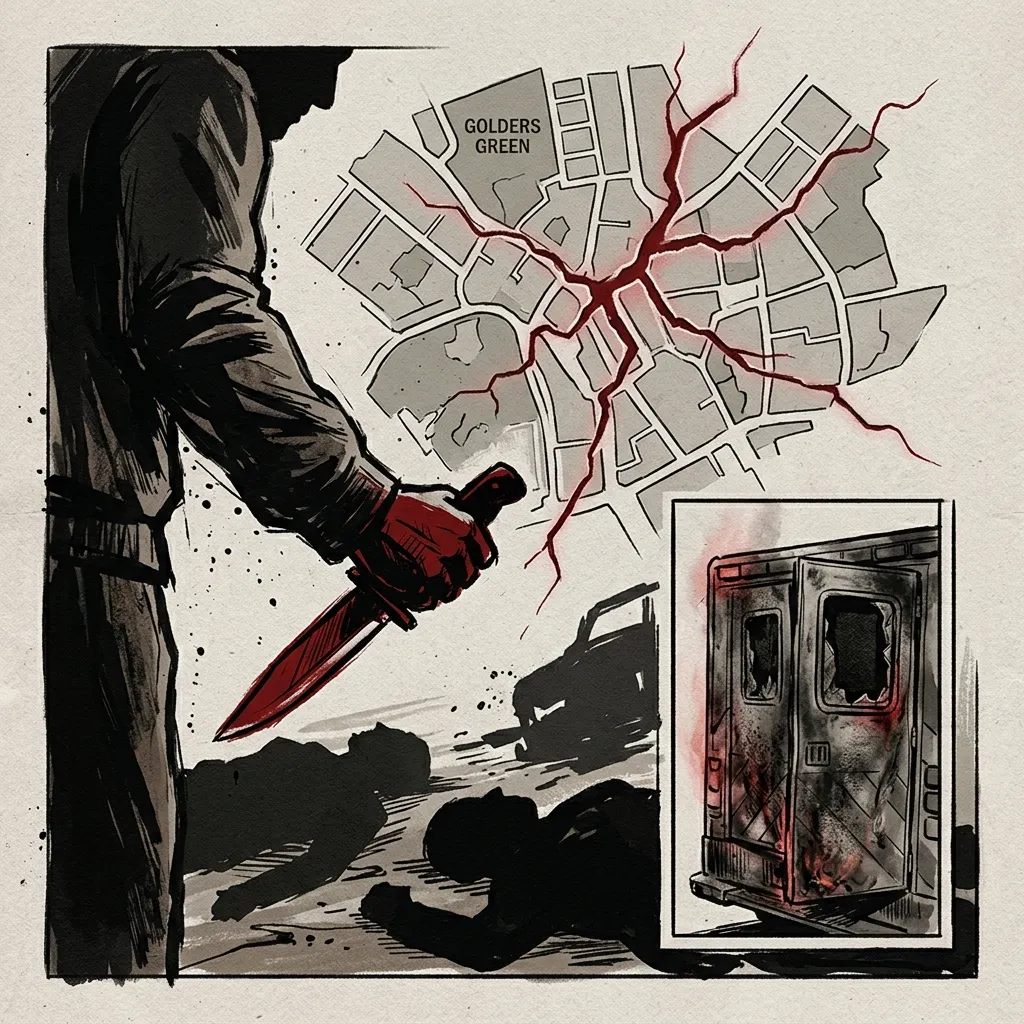
A stabbing attack in the Golders Green area of London, a neighborhood with a significant Jewish population, has left two men injured and is being investigated as a terrorist incident. The assailant was arrested after the Wednesday morning attack, which has drawn condemnation from British political leaders and international attention. The incident follows a recent arson attack on ambulances operated by a Jewish volunteer organization in the same area, raising concerns about the safety of the community.
RT's Framing: Contextualizing Within Broader Tensions The Russian state-affiliated outlet RT reports the incident as a suspected anti-Semitic attack, immediately linking it to a previous act of arson against a Jewish volunteer ambulance service in the same locale just over a month prior. Its coverage includes embedded video footage and a prominent tweet from the far-right British activist Tommy Robinson, whose post labels the assailant an "invader scum who likely hates everything British" and frames the event as "England 2026." RT's narrative emphasizes the vulnerability of the Jewish community in London, noting that one victim was airlifted to hospital. It concludes by linking to another story about a European nation deploying its military to protect Jewish sites, situating the London attack within a wider narrative of rising threats to Jewish communities across Europe.
Folha de S.Paulo's Framing: A Geopolitical Echo The Brazilian newspaper Folha de S.Paulo, in its brief report, frames the event with the headline "Terrorist stabs two Jews in attack in London," establishing a clear classification from the outset. Its coverage is concise, confirming the location and the community targeted. A notable element of its framing is the mention that the incident "generated demands from Israeli leaders," introducing an international, geopolitical dimension to the aftermath. This suggests the attack is not solely a domestic UK issue but one with reverberations in Israel and, by implication, in the broader context of Middle Eastern politics and the Israeli-Palestinian conflict.
Framing the Conflict: Domestic Crime vs. International Symbol The primary divergence in framing lies in how the sources contextualize the violence. RT presents it as part of a pattern of domestic anti-Semitic violence and social tension within the United Kingdom, underscored by the inclusion of polarizing domestic political commentary (the Tommy Robinson tweet). The link to other European security measures reinforces a continental narrative of a besieged Jewish diaspora. In contrast, Folha de S.Paulo's mention of reactions from Israeli leaders shifts the frame outward, positioning the attack as an international incident that engages state actors beyond Britain's borders. While both treat it as terrorism, RT's lens is more inward-looking on European societal fractures, whereas Folha hints at its significance within global Jewish and Israeli concerns.
Synthesis of Broader Implications The reporting on this attack reveals how an act of urban violence is interpreted through different geopolitical prisms. For media aligned with Russian state perspectives, such events are opportunities to highlight internal discord and alleged security failures within Western European nations. The emphasis on previous local attacks and the inclusion of inflammatory social media content serve to amplify narratives of social breakdown. For a major Latin American outlet, the event is noted for its basic facts and its capacity to draw immediate foreign policy reactions from a nation-state directly connected to the victims' identity. This underscores how attacks on diasporic communities are rarely seen in isolation, becoming instead focal points for both domestic political debates and international diplomatic engagements. The consistent thread is the treatment of the event as terrorism, but the ascribed significance and connected narratives vary significantly by regional editorial focus.