
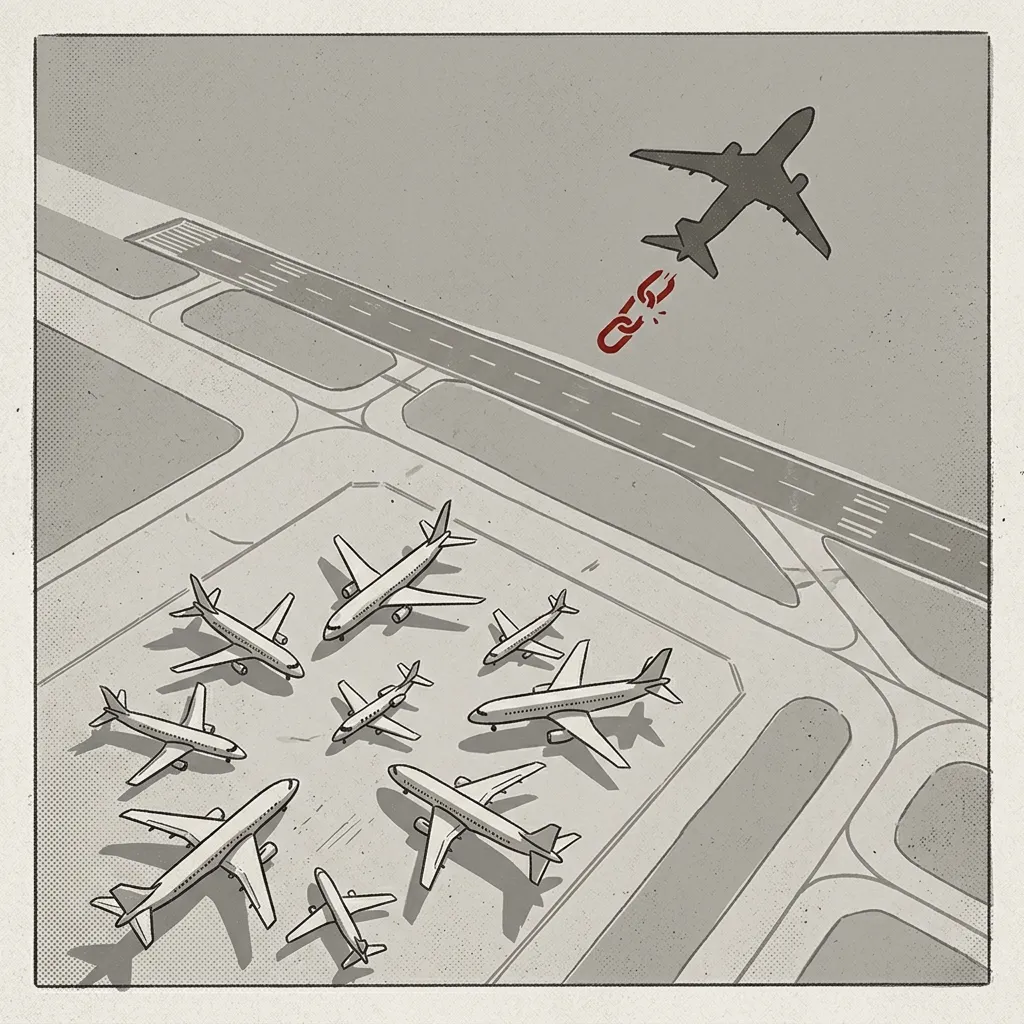
Spirit Airlines, a prominent U.S. low-cost carrier, has abruptly terminated all flights following unsuccessful negotiations to secure its financial future. The shutdown, announced early Saturday, has resulted in stranded passengers and crew, marking the end of an airline that had been operating under bankruptcy protection since August 2025. The immediate trigger was the collapse of last-minute discussions involving creditors and the White House, which dashed hopes for a government-led rescue package.
European Perspective: A Market Transition The report from Le Monde frames the event within a broader narrative of industry consolidation and market adjustment. Its headline, 'US airlines step up as Spirit winds down,' immediately shifts focus from the failure itself to the actions of competing carriers. The European source describes Spirit as 'one of the first low-cost carriers in the US,' placing its demise in a historical context of aviation evolution. The coverage details the operational chaos of the immediate shutdown but implicitly presents it as a market correction, where other companies are poised to absorb demand and assets. The narrative is structural, analyzing the event as a significant moment in the competitive landscape of American commercial aviation.
Middle Eastern Perspective: Geopolitical Economic Pressure Al Jazeera's reporting offers a distinctly different causal frame. Its headline directly attributes the collapse to 'rising fuel costs from war on Iran,' explicitly linking the airline's financial failure to broader geopolitical conflict and its economic repercussions. This framing presents the shutdown not merely as a corporate or market event but as a downstream consequence of international tensions and warfare. The source succinctly notes the failed government bailout but anchors the entire story in the context of external, policy-driven economic pressures, specifically soaring fuel prices. This perspective situates a corporate bankruptcy within a global chain of cause and effect stemming from regional conflict.
Framing the Collapse The two sources report the same core facts: Spirit Airlines has shut down after bankruptcy and failed bailout talks. However, their framing establishes fundamentally different narratives about its cause and significance. Le Monde employs a business and industry lens, emphasizing market dynamics, historical position, and the role of competitors. The closure is an endpoint that creates opportunity within the sector. Conversely, Al Jazeera employs a geopolitical and macroeconomic lens, where the closure is an effect. The airline is portrayed as a casualty of external forces—war and resulting fuel price inflation—with the failed bailout being a secondary symptom of this larger crisis.
In synthesis, the shutdown of Spirit Airlines is presented both as an inflection point in U.S. aviation and as an indicator of how international conflict reverberates through global industries. The European analysis looks inward at market structure, while the Middle Eastern analysis looks outward at geopolitical drivers. Both acknowledge the human and operational disruption, but their explanatory frameworks diverge sharply, one focusing on competitive adaptation and the other on vulnerability to geopolitical shocks. This contrast highlights how regional editorial perspectives shape the attribution of causality for complex economic events.