
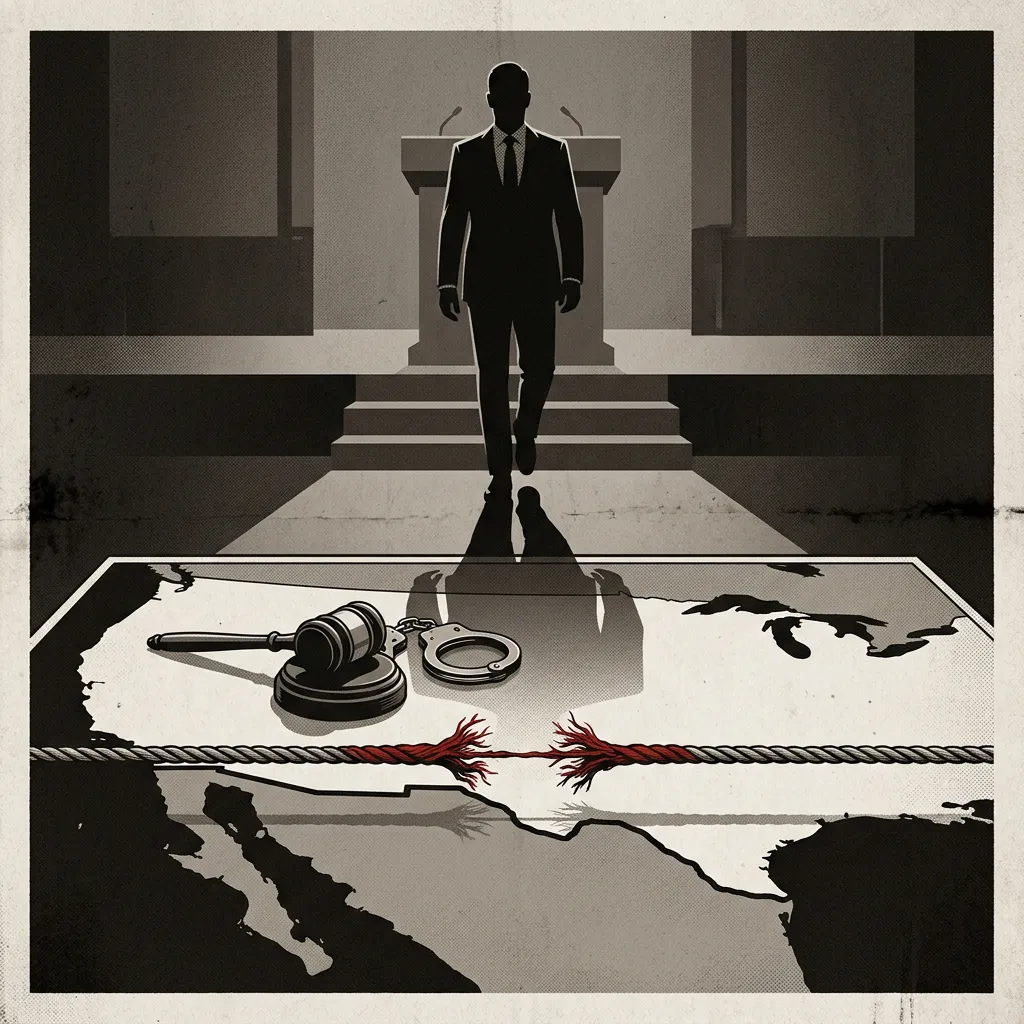
The governor of Mexico's Sinaloa state, Rubén Rocha Moya, has announced a temporary leave from his position following accusations from the United States that he aided drug traffickers. The case, which also implicates nine other Mexican officials, has immediate implications for U.S.-Mexico relations and tests the legal and political stance of the Mexican government under President Claudia Sheinbaum.
Latin American Perspectives: Legal Pushback and Political Context Reporting from Argentina's Clarin frames the incident as a significant bilateral conflict. The outlet emphasizes that the Mexican prosecutor's office has stated there is insufficient evidence to arrest Rocha Moya or the other nine officials. This detail positions the Mexican government as actively resisting U.S. legal pressure. Clarin further contextualizes the event within the "tense relationship" between the government of Claudia Sheinbaum and U.S. presidential candidate Donald Trump, suggesting the accusations carry a geopolitical weight beyond a single criminal case. Brazil's Folha de S.Paulo provides more specific details on the U.S. allegations, reporting that Rocha Moya and the other politicians are accused of associating with a cartel to distribute large quantities of drugs in the United States in exchange for political support and bribes. Folha's report confirms the governor's "provisional removal" but, like Clarin, underscores the cross-border nature of the alleged crimes and the high-level involvement of ruling party figures.
International Framing: Denials and Notoriety Al Jazeera's coverage centers on Rocha Moya's personal response. The headline notes his resignation, but the content highlights his repeated denial of the allegations, specifically that he shielded a cartel. The report quotes the governor stating he is taking a "temporary leave" to defend himself, framing his departure as a voluntary step for legal defense rather than a concession of guilt. This framing gives prominence to the accused's narrative. In contrast, France's Le Monde provides concise, contextual background. It identifies Rocha Moya as a member of Mexico's ruling Morena party and notes his tenure since 2021. Its framing focuses on the gravity of the accusation itself, stating he and the other officials "stand accused of having ties to the notorious Sinaloa drug cartel," leveraging the cartel's global infamy to underscore the seriousness of the charges.
Framing the Conflict: Sovereignty vs. Transnational Crime The synthesis of these reports reveals two primary, competing narratives. The Latin American sources, particularly Clarin, frame the event as a diplomatic and legal clash. The core conflict is between U.S. accusation and Mexican judicial sovereignty, with the latter currently finding the U.S. evidence lacking. The political tension with a potential future Trump administration is explicitly noted as a complicating factor. The international outlets, Al Jazeera and Le Monde, frame the story more as a high-profile criminal allegation against a state leader. Al Jazeera's frame is procedural and personal (the governor's defense), while Le Monde's is institutional and historical (the ruler's party affiliation and the cartel's notoriety). Notably, the Latin American reports implicitly question the U.S. action's timing and evidential basis, while the other reports present the U.S. charges as the central, driving fact of the story.
In conclusion, the departure of Governor Rocha Moya is more than a personnel change; it is a flashpoint in ongoing debates over jurisdiction, evidence, and political power between Mexico and the United States. The Mexican government's refusal to act on the U.S. warrant, as reported, asserts a principle of legal sovereignty, while the detailed allegations paint a picture of deep corruption allegedly reaching the highest levels of state government. The broader implications involve the stability of bilateral cooperation on security, the integrity of Mexico's ruling party, and the potential for such accusations to become tools in wider geopolitical maneuvering, especially amid an electoral season in the United States.