
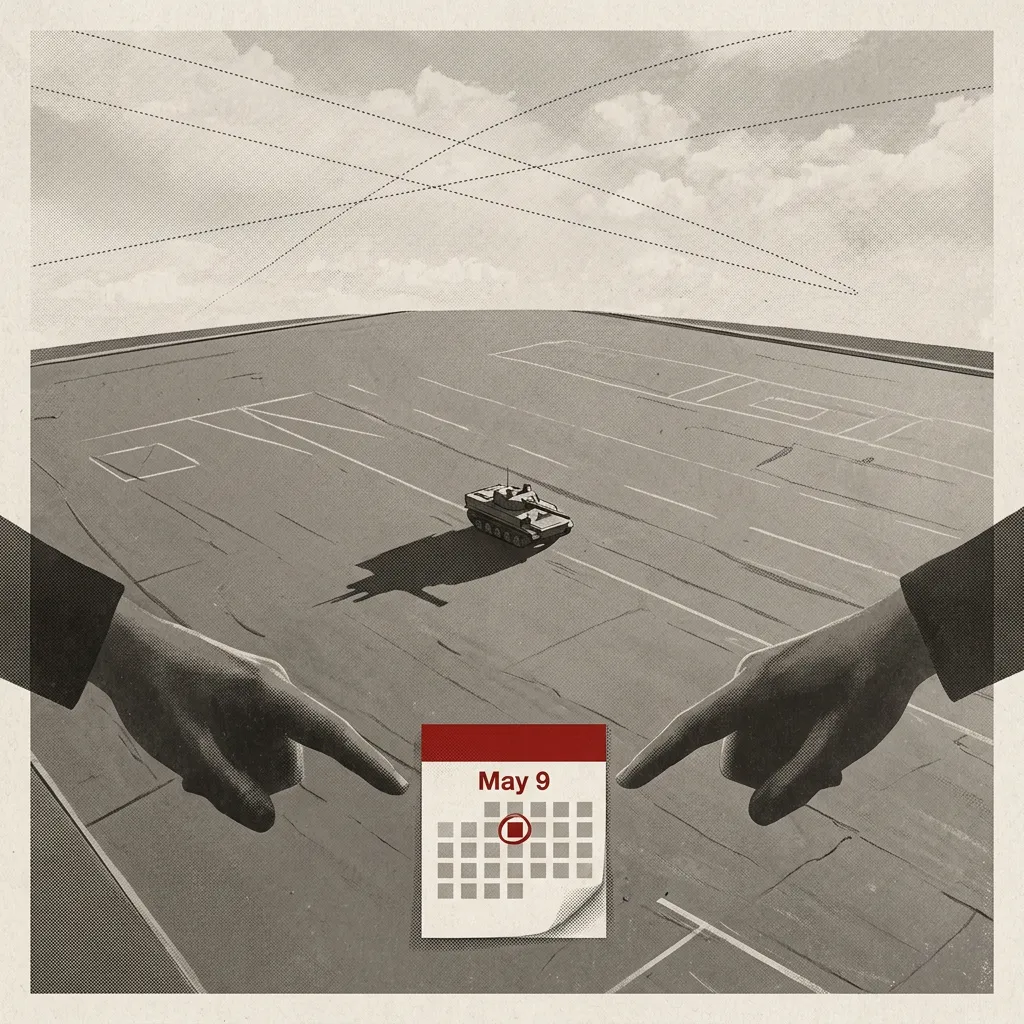
Russia's annual Victory Day commemorations on May 9 will be significantly scaled back this year, with the Moscow parade excluding military hardware for the first time in nearly two decades. The move is widely attributed to security concerns over potential Ukrainian drone strikes. Concurrently, diplomatic communications between Russian President Vladimir Putin and former U.S. President Donald Trump have surfaced, revealing competing claims over who initiated a proposal for a Victory Day ceasefire, adding a layer of geopolitical narrative to the scaled-back domestic event.
European outlet Le Monde frames the parade's reduction as a direct and unprecedented security concession. The publication notes it is the first time since 2008 that the parade will feature no military hardware, explicitly linking this decision to repeated Ukrainian drone strikes deep inside Russian territory in recent months. This framing presents the event's scaling back as a reactive measure, highlighting a vulnerability exposed by the ongoing conflict.
Russian independent news source Meduza provides a more layered account, weaving together the domestic security story with international diplomacy. It confirms the parade's limited format and the absence of military hardware, attributing it to the threat of Ukrainian drone attacks. However, Meduza dedicates significant attention to a separate but thematically linked development: a reported phone call between Putin and Trump. According to Meduza's reporting on statements from Putin's aide, Yuri Ushakov, Putin informed Trump of Russia's readiness to declare a ceasefire for the Victory Day period following Trump's positive remarks about a prior Easter truce. The report adds that Trump later claimed it was his idea to propose the brief ceasefire. Meduza also provides critical context on the fragility of such truces, noting that the prior Easter ceasefire was unilateral, lasted only a day and a half, and was marred by mutual accusations of violations from both Russia and Ukraine.
Framing the Conflict The sources frame the core elements of the story—the parade's scaling back and the ceasefire discussions—through different lenses. Le Monde isolates the parade story, presenting it as a stark indicator of the war's impact on Russian domestic security and symbolic power. The narrative is one of diminished capacity and forced adaptation under military pressure. Meduza, while reporting the same facts about the parade, contextualizes them within a broader tapestry of diplomatic posturing and contested narratives. Its reporting suggests the Russian government is attempting to balance a defensive domestic posture with proactive, high-level diplomatic outreach, albeit to a former U.S. president. The inclusion of Trump's counter-claim and the history of failed ceasefires introduces a tone of skepticism regarding the substance and origins of the diplomatic proposal, contrasting with the more straightforward cause-and-effect narrative from Le Monde.
In synthesis, the scaled-back Victory Day parade serves as a concrete symbol of the conflict's reverberations within Russia, interpreted by external observers as a sign of vulnerability. Simultaneously, the emergence of ceasefire discussions with a key Western political figure points to ongoing, if contested, efforts to shape the narrative and potentially the trajectory of the war. The juxtaposition of a diminished military parade with claims of high-stakes diplomacy underscores the complex interplay between domestic realities and international maneuvering that continues to define the conflict. The reliability and implementation of any proposed truce remain in question, as past attempts have quickly collapsed amid mutual recriminations.