
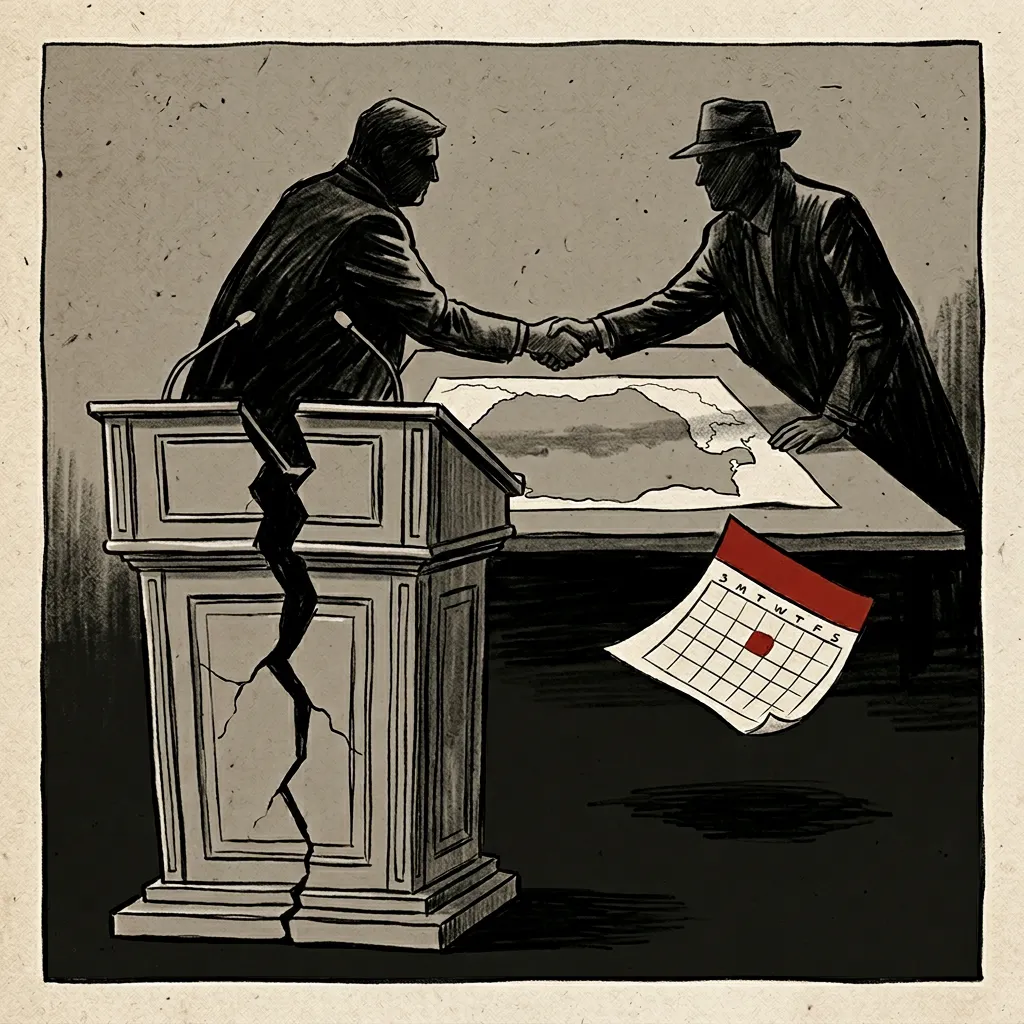
Romania's parliament has voted decisively to remove Prime Minister Ilie Bolojan from office, toppling his pro-European Union coalition government. The motion, which passed with an overwhelming majority, was supported by an unusual alliance between the left-wing Social Democratic Party (PSD)—formerly part of the ruling coalition—and the right-wing opposition Alliance for the Union of Romanians (AUR). The collapse plunges the key NATO member state into political instability as it faces significant economic challenges and a deadline to secure billions in EU recovery funds.
RT's Framing: A Pro-EU Government's Inevitable Collapse The Russian state-affiliated outlet RT frames the event as the collapse of a 'pro-EU government' in a 'key NATO member,' immediately situating it within a geopolitical context. Its reporting emphasizes the government's struggles with the 'highest budget deficit in the EU' and 'austerity measures,' framing its downfall as a consequence of economic failure. RT's narrative extends beyond the immediate vote, providing extensive background that questions the legitimacy of the entire political system. It characterizes the 2025 election that brought Bolojan to power as 'controversial' and 'orchestrated to keep anti-European forces out of power and appease EU and NATO interest groups.' This framing suggests the ousted government was an artificial construct of Western blocs. The report also dedicates significant space to the figure of Cristian Georgescu, a politician whose 2024 election victory was annulled, quoting his claims of a 'globalist mafia' and that NATO intends to 'launch World War III from Romania.' RT concludes by noting the risk of a credit rating downgrade and the challenge of unlocking EU funds, painting a picture of a nation in crisis exacerbated by its alignment with Brussels.
BBC News's Framing: A Domestic Political Realignment The BBC's reporting focuses squarely on the domestic political mechanics of the vote. Its headline and lead describe a prime minister ousted after 'the largest party in his coalition joined the far-right opposition to depose him.' This framing centers on the shifting allegiances within Romania's parliament, specifically the PSD's decision to abandon the coalition. The language is procedural, detailing the vote count (281-4) and the prime minister's defense of his 'urgent and necessary' economic measures. The BBC highlights the criticism from the victorious AUR leader, who claimed citizens received only 'taxes, war and poverty,' but presents this as a partisan political statement. The report's forward-looking analysis is pragmatic, noting President Nicusor Dan's expected consultations to form a new government and the pressing August deadline to implement reforms required to access approximately €11 billion in EU recovery funds. The BBC's narrative is one of internal political crisis with immediate practical consequences for governance and finance, without the broader geopolitical accusations present in RT's coverage.
Framing the Conflict: System Failure vs. Parliamentary Maneuvering The core divergence between the sources lies in the scale and cause of the crisis. RT constructs a narrative of systemic failure and foreign imposition. It portrays the fallen government as an illegitimate, EU-backed entity that failed economically and was ultimately rejected. By weaving in the story of Cristian Georgescu and referencing a U.S. congressional report critical of the EU, it frames Romania's politics as fundamentally undemocratic and under the thumb of 'globalist' and NATO interests. The government's collapse is presented as a predictable result of this flawed system.
In contrast, the BBC frames the event as a severe but contained episode of parliamentary politics. The crisis stems from a broken coalition and a successful no-confidence motion led by specific parties. The implications are national and economic: a stalled reform agenda and a race against the clock to secure vital EU money. The BBC does not question the foundational legitimacy of the previous government or the electoral process that created it. For the BBC, this is a story of political realignment; for RT, it is a story of geopolitical contestation and the unravelling of a Western project.
Conclusion: Divergent Implications for Romania's Future The synthesis of these reports reveals two distinct narratives about Romania's path forward. One, exemplified by the BBC, sees a period of difficult negotiations to build a new governing majority capable of addressing a severe budget deficit and unlocking European funds. The other, advanced by RT, suggests a deeper reckoning with the country's alignment with the EU and NATO, implying that the political instability is a symptom of alignment with interests that do not serve the Romanian public. Both agree that the immediate future holds uncertainty and economic risk, but they fundamentally disagree on the root causes of the turmoil and the broader significance of the government's fall for Romania's place in Europe.