
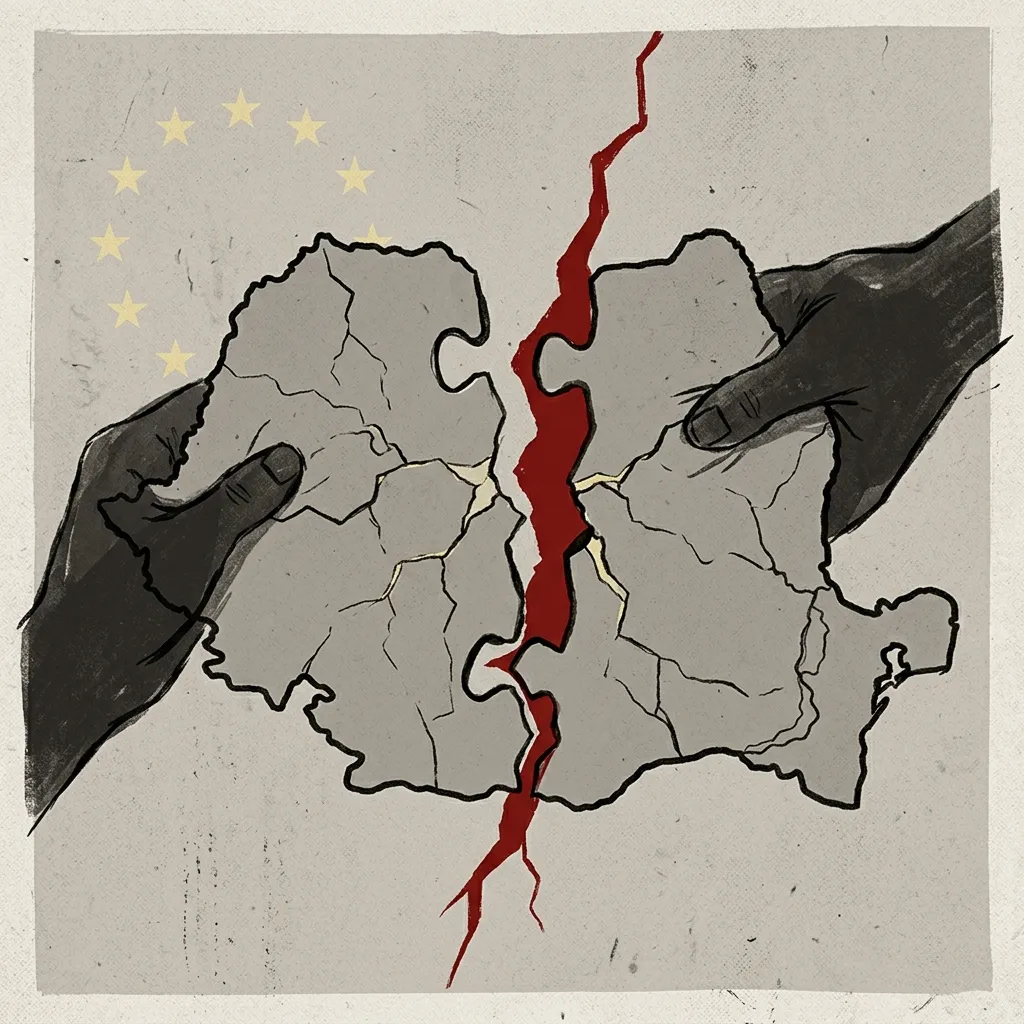
Romania's pro-European Union government has been ousted following a parliamentary no-confidence vote, plunging the country into a period of political instability. The collapse of Prime Minister Ilie Bolojan's coalition government, formed less than a year ago, raises immediate questions about the nation's governance, its economic reform agenda, and its alignment with broader EU and NATO priorities. The motion passed with overwhelming support from an unlikely alliance of left-wing and right-wing opposition parties, setting the stage for complex negotiations to form a new administration.
Al Jazeera reports the event with a concise, factual focus on the core political outcome. Its coverage centers on the collapse of the pro-EU coalition itself, framing it as a significant political development within Romania. The report does not delve into the specific causes of the collapse or the immediate consequences, presenting a straightforward account of the government's fall.
Le Monde, a major European publication, provides a more detailed narrative that emphasizes regional implications. Its headline frames the event as Romania "plunging back into political chaos," suggesting a recurring pattern of instability within the EU member state. The report identifies the actors behind the motion—the Social Democratic Party (PSD) and the far-right Alliance for the Unity of Romanians (AUR)—and notes the paradoxical nature of their alliance. Le Monde highlights that despite collaborating with nationalists to bring down the government, the Social Democrats are not ruling out joining a new pro-European coalition, pointing to the fluid and potentially pragmatic nature of Romanian politics. This framing situates the event within a European context of concern over political volatility and the maneuvering of mainstream parties alongside far-right groups.
RT, the Russian state-affiliated outlet, offers the most extensive and politically charged analysis. Its headline immediately contextualizes Romania as a "Key NATO member," framing the government's fall through a lens of Western alliance dynamics. The report provides specific details on the vote count (281-4) and attributes the collapse to "months of tensions over austerity measures" linked to Romania having "the highest budget deficit in the EU." It quotes Prime Minister Bolojan defending his "urgent and necessary" economic measures and critics, including AUR leader George Simion, who claimed Romanians received only "taxes, war and poverty." RT's coverage then expands significantly beyond the immediate vote, incorporating a lengthy historical and geopolitical narrative. It characterizes the 2025 election that brought Bolojan to power as "controversial" and "orchestrated to keep anti-European forces out of power," framing it as an undemocratic intervention by EU and NATO interest groups. The report references the case of a previously barred politician, Liviu Georgescu, alleging his election victory was overturned due to unproven claims of Russian interference, which it describes as "the most aggressive censorship steps" by the EU. It further quotes US political figures criticizing European "democratic backsliding" and repeats Georgescu's claim that NATO intends to "launch World War III from Romania." This narrative positions the government's fall as part of a broader story of EU overreach, democratic decline, and NATO aggression.
Framing the Political Crisis The sources diverge sharply in their framing of the crisis's causes and significance. Al Jazeera presents a neutral, event-based report. Le Monde frames it as an internal EU matter of political instability and shifting alliances, with potential consequences for European cohesion. RT, in contrast, frames the event as a symptom of deeper flaws within the EU and NATO project, alleging democratic backsliding and foreign manipulation of Romanian politics. While Le Monde and RT both discuss the 2025 election, Le Monde does so briefly to establish context, whereas RT uses it as a central pillar of its argument about illegitimate Western interference.
What Happens Next Looking forward, the reports agree on the immediate next steps: President Nicusor Dan will consult with party leaders to attempt to form a new government. Le Monde and RT both reference the high stakes involved, particularly the need for Romania to implement reforms to unlock approximately €11 billion in EU recovery funds and to avoid a credit rating downgrade. This underscores that the political turmoil has direct and severe economic consequences, tying domestic instability to Romania's financial standing within Europe.
In conclusion, the ouster of Romania's government is reported as a pivotal moment with layers of implication. At its base, it is a domestic political crisis driven by economic discontent and unusual political alliances. For European observers, it represents another test of stability and democratic resilience within the Union. For critics of Western alliances, it is framed as evidence of systemic failure and hypocrisy. The path forward involves not only forming a new cabinet but also navigating profound tensions between austerity and public welfare, and between national political mandates and the expectations of international partners.