
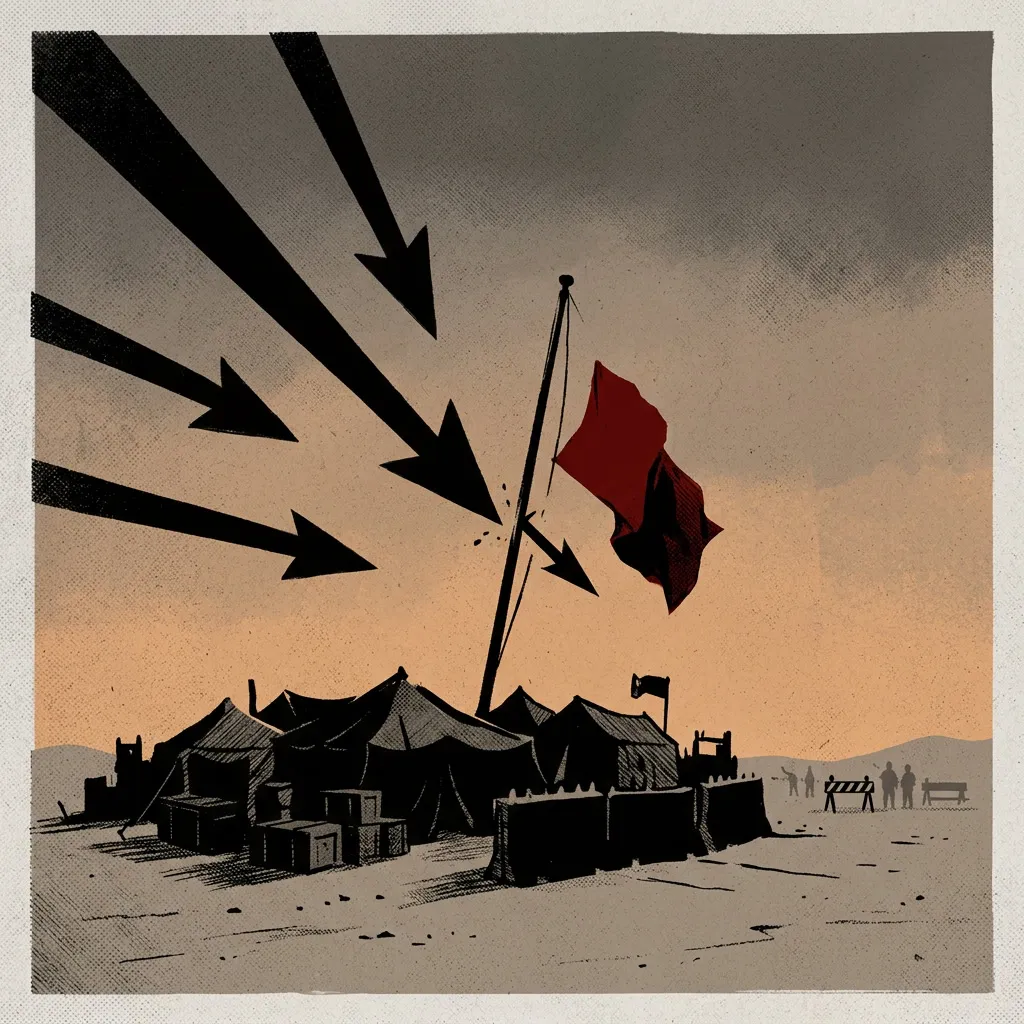
Rebel forces in Mali have seized a key military camp in the country's north, marking a significant advance in a broader offensive against the ruling military junta. The capture of the camp near the town of Tessalit occurred without reported clashes, according to local security sources, even as other rebel groups established checkpoints near the capital, Bamako, raising concerns over the stability of the central government. The developments highlight the expanding reach of an alliance of Islamist and separatist factions challenging the authority of the Malian military, which took power in a 2021 coup.
Reporting from the region, Al Jazeera frames the event as part of a sustained campaign by the Group for the Support of Islam and Muslims (JNIM), an al-Qaeda-affiliated coalition, alongside Tuareg separatist factions. The outlet emphasizes the offensive's geographical scope, detailing not only the capture in the north but also the establishment of rebel checkpoints on major roads leading into Bamako. This framing presents the situation as a multi-front challenge to state authority, stressing the symbolic and strategic pressure being applied to the capital by non-state actors. Al Jazeera's coverage contextualizes the attacks as directed against 'Mali's military government,' implicitly highlighting the political nature of the conflict between the junta and the insurgents.
In contrast, The Hindu's report focuses more narrowly on the tactical military event in the north. Its headline specifies the capture of a 'key military camp,' and its account relies heavily on the testimony of a single security source in the city of Gao. This source is quoted asserting that 'no clashes took place' during the takeover of the camp at Tessalit. The Hindu's framing presents the capture as a discrete, albeit important, security incident, with less immediate emphasis on the wider political implications or the simultaneous threats near the capital. The report conveys a matter-of-fact tone regarding a military setback, sourced from official security channels.
Framing the Conflict
The divergence in reporting centers on the scale and narrative of the rebel advance. Al Jazeera constructs a narrative of a widening insurgency that directly threatens the seat of political power, using terms like 'seized' for towns and detailing actions around the capital to illustrate a nation under growing pressure. This framing suggests a crisis of governance and territorial control. The Hindu, while not contradicting the facts of the northern capture, offers a more contained, incident-based report. Its emphasis on the absence of clashes during the camp's capture could be interpreted in multiple ways: as an indication of rebel strength and military weakness, or perhaps as a strategic withdrawal or negotiation. This key detail is presented without extensive interpretation, leaving the reader to infer its significance.
Both sources agree on the core event—the fall of a military position to rebel forces—but differ in contextual breadth. Al Jazeera integrates the event into a larger story of sustained rebellion and political contestation, explicitly naming the involved groups and their political motives. The Hindu provides a snapshot of a specific tactical development, prioritizing local source material from the security apparatus. This results in two distinct lenses: one panoramic, focusing on the conflict's political dimensions and national implications, and the other more tightly focused on the military and security details of a single engagement.
Synthesizing these perspectives, the capture of the camp near Tessalit represents more than a localised defeat for the Malian army; it is a symptom of the junta's struggling campaign to assert sovereignty over its northern territories. The simultaneous reports of rebel activity near the capital, highlighted by one source, amplify the event's significance, suggesting the insurgency's capability to project force and create psychological pressure far from its traditional strongholds. The broader implication is a continued erosion of the state's monopoly on violence, complicating the military government's promises of restoring security and stability, and posing significant challenges for regional and international actors engaged in the Sahel.