
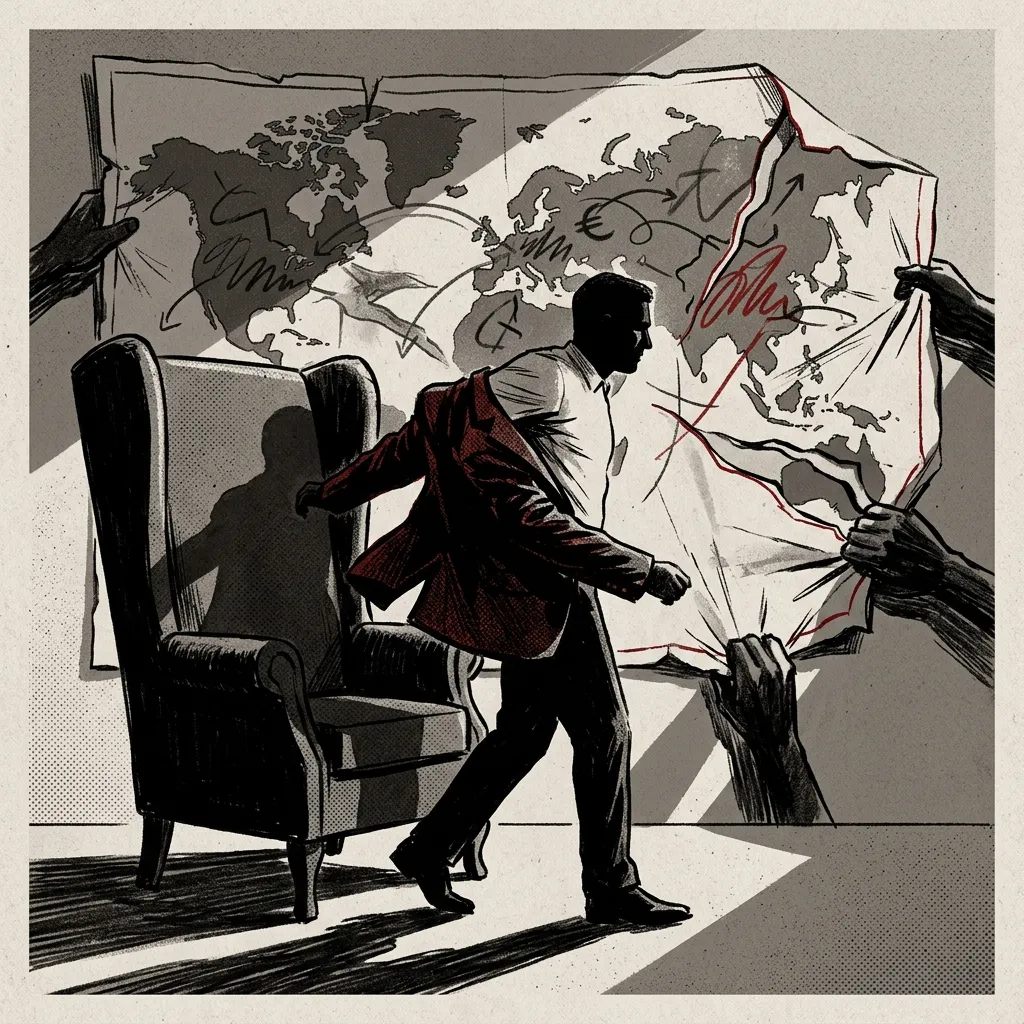
The conclusion of Jerome Powell's term as Chair of the U.S. Federal Reserve has become a focal point for discussions on central bank independence and political pressure. Powell confirmed he will step down from the chairmanship in mid-May but intends to remain on the Fed's Board of Governors, a decision that has drawn immediate criticism from the Trump administration. Global media coverage of his final policy meeting and press conference highlights divergent regional emphases, from the legal and political conflict in U.S. domestic politics to the broader implications for global economic stability.
The Hindu frames the story through the lens of a sustained political conflict, describing Powell's tenure as ending amid a legal 'battering' by the Trump administration. The Indian publication focuses on the adversarial relationship, quoting Powell's straightforward announcement about his future service as a governor. Its reporting suggests a narrative of institutional resilience under pressure, positioning the Fed's leadership as enduring significant external challenges. The emphasis is less on monetary policy specifics and more on the political drama surrounding the central bank's autonomy.
Le Monde provides two distinct but complementary angles. One article, titled "Jerome Powell's final run at the helm of the Fed," adopts a procedural and institutional tone. It notes Powell presiding over his last meeting and clarifies the statutory rules allowing him to remain on the board until 2028, framing the situation within the established legal framework of the Fed. The second Le Monde article, headlined "Trump blasts Powell staying on Fed board: 'Nobody wants him'," directly contrasts this institutional perspective with the political reaction. It reports that Powell, often at odds with the administration, cited attacks against the institution to justify his decision to stay. This creates a clear narrative tension between institutional continuity and political disapproval.
BBC News takes a broader, more analytical approach, summarizing the key themes from Powell's final press conference. It lists four takeaways: the US-Israel war with Iran, inflation, legal attacks, and the Fed's independence. By bundling geopolitical concerns with domestic economic and political issues, the BBC frames Powell's departure as a moment intersecting multiple high-stakes global narratives. The coverage implicitly connects the Fed's policy decisions and its leader's vulnerability to a wide array of international and domestic pressures, suggesting the central bank's role extends far beyond interest rates.
Framing the Conflict The sources collectively paint a picture of a pivotal transition marked by conflict, but they prioritize different elements of that conflict. The Hindu and the second Le Monde article explicitly frame the story as a battle, with Powell and the Fed's independence on one side and a hostile Trump administration on the other. Le Monde's first article and the BBC introduce more nuanced frames: one of bureaucratic procedure and legal statute, and another of a multifaceted leader grappling with a complex world. The BBC's inclusion of the US-Israel-Iran conflict as a key takeaway is particularly notable, as it expands the context of Powell's challenges beyond domestic politics to include active foreign policy crises, a connection not emphasized by the other sources.
In conclusion, the synthesis of these reports reveals that Powell's final act as chair is being interpreted as a test case for central bank independence in a politically charged era. The decision for him to remain on the board, while a minor procedural detail, has become a symbolic flashpoint. The regional divergences in coverage show how the story resonates: as a domestic political clash in U.S.-focused reporting, as a matter of institutional integrity in European analysis, and as a component of broader global economic uncertainty in international summaries. The enduring question highlighted by all framings is how the Fed navigates its dual mandate when its leadership and decisions are subject to intense political and legal scrutiny.