
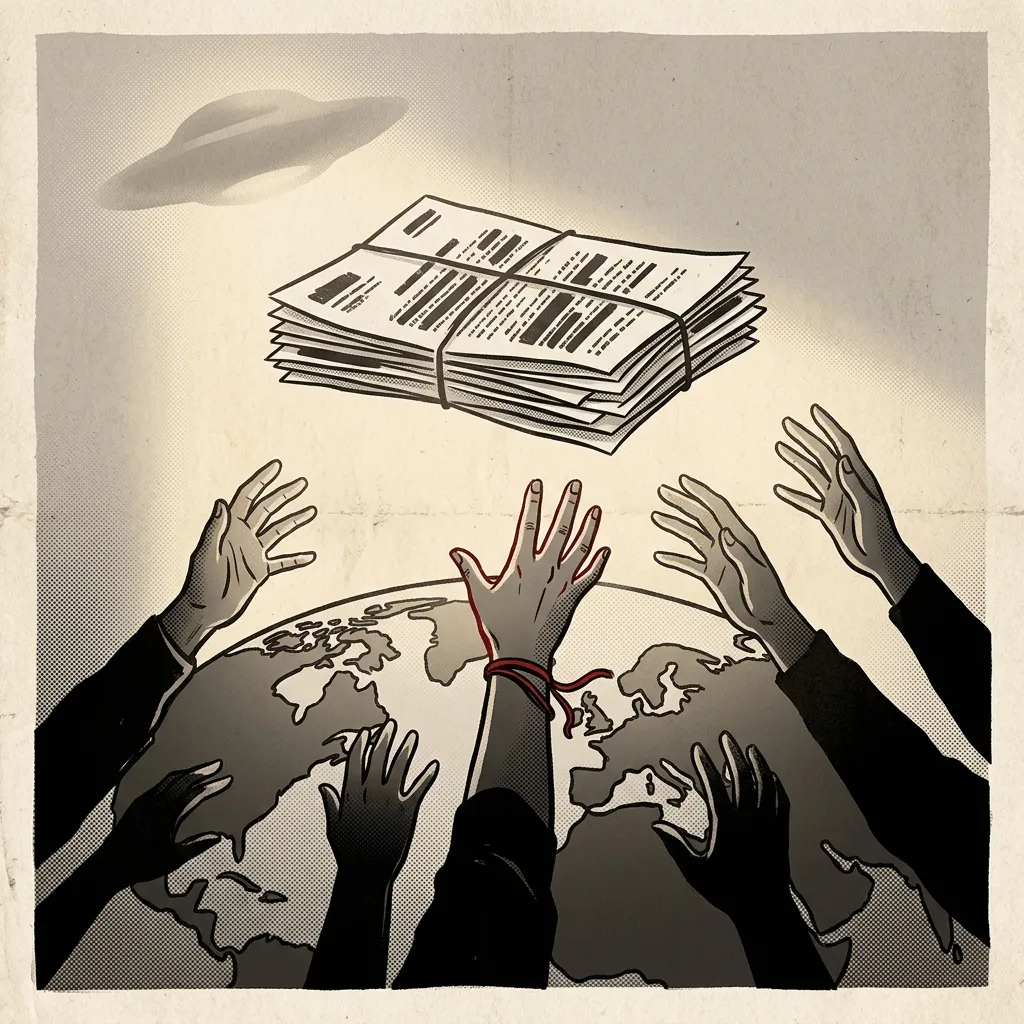
The U.S. Department of Defense has initiated the public release of previously classified documents concerning unidentified flying objects, a move framed by officials as an act of transparency. The release, ordered by President Trump earlier this year, has generated international attention, with media outlets across different regions highlighting distinct aspects of the story, from the political timing to the procedural history behind the disclosures.
Al Jazeera's coverage, based in the Middle East, places significant emphasis on the political context of the release. The report notes that President Trump ordered the disclosure in February, linking it to a period of renewed public interest in the topic. More critically, the source includes the perspective of unnamed critics who characterize the action as a potential "distraction." This framing introduces a layer of skepticism, suggesting the release could serve political purposes beyond pure governmental openness. The outlet's headline, quoting the Pentagon's phrase that the public should "make up their own minds," is presented alongside this critical counterpoint, creating a narrative that balances official statements with questions about underlying motives.
Folha de S.Paulo, a major Brazilian newspaper, reports the news with a focus on the Pentagon's own characterization of the event. The article highlights that the released materials are described by the U.S. defense department as "new, never-before-seen" files. It frames the move as being hailed by the Pentagon itself as an example of the department's commitment to transparency. However, Folha injects a pointed contextual note absent from other reports, reminding readers that this same department "expelled journalists at the beginning of this year." This juxtaposition implicitly questions the consistency and depth of the Pentagon's proclaimed dedication to open information, contrasting a current act of disclosure with a recent act of restricting press access.
The Hindu, from India, provides a more procedural and institutional account. Its reporting details the longer timeline behind the declassification effort, stating that the Pentagon has been working on this process for years. It specifically notes the creation of a dedicated congressional office in 2022 tasked with declassifying related material. This framing presents the release not as a sudden, politically driven event, but as the result of an established, ongoing bureaucratic and legislative process. The headline's focus on the public being invited to "draw its own conclusions" aligns with the Pentagon's messaging, but the body of the report grounds that message in a context of sustained official effort rather than immediate political impetus.
Framing the Disclosure The divergence in regional framing is clear. Al Jazeera constructs a narrative of political spectacle, potentially meant to divert attention. Folha de S.Paulo presents a story of official self-praise that is immediately contrasted with the institution's recent record on media freedom, casting doubt on the sincerity of the transparency claim. The Hindu, conversely, offers a more neutral, process-oriented narrative that depoliticizes the event, framing it as the latest step in a multi-year governmental project mandated partly by Congress. All three sources relay the core fact of the file release and the Pentagon's stated goal of public transparency, but they embed this fact within vastly different contexts—political strategy, institutional credibility, and administrative procedure.
In conclusion, the global reception of the Pentagon's UFO document release reveals how a single act of information disclosure is interpreted through distinct regional and editorial lenses. The underlying event remains the same, but its significance is constructed differently: as a potential political tactic, a test of institutional consistency, or a routine outcome of policy machinery. This synthesis underscores that the story is less about the content of the files themselves at this initial stage and more about the motivations attributed to the releasing authority and the historical backdrop against which the action is judged.