
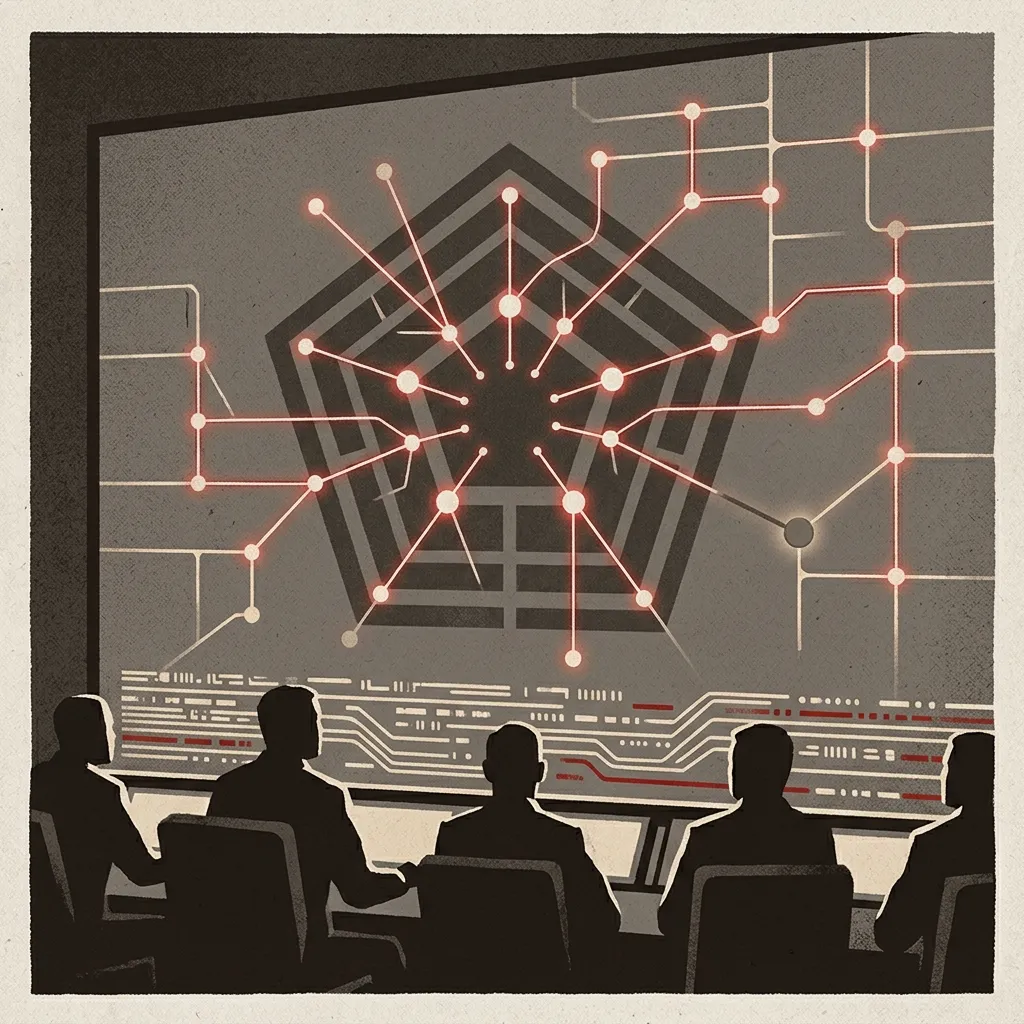
The U.S. Department of Defense has finalized agreements with several leading artificial intelligence firms to integrate their technologies into its most secure, classified networks. The initiative aims to enhance military data analysis and decision-making. The deals notably exclude the AI company Anthropic, a point of significant contention and legal dispute, highlighting a broader debate over the ethical boundaries of military AI applications.
Source Perspectives and Framing Differences
Russian state media outlet RT provides a detailed account that emphasizes internal U.S. conflict and potential risks. It consistently refers to the Pentagon as the "Department of War," a term not used in official U.S. nomenclature, which frames the institution's purpose in inherently combative terms. The report foregrounds expert concerns about AI's reliability under international humanitarian law and its potential for civilian privacy invasion. It dedicates substantial coverage to the exclusion of Anthropic, portraying it as a company penalized for its ethical stance. RT quotes the U.S. Secretary of Defense using harsh language, labeling Anthropic's CEO an "ideological lunatic," and frames the company's court challenge as a direct confrontation with the military establishment. The report links this event to a previous story about Anthropic warning of a military AI 'kill switch,' situating the current news within a narrative of corporate resistance to unchecked military power.
India's The Hindu offers a more procedural and business-oriented report. It frames the story as a significant procurement and technological development, specifying the number of companies (seven) involved. Its language is more neutral, using standard terms like "Pentagon" and "U.S. military." While it confirms Anthropic's absence from the deals, it provides less detail on the acrimony behind it, summarizing the conflict as stemming from the company's refusal to modify its AI's safety features for military use. The Hindu focuses more on the Pentagon's stated goals for the technology: to synthesize data, improve situational awareness, and aid decision-making for personnel in complex environments. It notes the agreements allow for "lawful operational use," implicitly acknowledging a legal framework, but does not delve into critiques of that framework as RT does.
Framing the Partnerships
The core factual event—the Pentagon securing AI capabilities from major tech firms—is reported by both sources. However, their framing creates divergent narratives. RT constructs a story of controversy and ethical peril. It positions the military as an aggressive entity (the "Department of War") coercing industry and sidelining dissenters who raise alarms about autonomous weapons and surveillance. This framing aligns with a broader geopolitical narrative often found in Russian media, which seeks to portray U.S. military policy as reckless and hypocritical regarding international norms.
Conversely, The Hindu presents the story as a strategic technological upgrade. The framing is that of a major military power modernizing its tools through standard contracting procedures with the private sector. The conflict with Anthropic is reported as a notable sidebar—a business and legal dispute—rather than the central theme of ethical confrontation. This reflects a more detached, technocratic perspective focused on the geopolitical and industrial implications of the U.S. military accelerating its AI adoption, potentially relevant to India's own strategic calculations.
In synthesis, the reporting reveals a fundamental split in narrative emphasis. One source emphasizes the why and the conflict—questioning motives and highlighting dissent. The other emphasizes the what and the mechanism—detailing the partnerships and their intended operational benefits. The exclusion of Anthropic serves as the pivotal point where these framings diverge most sharply: for one, it is a case of principled resistance and punitive retaliation; for the other, it is a consequential breakdown in contract negotiations due to a mismatch in requirements.
The broader implication is the global observation of the U.S. military's deepening entanglement with commercial AI. This move is watched not only for its tactical advantages but as a bellwether for how democratic states will navigate the integration of powerful, dual-use technologies developed in the private sector into national security frameworks. The intense scrutiny on the Anthropic case underscores the unresolved tension between innovation, operational demand, and ethical governance in an emerging era of algorithmic warfare.