
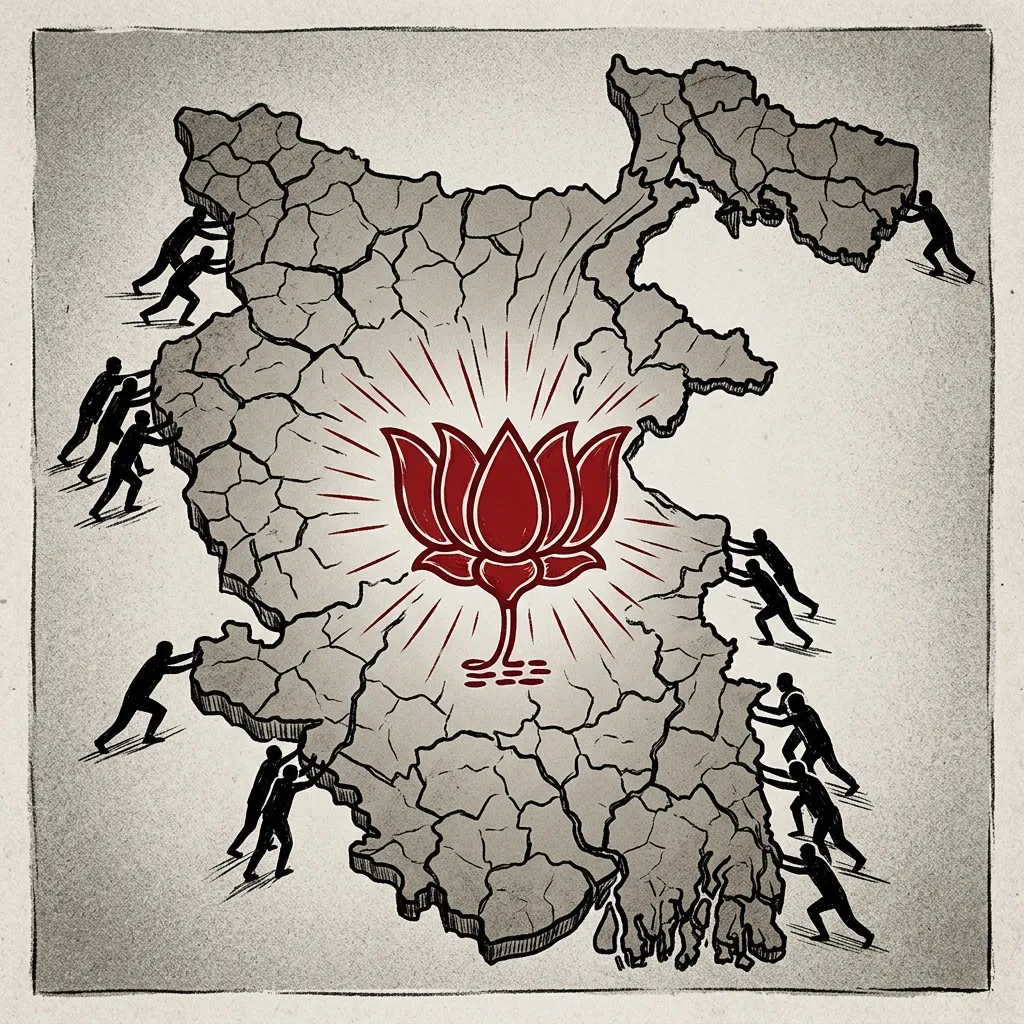
India's ruling Bharatiya Janata Party (BJP), led by Prime Minister Narendra Modi, appears poised for significant gains in the state of West Bengal, according to early electoral analysis. This development, emerging from a series of crucial state elections, is framed by international media as a potential political watershed with implications for both regional governance and the national opposition. The results, if confirmed, would mark a substantial shift in one of India's most politically entrenched regions and could reshape the balance of power halfway through Modi's third term in office.
Al Jazeera's coverage frames the event as the BJP being set to "wrest control" of West Bengal, employing language that suggests a forceful takeover from the long-dominant regional party, the Trinamool Congress (TMC). This framing presents the development as a conquest, emphasizing the BJP's expansionist political strategy and the potential displacement of an established regional force. The report positions the gain as a direct achievement of Modi's party, focusing on the act of seizing power in a historically difficult territory.
The BBC adopts a similar but more historically contextualized narrative, describing the event as the BJP "conquering Bengal." The British broadcaster explicitly labels West Bengal as "one of India's toughest political frontiers," framing the potential victory as a monumental and hard-fought breakthrough. The BBC's analysis extends the significance beyond the state, suggesting the verdict could "reshape not just the state’s politics, but the future trajectory of Modi’s BJP." This perspective places the state election within a national strategic context, implying it could alter the party's long-term direction and capacity for further expansion.
Daily Maverick, reporting from an African perspective, provides a broader electoral context. Its report notes that Modi's party was "on course to win two of four crucial state elections," with the gains in West Bengal being a central component. This framing presents the outcome as part of a wider national pattern of the BJP "expanding its influence and weakening its key rival." The source explicitly links the results to the midpoint of Modi's third term, analyzing them as a measure of the ruling party's enduring strength and its success in diminishing the principal national opposition, the Indian National Congress.
Framing the Political Shift
The sources converge on the core fact of significant BJP gains in West Bengal but differ in their emphasis and scope. Al Jazeera and the BBC focus intensely on the symbolic and strategic importance of capturing West Bengal itself, using martial language like "wrest" and "conquer." They portray it as the breaching of a final bastion of resistance to the BJP's national project. In contrast, Daily Maverick situates the Bengal result within a multi-state electoral battle, interpreting it as one critical move in a larger game to consolidate national power and weaken the primary opposition bloc. While all sources acknowledge the setback for regional and national rivals, the African outlet makes the weakening of the "key rival" a central, explicit point of its analysis.
In synthesis, the international reporting depicts the West Bengal result as a pivotal moment in Indian politics. The consensus is that it represents a major expansion of the BJP's geographical and political footprint into a region that had previously withstood its influence. The broader implication, as suggested by these framings, is a further centralization of political power under Modi's BJP, with regional strongholds becoming increasingly integrated into the party's national dominance. The elections are presented not merely as a state-level contest but as a barometer for the opposition's viability and the ruling party's momentum as it advances into its third term.