
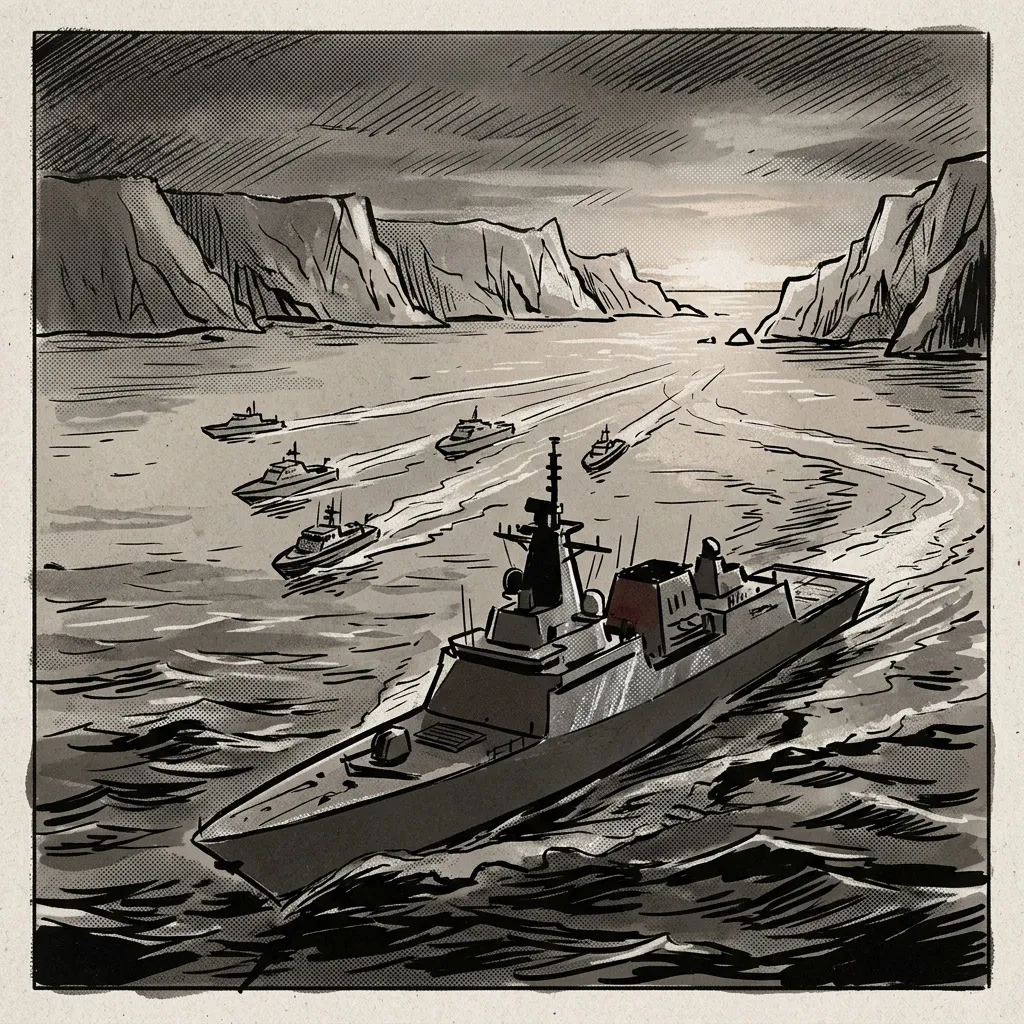
Heightened military activity in the strategically vital Strait of Hormuz coincides with a fragile diplomatic pause, as the United States awaits a formal response from Iran to a proposed deal aimed at ending regional hostilities. While official statements from Washington maintain that a ceasefire remains in effect, reports of naval clashes, a U.S.-led blockade, and accusations of truce violations paint a picture of escalating tensions that threaten to derail negotiations. The situation has triggered volatility in global oil markets and raised concerns about the security of one of the world's most critical maritime chokepoints for energy shipments.
European and U.S.-aligned media, such as Le Monde and the BBC, frame the recent violence as a sequence of action and reprisal that jeopardizes a tentative truce. Le Monde reports that U.S. fighter jets disabled two Iranian-flagged tankers, which then triggered retaliatory attacks. It notes President Donald Trump's comment about awaiting a letter from Iran, framing the military action within the context of uncertain diplomacy. Similarly, BBC News reports that President Trump asserts the ceasefire is still in place despite an exchange of fire, while also noting Iran's counter-accusation that the U.S. violated the truce by targeting an oil tanker and attacking coastal areas. This framing presents two state actors in a cycle of provocation and response, with the diplomatic channel as a fragile counterweight.
In contrast, RT, representing a Russian perspective, shifts the narrative focus to highlight Iranian resilience and alleged Western malfeasance. One report details how three Iranian oil tankers successfully bypassed what it describes as President Trump's naval "wall of steel" by using Pakistani waters to reach Iranian ports outside the Strait of Hormuz. This framing emphasizes Iran's ability to withstand a U.S.-imposed blockade, a point reinforced by citing leaked U.S. intelligence suggesting Tehran could endure the pressure for months. A separate RT report amplifies allegations of insider trading, citing an expert who claims that "suspiciously well-timed" financial bets, potentially worth hundreds of millions of dollars, have repeatedly coincided with major developments in the conflict and statements by U.S. officials. This narrative thread suggests corruption and profiteering within the Western financial system linked to the war.
Al Jazeera, based in the Middle East, provides a distinct angle by highlighting the rhetoric of U.S. officials. Its report focuses on U.S. Secretary of State Marco Rubio's defense of military actions, quoting him as saying Iranian boats firing at Americans will be "blown up." This framing spotlights the aggressive and uncompromising language emanating from Washington, which may be intended for domestic or regional audiences but also escalates the perception of imminent conflict.
Africanews offers a different point of origin for the crisis, reporting that Iran effectively seized control of the Strait after being attacked by the United States and Israel on February 28. This framing places the current Iranian posture as a reactive measure to prior Western and Israeli military action, rather than an unprovoked act of aggression. It also reports that ships remain stranded due to Iran's control, emphasizing the tangible economic and logistical consequences of the standoff.
Folha de S.Paulo and Channel News Asia contribute perspectives focused on regional economic impacts and corporate responses. The Latin American outlet confirms the U.S. is awaiting Iran's response amid military confrontations and notes new attacks against the United Arab Emirates, broadening the geographic scope of the conflict. The Asian source, Channel News Asia, reports on the practical concerns of commercial shipping, citing Japanese shipping giant Mitsui O.S.K. Lines stating its vessels did not pay fees for transiting the Hormuz Strait. This highlights the commercial uncertainties and potential for coercion or illicit charges in the waterway.
Framing the Conflict
The sources collectively describe a high-stakes environment but diverge sharply in their narrative emphasis and attribution of cause. Western sources (Le Monde, BBC) typically present a symmetrical conflict where both sides exchange fire, threatening a negotiated solution. Russian media (RT) constructs a narrative of Iranian defiance against an overbearing but potentially corrupt U.S. strategy, aiming to undermine the moral and strategic authority of Washington's position. Middle Eastern media (Al Jazeera) focuses on escalatory U.S. rhetoric, while African media (Africanews) contextualizes Iran's actions as a direct response to earlier Western attacks. Latin American and Asian sources add layers concerning regional spillover and commercial disruption, reflecting concerns about global economic stability.
In conclusion, the reporting reveals a multifaceted crisis where military posturing, economic warfare, and diplomatic signals are deeply intertwined. The core divergence lies in whether the situation is framed as a bilateral escalation imperiling peace (Western view), a story of resistance and Western hypocrisy (Russian view), a case of U.S. provocation (Middle Eastern/African view), or a source of global economic instability (Latin American/Asian view). The immediate trigger of the latest clashes is disputed, with the U.S. and Iran blaming each other for violating the ceasefire, even as their leaders signal a desire to keep negotiations alive. The outcome hinges not only on the content of Iran's awaited response but also on which of these competing narratives gains traction, influencing domestic and international perceptions of legitimacy and blame.