
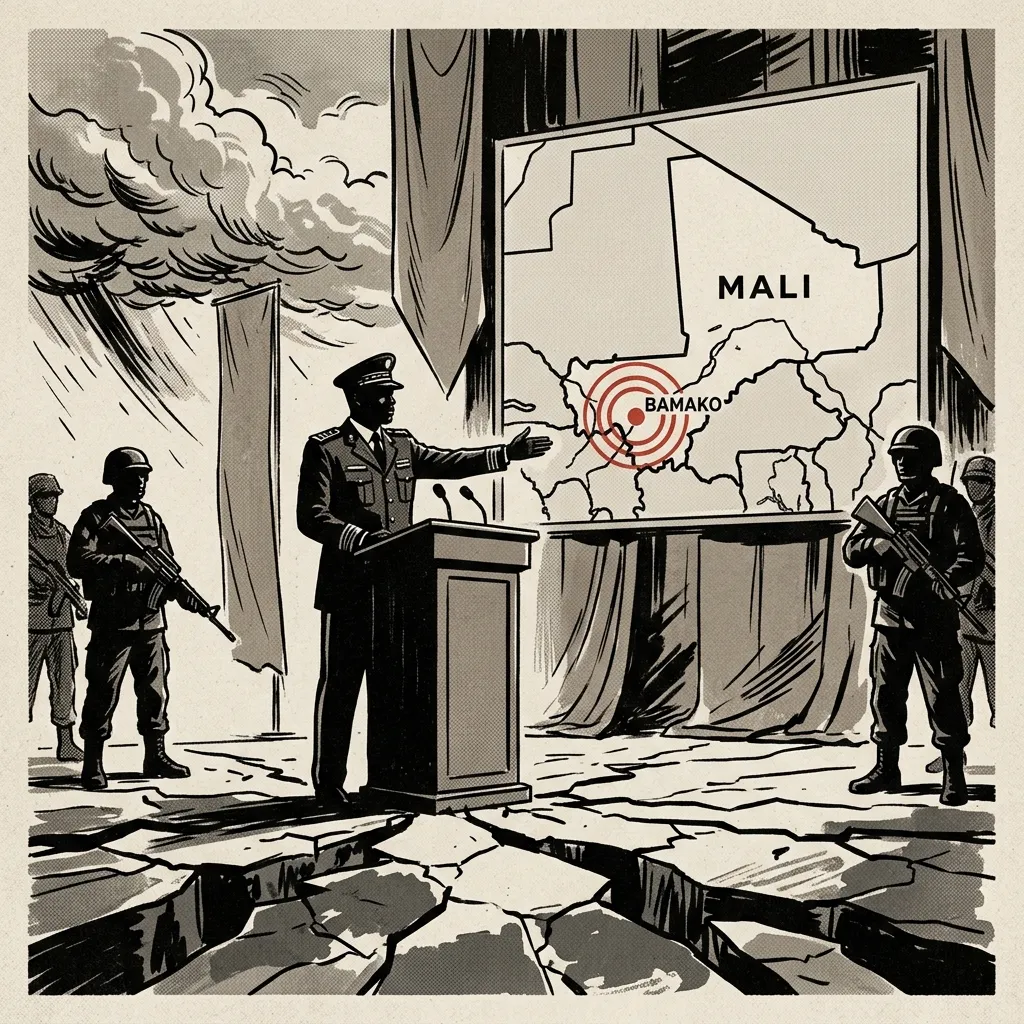
Coordinated Crisis Tests Bamako's Military Government
Mali's military leader Assimi Goita made his first public appearance since weekend insurgent attacks, meeting with Russia's ambassador on Tuesday, according to statements from his office reported across multiple outlets. The reappearance follows what Al Jazeera describes as an "alleged coup attempt," with Goita asserting the country remains "under control."
The timing of Goita's emergence coincides with an announcement by JNIM—an al-Qaeda-linked jihadist alliance—declaring a "total siege" on the capital Bamako, according to Al Jazeera's reporting. The group launched what sources characterize as coordinated attacks over the weekend, though specific details about casualties, targets, or the scale of violence differ in emphasis across reports.
Framing the Internal Threat
Sources diverge notably in how they characterize the weekend events. Al Jazeera explicitly references an "attempted coup" alongside the jihadist attacks, presenting these as potentially separate but concurrent threats to Goita's authority. The outlet quotes Goita stating Mali is "under control," framing this as a response to coup allegations specifically.
Meanwhile, African outlets Daily Maverick and Africanews focus exclusively on "insurgent" or "jihadist-separatist attacks," making no mention of any coup attempt. Daily Maverick, citing Reuters, describes "coordinated attacks" by insurgents, while Africanews refers to "large-scale jihadist-separatist attacks." Neither source suggests internal military dissent played a role in the weekend's events.
This framing difference is significant: one narrative presents a government facing external jihadist pressure and internal military fractures simultaneously, while the other depicts solely an external security crisis.
Russia's Role and Regional Dynamics
Multiple sources note Goita's choice to meet with Russia's ambassador as his first public engagement following the attacks. Neither African outlet elaborates on the significance of this meeting or what was discussed. The selection of Russia as the first diplomatic contact, however, occurs against a backdrop of Mali's military government having expelled French forces and increasingly relied on Russian military contractors—context the sources themselves do not provide but which shapes how readers might interpret this detail.
Le Monde offers a distinctly different analytical frame, positioning Mali's current difficulties within a broader regional power shift. The French publication reports that "setbacks suffered by the Bamako junta against insurgent groups have reestablished Algiers as a mediator after years of waning influence in the region." This framing emphasizes Algeria's diplomatic resurgence rather than the immediate crisis in Bamako, presenting Mali's struggles as an opportunity for Algerian regional influence.
Le Monde's characterization of Mali's leadership as a "junta" contrasts with other sources' more neutral "military government" or "military leader" terminology. The term carries connotations of illegitimacy that other outlets avoid, reflecting editorial choices about how to describe a government that took power through military overthrow.
The Siege Announcement
Al Jazeera reports JNIM's declaration of a "total siege" on Bamako, a dramatic escalation in rhetoric if not necessarily in military capability. No other source in this collection mentions this specific announcement, raising questions about whether other outlets deemed it less credible, less significant, or simply had not yet reported it at the time of publication.
The absence of detail across all sources about the weekend attacks themselves—casualty figures, specific targets, or the military response—suggests either information restrictions by Mali's government or the difficulty international media face in independently verifying events in the country.
Goita's Reappearance Strategy
Goita's days-long absence before the Tuesday meeting, noted by both African sources, appears significant enough to warrant mention but receives no interpretation. Whether this absence reflected security concerns, strategic calculation, or incapacitation remains unaddressed. His subsequent assertion that Mali is "under control" serves as the government's official narrative, though sources present this claim without independent verification of the security situation.
The military government's choice to communicate Goita's reappearance through social media posts, as reported by Daily Maverick, reflects modern crisis communication strategies but also suggests potential limitations in the government's ability to stage traditional public appearances or press conferences during the ongoing security situation.