
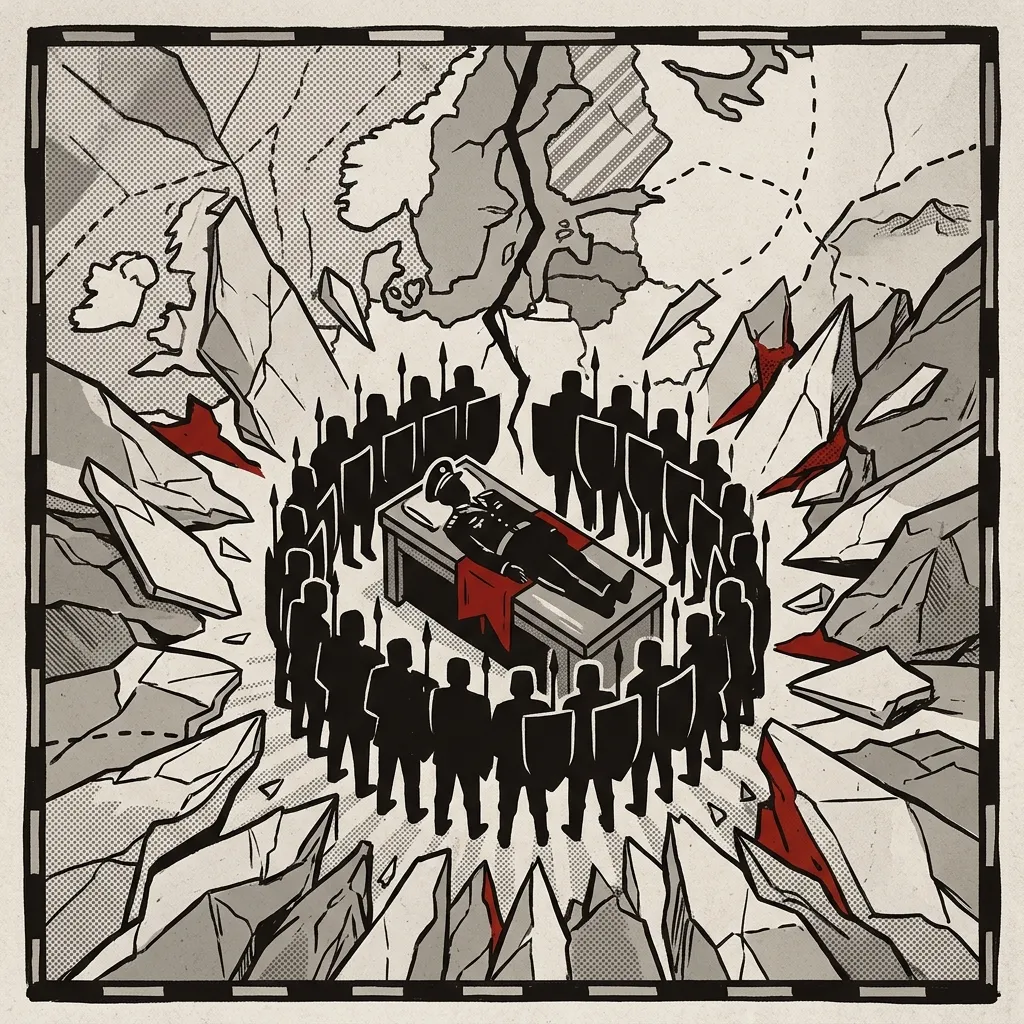
The assassination of Mali's Defense Minister Sadio Camara during a major rebel offensive has plunged the country into a deepening security crisis, marked by a tightening blockade of the capital and a high-security funeral for the slain official. The attacks, which targeted the capital Bamako and northern towns, represent a significant escalation against the ruling military junta and have prompted security alerts across the region and international reactions. Reporting on the event varies significantly, with sources emphasizing different actors—such as Russian paramilitaries, jihadist groups, or the junta itself—and framing the implications for state stability and regional security in distinct ways.
Indian and Russian Involvement The Hindu focuses on the international dimension, reporting that Moscow's Africa Corps paramilitary unit withdrew from a key northern town during the rebel assaults. The outlet notes that Russia subsequently rejected demands from the insurgents for its forces to leave the country entirely. This framing places the event within the context of great-power competition in the Sahel, highlighting the role of foreign military actors alongside the domestic threat.
Junta's Response and Funeral Africanews and AllAfrica provide detailed coverage of the junta's domestic response. They report that the funeral for Camara was held on Thursday in Bamako under exceptionally tight security, with thousands in attendance and junta leader Assimi Goita expected to preside. These sources describe the minister as having been killed in an assault on his personal residence, an attack they characterize as part of a series that has 'destabilised the army's grip on power.' This narrative centers on the state's ceremonial response and the direct challenge to the ruling military authority.
Nature of the Rebel Threat and Blockade BBC News and Le Monde offer a more detailed analysis of the perpetrators and their strategic aims. Both identify the Islamist group JNIM (Group for the Support of Islam and Muslims) as leading the offensive, with Le Monde specifying its affiliation with Al Qaeda. They report that the group has declared a formal blockade of Bamako in the days following the attacks, which included the assassination. The BBC's headline frames this as a humanitarian concern for residents ('How are we going to get back home?'), while Le Monde emphasizes the terrorist designation and notes that France has advised its citizens to leave Mali temporarily.
Regional Security Repercussions Further reporting from Africanews indicates the crisis is having immediate regional effects. It states that the ruling junta in neighboring Burkina Faso, an ally of Mali's government, has heightened security in its own capital, Ouagadougou, following the coordinated attacks. This highlights the transnational nature of the security threat in the Sahel and the potential for instability to spread across borders.
Framing the Conflict The sources collectively paint a picture of a multi-front crisis but from different vantage points. The Hindu and Le Monde frame it as an internationalized conflict: one through the lens of Russian involvement and the other through the lens of jihadist terrorism and former colonial power France's response. African outlets like Africanews and AllAfrica focus more intently on the domestic political blow to the junta and the state's funeral proceedings, while also tracking regional ally responses. The BBC straddles both, detailing the jihadist blockade's impact on civilians while noting the assassination as a key event. A critical divergence is whether the rebels are described in neutral terms ('rebels'), as part of an Islamist insurgency (BBC), or explicitly as 'terrorists' (Le Monde).
Broader Implications The synthesis of reports suggests the attacks represent a potent challenge to the Malian junta's authority, both militarily and symbolically, by striking at the heart of its security apparatus. The subsequent blockade of Bamako aims to compound the psychological and economic impact. The varied international reactions—from Russia's defiant stance to France's travel warning—underscore how the conflict is viewed through competing geopolitical lenses. Regionally, the security tightening in Burkina Faso demonstrates the contagion effect of instability in the Sahel, where militant groups operate across borders. The high-security funeral serves as a display of state resilience but also underscores the profound vulnerability of the regime.