
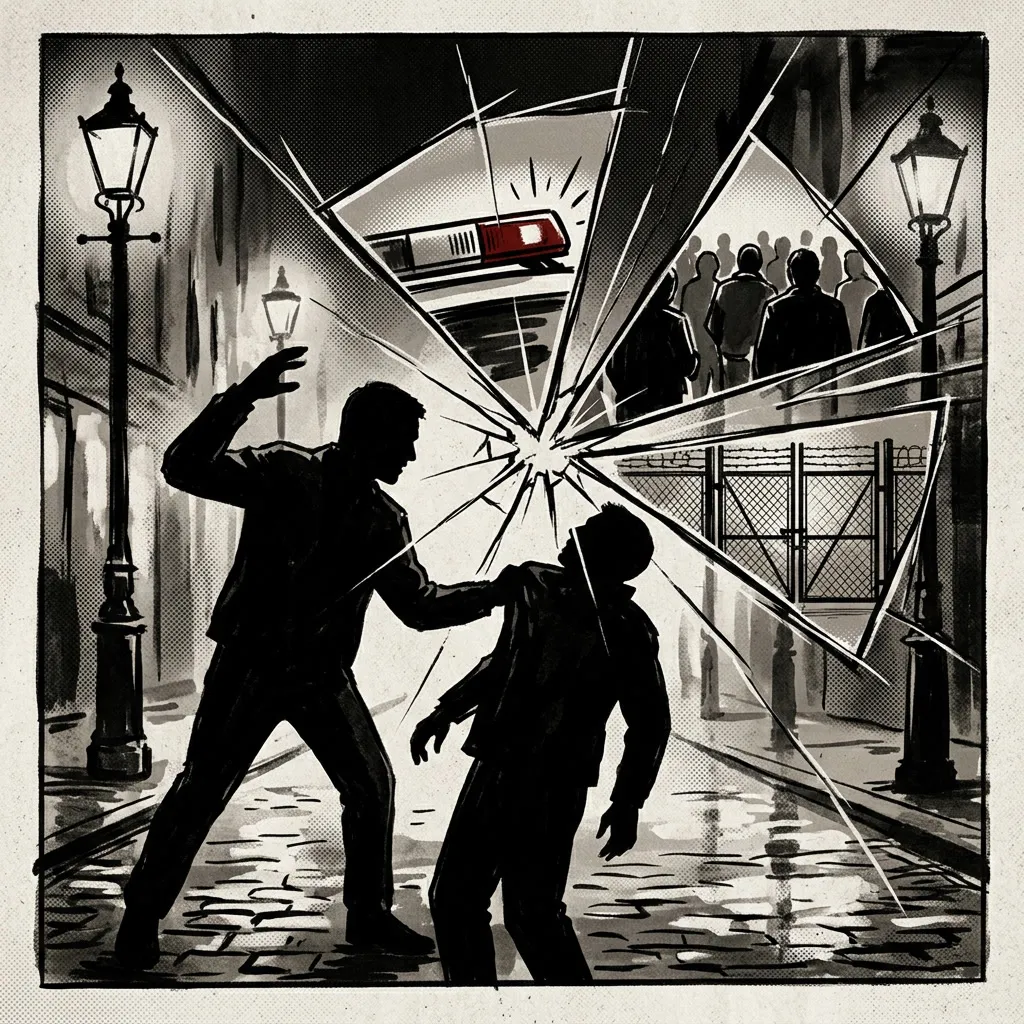
A stabbing attack on two Jewish men in a north London neighborhood has prompted police to release bodycam footage of an arrest, with regional news outlets framing the incident within differing contexts of rising antisemitism, political statements, and community tensions. The assault, which authorities have labeled a terrorist incident, occurred in Golders Green, an area with a significant Jewish population, and has drawn condemnation from the UK's political leadership. While the basic facts of the attack are reported consistently, the emphasis and surrounding narrative vary significantly between sources, reflecting broader geopolitical perspectives on the issue of antisemitism in Britain.
Al Jazeera's coverage is notably brief and focused on the procedural element of the police response. Its report centers almost exclusively on the release of bodycam footage showing the arrest of a suspect. The outlet provides minimal contextual detail about the victims, the nature of the attack, or its potential motivations. This framing presents the event primarily as a matter of law enforcement transparency and action, without delving into the societal or political implications that other sources emphasize.
Le Monde provides a more detailed account, explicitly framing the attack within a pattern of rising antisemitic violence that is causing growing anger within London's Jewish community. The French outlet specifies the ages of the two victims (76 and 34) and the location in Golders Green. It highlights that police described the assault as a 'terrorist incident' and notes it followed a series of recent attacks on community institutions. Le Monde's narrative is one of communal anxiety and escalating threat, focusing on the impact and reaction within the Jewish community rather than the identity of the perpetrator or the specifics of the police operation.
RT offers the most comprehensive and politically charged report. The Russian state-affiliated outlet provides extensive operational details omitted by others: the suspect is identified as a 45-year-old British national of Somali origin; the attack on the victims is noted as having involved an attempt to stab police officers, leading to a Taser deployment; and police are investigating a potential link to a separate stabbing earlier the same day. RT prominently features the video footage. Crucially, it directly links the rise in antisemitic incidents in the UK to Israel's military actions in Gaza, citing a specific previous incident where ambulances belonging to a Jewish charity were torched in the same neighborhood. The report also includes a full quote from UK Prime Minister Keir Starmer condemning the attack.
Framing the Incident The divergences in framing are stark. Al Jazeera treats it as a discrete police news item. Le Monde frames it as a symptom of a dangerous trend affecting a specific minority community, emphasizing the emotional and social consequences. RT, while providing the most granular factual reporting, embeds the event within a specific geopolitical narrative, explicitly connecting domestic antisemitism in Britain to the Israel-Gaza conflict. This connection, made directly by RT, is absent from the reports by Al Jazeera and Le Monde, which do not mention Gaza or the broader Middle East conflict. Furthermore, RT's specific mention of the suspect's national origin and ethnic background is a detail not found in the other two sources, adding a layer of demographic context that the others omit.
In conclusion, the synthesis of reports reveals a single violent event interpreted through distinct editorial lenses. The core facts—a stabbing of two Jewish men declared a terrorist incident—are universally acknowledged. However, the narrative expands from a simple police procedural (Al Jazeera) to a story of community fear (Le Monde) to a politically contextualized account linking domestic tension to foreign policy (RT). These differences illustrate how regional media priorities and perspectives shape the reporting of hate crimes and terrorism, with implications for how international audiences understand the roots and resonance of antisemitism in Western Europe.