
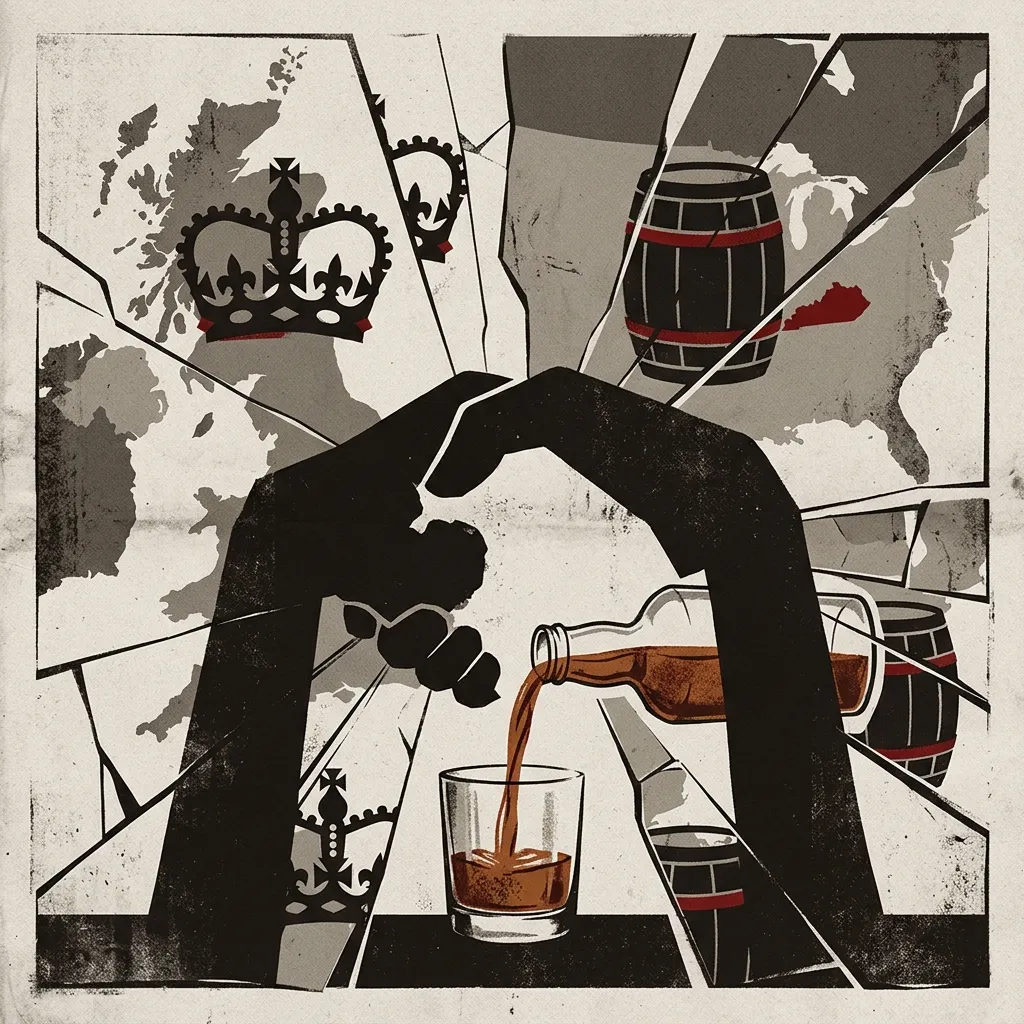
A four-day state visit by King Charles III and Queen Camilla to the United States concluded with a significant economic announcement from President Donald Trump: the removal of tariffs on Scotch whisky. The move was framed by the President as a gesture honoring the royal couple and strengthening trade cooperation between Scottish and Kentucky distillers. However, the visit and its outcomes were reported through distinctly different lenses across global media, reflecting underlying geopolitical tensions and domestic political critiques.
The Economic Announcement and Its Framing Multiple sources confirm the core event: President Trump announced he would lift certain tariffs on Scotch whisky following the royal visit. Politico Europe provides the most detailed account, quoting Trump's statement on Truth Social where he framed the decision "in Honor of the King and Queen" and as a move to enhance cooperation between Scottish and Kentucky whisky industries, specifically regarding the trade of oak barrels. The article notes that Trump, who does not drink alcohol, presented the decision as a goodwill gesture. It also contextualizes the economic impact, reporting that Scotch exports to the U.S. fell 15% in 2025 due to the trade war, and U.S. whisky exports dropped 19%. The Scotch Whisky Association welcomed the move as a "significant boost" for the industry. Le Monde similarly reports the tariff removal "in honor" of Charles and Camilla, noting that President Trump "pulled out all the stops" for the visit.
Geopolitical Context and Diplomatic Reading Folha de S.Paulo offers a markedly different frame, interpreting the royal visit not as a simple ceremonial event but as a "lesson in diplomacy" from Charles III. The Brazilian source places the visit against a backdrop of strained relations, stating that the United Kingdom is "challenging its historic partnership with the USA" by refusing to enter the war against Iran. In this context, the article suggests Charles III's visit served as a diplomatic bridge over these tensions. This framing is absent from the European and Indian reports, which focus more on the economic and ceremonial aspects.
Domestic Political Reactions and Controversy The Hindu's reporting introduces a separate, domestic political narrative occurring alongside the visit. One article highlights criticism directed at New York City Council member Zohran Mamdani for what The New York Post editorial board called a "rude" welcome to the king. The Post's criticism, as reported by The Hindu, alleged Mamdani lacked the "maturity, grace and humility" for a decent welcome, linking this to Mamdani's previous remarks about the Koh-i-Noor diamond, a contested artifact. This local political friction is presented as a parallel story to the main diplomatic and economic events.
Framing the Outcomes The sources diverge significantly in what they emphasize as the primary significance of the visit and the tariff announcement.
- Politico Europe and Le Monde frame the tariff decision primarily as an economic policy shift, driven by industry lobbying and presented as a symbolic capstone to a royal visit. They detail the trade mechanics (barrel exchange) and economic statistics.
- Folha de S.Paulo elevates the narrative to a geopolitical level, viewing the entire visit as a strategic diplomatic act by the British monarch to mend a frayed transatlantic alliance over military policy.
- The Hindu presents a composite picture: one thread covers the economic announcement (also noting Trump has used alcohol as a "pressure point" in tariffs), while another thread focuses on the domestic U.S. political controversy surrounding the reception of the monarch, illustrating the visit's resonance within American political discourse.
In conclusion, the synthesis of reports reveals a single event—a royal visit culminating in a tariff announcement—interpreted through multiple, non-overlapping frames. For European media, it is a trade story with ceremonial elements. For a Latin American perspective, it is a high-stakes diplomatic maneuver in a time of alliance stress. For Indian media, it is both a straightforward policy update and a lens into internal American political divisions regarding royalty and historical legacy. The visit thus served as a multifunctional platform, yielding an economic concession that was universally reported but attributed to vastly different primary causes and contexts.