
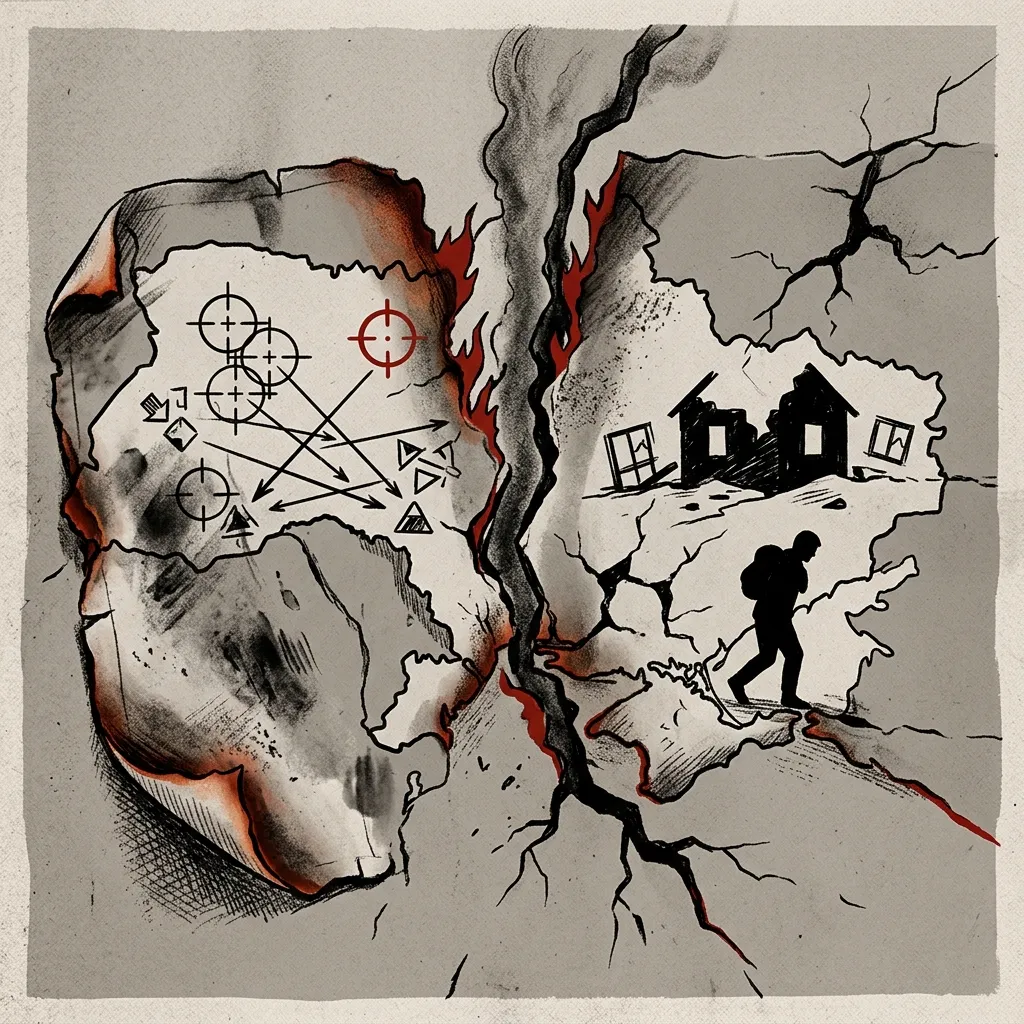
Israeli military operations in Lebanon have continued despite a declared ceasefire, with strikes targeting areas from Beirut's southern suburbs to the southern Tyre district. The attacks have resulted in significant civilian infrastructure damage, casualties, and displacement, while Israeli authorities assert they are targeting Hezbollah commanders. The reporting on these events varies significantly, with sources focusing either on the military rationale behind the strikes or the humanitarian consequences for Lebanese civilians.
RT's report frames the events primarily through the lens of civilian devastation and the violation of the ceasefire. The article, headlined "Israeli strikes devastate Lebanese cities despite ceasefire," centers on video evidence showing extensive damage to a commercial center and residential buildings in Beirut's Bourj al-Barajneh suburb and the town of Al-Saksakiyeh. It quotes local residents describing scenes of "massive destruction" and recounts an eyewitness account of people being killed by shelling while passing on a road. The report explicitly questions the timing of the attacks, stating they occurred "despite a ceasefire," and includes a link to a separate analysis titled "Israel’s assault on Lebanon: What’s really behind it," suggesting a deeper investigative angle into Israeli motives. The narrative is built on visual evidence and civilian testimony, with no mention of any Israeli military justification for the strikes.
In contrast, The Hindu's reporting provides the Israeli military's perspective, framing the Beirut strike as a targeted operation. Its headline, "Israel says it killed Hezbollah commander in first strike on Beirut since ceasefire," immediately establishes the official justification. The article presents the event as a calculated military action aimed at a specific Hezbollah figure, characterizing it as the "first strike on Beirut" following the cessation of hostilities. This framing implicitly acknowledges the ceasefire context but positions the strike as a legitimate counter-terrorism measure. The report also notes that Hezbollah has responded to Israeli actions with drone and rocket attacks, presenting a cycle of action and reaction. The focus is on the strategic objective (killing a commander) rather than the location of the strike or potential collateral damage.
Africanews provides two distinct angles, together painting a picture of the conflict's human cost. One article, "Israeli airstrike kills 4 and injures 33 in southern Lebanon despite fragile ceasefire," reports on the strike in Saksakieh (corresponding to RT's Al-Saksakiyeh) with specific casualty figures. It describes the target as a "house" and states the action has stoked "fears of renewed escalation." This report acknowledges the ceasefire but emphasizes its "fragile" nature and the concrete human toll. A separate Africanews piece shifts focus entirely to the humanitarian aftermath, detailing the lives of "displaced families" in Beirut. It highlights a volunteer barber providing free haircuts at a shoreline camp, framing this as an effort to "bring dignity" and provide "small moments of relief" to those affected by "weeks of conflict." This human-interest story abstracts from the immediate military events to illustrate the prolonged societal impact of the hostilities.
Framing the Conflict The divergence in reporting reveals a clear split between a narrative of military necessity and one of civilian suffering. RT and the casualty-focused Africanews article construct a narrative of ceasefire violation and disproportionate force, highlighting destruction in commercial and residential areas with vivid descriptions of rubble, blood stains, and abandoned belongings. The Israeli viewpoint, represented by The Hindu, constructs a narrative of precision and legitimacy, focusing on the neutralization of a Hezbollah commander as a defensive security measure. The human-interest story from Africanews introduces a third, longer-term narrative of displacement and the struggle to maintain normalcy and dignity amid ongoing instability, which is absent from the other reports.
Synthesizing these perspectives, the broader implication is a conflict where the facts on the ground—strikes occurring—are agreed upon, but their characterization is deeply contested. One frame justifies military action as a targeted counter to an armed threat, potentially acceptable even during a tense ceasefire. The opposing frame condemns the same actions as indiscriminate attacks that shatter the ceasefire and inflict severe harm on civilian populations and infrastructure. The inclusion of the displacement story further suggests that regardless of the military narrative, the conflict has created a sustained humanitarian crisis that persists beyond individual strikes. The reporting underscores the difficulty in reconciling security-focused and human-rights-focused interpretations of the same violent events.