
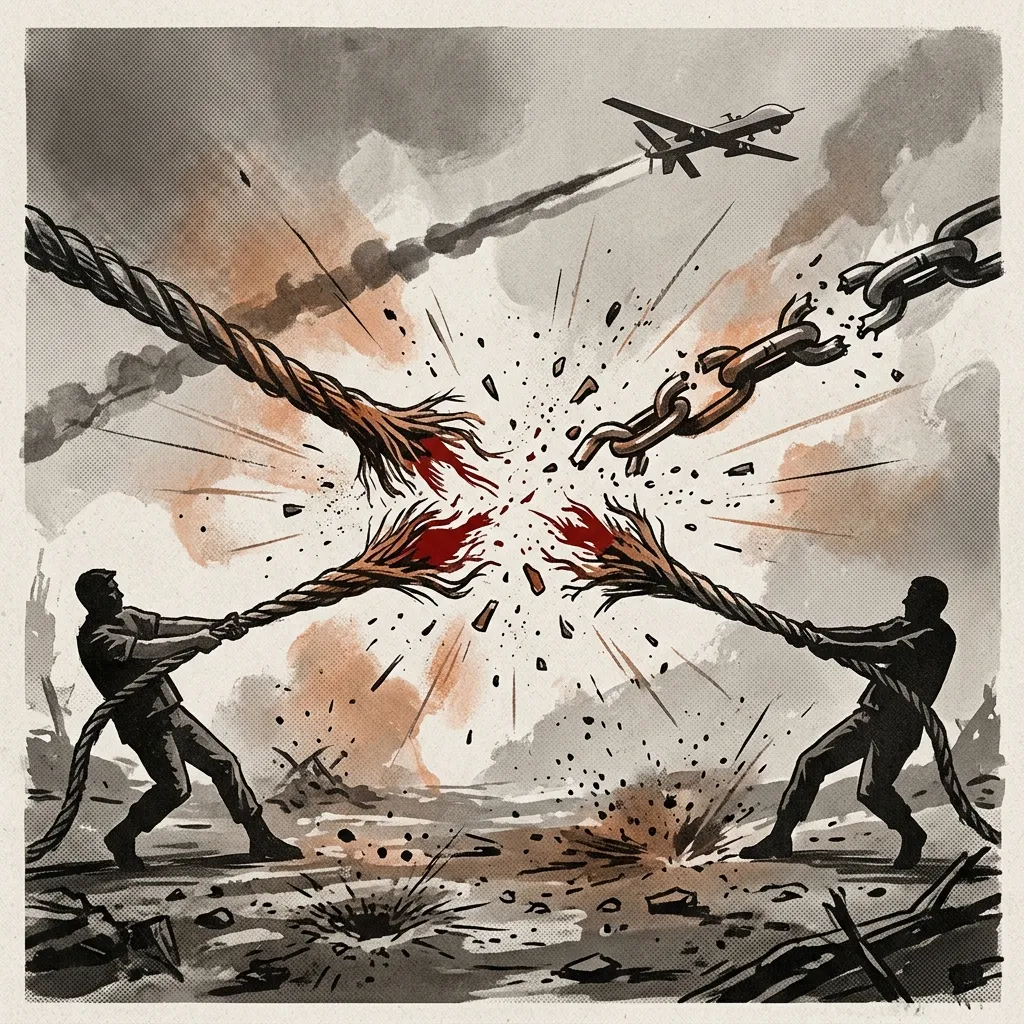
Escalating Violence Tests Fragile Truce
Violence has intensified along the Israeli-Lebanese border despite a US-mediated ceasefire that began April 16 and was recently extended through mid-May. The deadliest day since the truce began occurred Sunday, when Israeli strikes killed 14 people in southern Lebanon, according to Lebanon's Health Ministry as reported by multiple sources. The Hindu cites an AFP tally indicating at least 36 people have been killed by Israeli strikes since the ceasefire commenced.
Hezbollah Drone Attack on Israeli Forces
On Sunday, Hezbollah launched drone attacks against Israeli Defense Forces operating in the Lebanese border town of Taybeh. RT reports that the initial strike killed 19-year-old Sergeant Idan Fooks and wounded six others, four seriously. When Israeli forces dispatched a helicopter to evacuate the wounded, RT states that two additional drones targeted the evacuation operation. According to the IDF account cited by RT, one drone was intercepted while another exploded near troops and the aircraft without causing additional casualties.
The incident highlights the continued military engagement despite the nominal ceasefire, with Israeli forces maintaining operations north of the Litani River in what RT characterizes as an expanding "buffer zone" stretching approximately 10 kilometers into Lebanese territory.
Competing Narratives on Ceasefire Violations
Sources present sharply different framings of who bears responsibility for the ceasefire's deterioration. The Hindu reports that Israeli Prime Minister Benjamin Netanyahu accused Hezbollah of "dismantling" the ceasefire. The same source notes that under the truce terms, Israel "reserves the right to respond to 'planned, imminent or ongoing attacks'" and has been conducting strikes in southern Lebanon almost daily.
Al Jazeera, by contrast, reports that Hezbollah rejects Netanyahu's allegations that it is undermining the ceasefire. RT frames Israeli military activity as continued operations despite the ceasefire, describing Sunday's actions as "artillery and aerial strikes" targeting what Israel claimed were Hezbollah operatives and sites used to advance attacks against IDF soldiers.
Forced Evacuations and Destruction
Israel has issued forced evacuation orders for seven additional towns in southern Lebanon, according to RT and Al Jazeera. Al Jazeera published satellite imagery showing what it describes as the "massive scale of damage" Israeli military operations have inflicted on southern Lebanese towns. RT references a related article characterizing Israeli actions as imposing a "Gaza-style yellow zone" in southern Lebanon.
Journalist Casualties Spark International Condemnation
RT extensively covered the death of Lebanese journalist Amal Khalil, killed Wednesday in an Israeli drone strike in the village of al-Tiri. The outlet published an interview with wounded colleague Zeinab Faraj, who described how Khalil shielded her during the attack, recounting Khalil's final words: "Zeinab, I'm burning!" RT reports this is the ninth journalist killed by Israel in Lebanon since the conflict reignited, citing Lebanese authorities.
RT quotes international condemnation from Iranian and Russian officials, with Iranian Foreign Ministry spokesman Esmail Baqaei characterizing journalist killings as part of a "ruthless campaign to eradicate populations and seize land in pursuit of a colonial agenda," while Russian spokeswoman Maria Zakharova called it a "brutal killing" with "no justification." The IDF, according to RT, denied targeting journalists and stated the incident was under review.
Neither The Hindu nor Al Jazeera sources provided comparable coverage of journalist casualties in their available articles.
Ceasefire Terms Under Strain
The Hindu notes that the ceasefire terms explicitly allow Israel to respond to attacks it deems planned, imminent, or ongoing—a provision that appears central to competing interpretations of whether the truce is being violated or upheld. The frequency of Israeli strikes, described by The Hindu as occurring "almost every day," suggests the ceasefire functions more as a modified rules of engagement than a complete cessation of hostilities.