
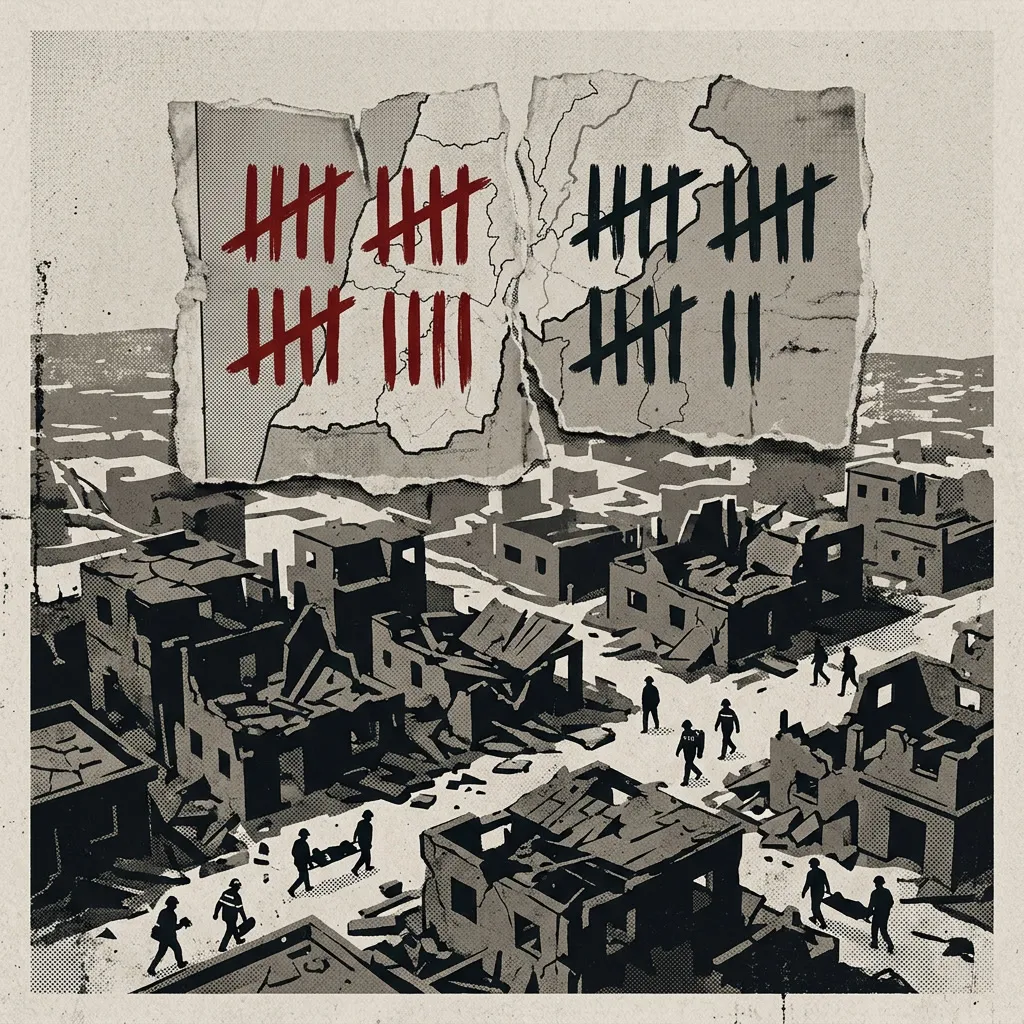
A series of Israeli airstrikes in southern Lebanon over a 24-hour period has resulted in multiple civilian casualties, according to regional reports, despite the context of a broader ceasefire. The attacks, which targeted villages including Kfar Dajal and Lwaizeh, have been reported with significantly differing fatality figures and framing by international news outlets, highlighting the ongoing volatility of the Israel-Lebanon border region.
Al Jazeera's Reporting: Emphasizing Scale and 'Devastation' Al Jazeera, a Qatar-based broadcaster, presents the incident with a focus on the scale of the military action and its human cost. Its report states that at least 41 people were killed as a result of approximately 50 Israeli airstrikes within a single day. The network's headline frames the events as a 'devastation' that 'continues under ‘ceasefire’', placing the term ceasefire in quotation marks. This linguistic choice implicitly questions the validity or reality of the truce on the ground. The report does not specify the affiliations of those killed, presenting the casualty figure as a stark total.
BBC News' Reporting: Specifying Civilian Casualties and Broader Conflict The BBC, based in the United Kingdom, provides a lower casualty figure, citing the Lebanese health ministry's report of thirteen fatalities. It specifically notes that four women and a child were among the dead, emphasizing the civilian nature of some victims. The BBC contextualizes the strikes within the wider 'fighting between Israel and Iran-backed Hezbollah', explicitly naming Hezbollah and attributing its backing to Iran. This framing directly links the local incident to the regional proxy conflict. Like Al Jazeera, the BBC notes these events are occurring 'despite a ceasefire', but without the use of skeptical punctuation.
The Hindu's Reporting: Focusing on Specific Incidents and Official Sources The Hindu, an Indian newspaper, offers the lowest fatality count, reporting seven killed. Its coverage is granular, detailing specific incidents based on reports from Lebanon's state-run National News Agency (NNA). It describes one airstrike on a car in Kfar Dajal killing two people and another on a home in Lwaizeh killing three. This approach grounds the report in specific, attributed local journalism. The headline describes the ceasefire as 'fragile', a descriptor that acknowledges its existence while underscoring its instability, differing from the more skeptical or matter-of-fact tones of the other sources.
Framing the Conflict The divergences in reporting create distinct narratives. Al Jazeera's high casualty number and framing suggest a major offensive that renders the ceasefire meaningless, focusing on the outcome for Lebanon. The BBC's narrative balances the civilian toll with the military context of Israel-Hezbollah hostilities, integrating the event into a familiar geopolitical storyline. The Hindu's account, while noting the ceasefire's fragility, prioritizes the documented details of individual strikes from an official Lebanese source, presenting a more localized, incident-based picture.
Synthesis of Broader Implications Collectively, these reports confirm that lethal airstrikes occurred in southern Lebanon during a purported ceasefire period, but they disagree fundamentally on the scale. The variance in fatality figures—41, 13, and 7—points to potential differences in sourcing, timeframes of counting, or definitions of which incidents are included. More significantly, the framing differences reveal how the event is contextualized: as a humanitarian catastrophe undermining peace (Al Jazeera), as a flare-up in a long-running state-non-state actor conflict (BBC), or as a series of tragic violations in a shaky truce (The Hindu). The coverage underscores the challenge of establishing a unified factual baseline in a conflict zone and how editorial priorities shape the perception of escalation and responsibility.