
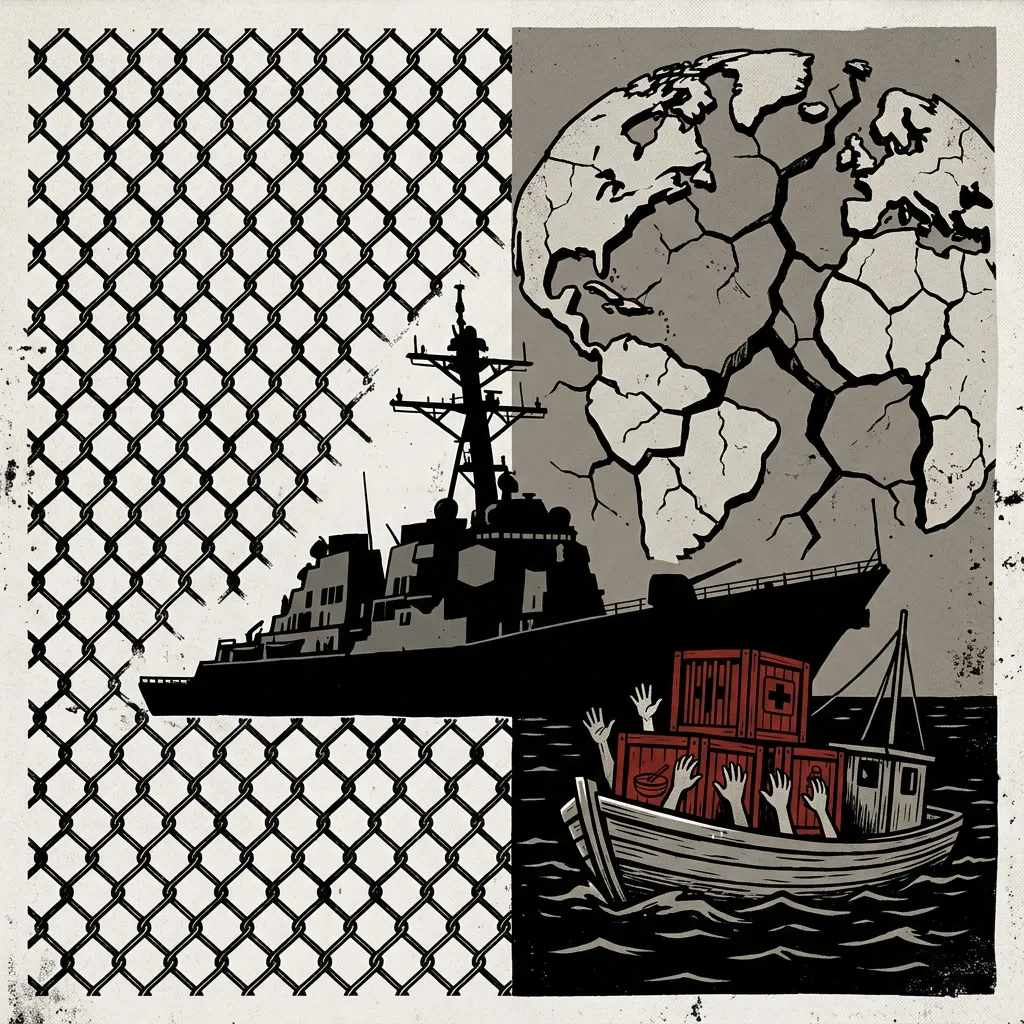
Israeli naval forces have intercepted a humanitarian aid flotilla bound for the Gaza Strip, an action that has led to the detention of activists and journalists and prompted a sharp international response. While Israel describes the operation as a necessary security measure against supporters of Hamas, a coalition of nations and advocacy groups have condemned the move as illegal, with significant differences emerging in how the event is framed across global media.
The Brazilian newspaper Folha de S.Paulo provides detailed reporting on the fate of specific detainees, focusing on the case of Brazilian activist Thiago Ávila. According to its coverage, Israeli authorities announced they would interrogate Ávila while releasing other captured activists to Greece. The report frames the incident through a national lens, highlighting the involvement of a Brazilian citizen and detailing a joint diplomatic note from Brazil and eleven other countries. This note is described as condemning the Israeli attack in the strongest terms and labeling the action as illegal. The source's framing centers on sovereign diplomatic protests and the legal status of the individuals involved.
BBC News offers a more concise, fact-oriented report that captures the opposing characterizations of the event from the primary actors. The British broadcaster notes that the organizing group, the Global Sumud Flotilla, denounced the interception as an act of "piracy." This is directly contrasted with the Israeli foreign ministry's position, which dismissed the flotilla as a "PR stunt." The BBC's reporting presents these conflicting claims side-by-side without extensive commentary, focusing on the core dispute over the mission's legitimacy and the terminology used to describe the naval operation.
In contrast, Al Jazeera's coverage adopts a more declarative and critical stance from the outset. The Middle Eastern outlet states that Israel has "provoked international condemnation" for intercepting the aid boats in international waters. This framing immediately positions the action as a transgression that has unified global criticism, emphasizing the location of the interception as a key point of contention under international law. The report's tone aligns with the perspective of the flotilla organizers and the surrounding diplomatic protests.
Russian state-funded media RT provides extensive operational details and amplifies specific accusations against Israel. Its report cites the advocacy group Reporters Without Borders (RSF), which accused Israel of "kidnapping" journalists aboard the flotilla, naming three correspondents. RT also notes a discrepancy in figures, reporting Israel's claim of detaining 175 people from 22 boats versus the organizers' claim of 211 activists being "kidnapped." The article quotes Spanish Prime Minister Pedro Sanchez accusing Israel of violating international maritime law and includes a social media post describing the operation as "piracy." It balances this by reporting Israeli Prime Minister Benjamin Netanyahu's characterization of the flotilla participants as "Hamas supporters" and the Foreign Minister's description of the action as a "PR stunt."
Framing the Conflict
The narrative divide is stark. Sources like Al Jazeera, RT, and the diplomatic coalition reported by Folha de S.Paulo frame the event as an illegal act of state aggression against a humanitarian mission and a violation of international law, with a particular emphasis on the detention of journalists and activists. The language used includes "attack," "raid," "abduction," and "piracy." Conversely, the Israeli position, reported by BBC and included in RT's account, frames the flotilla as a politically motivated provocation by Hamas sympathizers, a narrative of security necessity where the interception is a lawful defense measure. Folha de S.Paulo adds a layer of regional diplomatic action, framing the response as a collective Latin American and allied challenge to Israel's actions based on the principles of sovereignty and international law.
The synthesis of these reports reveals a fundamental clash not just over facts but over the very nature of the event. One narrative paints a picture of humanitarian activism and press freedom being suppressed by military force far from Israel's shores. The other constructs a narrative of a sovereign state defending its security perimeter from a staged political maneuver designed to undermine its blockade. The continued detention of specific individuals, such as the Brazilian activist and a Palestinian, as noted by Folha, and the journalists highlighted by RT, ensures the incident remains a live diplomatic and legal issue, extending beyond the immediate interception to questions of due process and the rights of detainees.