
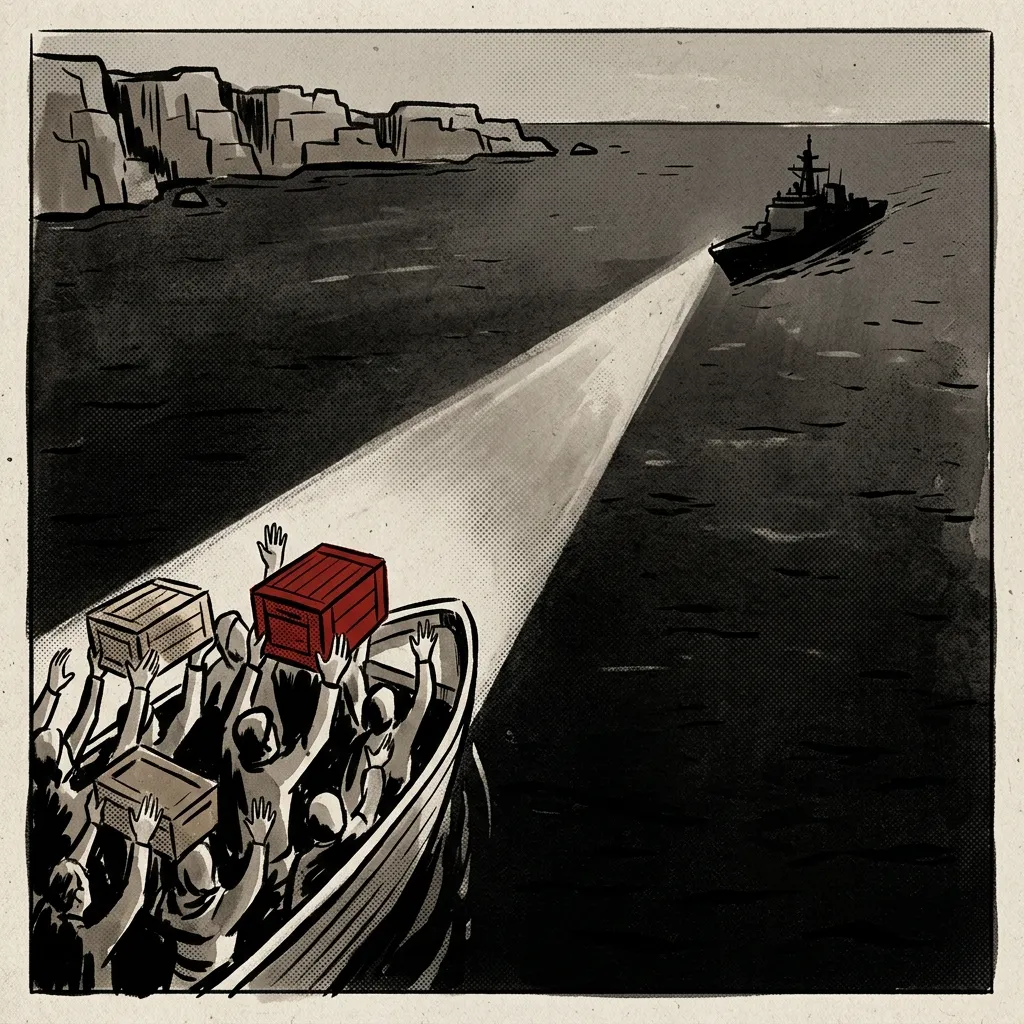
Israeli naval forces intercepted a flotilla of boats carrying humanitarian aid and activists toward the Gaza Strip near the Greek island of Crete late Wednesday, leading to the detention of scores of participants and sparking international condemnation. The incident, which occurred in international waters, has been described by organizers as a 'kidnapping' and by Israeli authorities as a lawful interception. Reports vary on the number of boats, detainees, and the treatment of those aboard, with particular focus on the detention of journalists and activists from multiple nations.
Regional Reporting and Framing
Middle Eastern coverage, led by Al Jazeera, frames the event as an act of aggression. One report quotes activist Omer Aslan condemning Israel's 'brutal attack' and vowing that it will not stop the 'Global Sumud Flotilla.' Another Al Jazeera article details the detention of its own staff, correspondent Hafed Mribah and cameraman Mahmut Yavuz, and highlights a statement from Reporters Without Borders (RSF) condemning their 'kidnapping.' This framing presents the interception as a violent suppression of both humanitarian aid and press freedom.
European reporting, represented by the BBC, adopts a more procedural tone while noting the activists' perspective. The BBC states that 'Pro-Palestinian activists say 22 boats carrying aid for Gaza were illegally intercepted in international waters.' This formulation presents the claim of illegality as originating from the activists, not as an established fact. The report focuses on the basic details: the location near Crete, the Israeli action, and the number of detainees cited by Israeli authorities (175).
Indian media, via The Hindu, explicitly contrasts the two main narratives in its reporting. The article notes that 'Gaza flotilla organisers say 211 activists ‘kidnapped’ by Israel,' while immediately juxtaposing this with the official Israeli statement: 'Approximately 175 activists from more than 20 boats... are now making their way peacefully to Israel.' The inclusion of the Israeli video showing activists aboard a naval ship is presented as part of Israel's effort to depict a non-violent transfer.
Latin American outlets focus on the nationality of detained activists, framing the event as a transnational humanitarian issue. Brazil's Folha de S.Paulo reports that 'four Brazilians participating in a new flotilla that intended to take humanitarian aid to the Gaza Strip were captured by Israeli forces.' Argentina's Clarín reports that Argentine militants from the Left Front were aboard one of the captured vessels, adding that there is 'concern for the whereabouts of some boats whose engines were disabled and were left adrift.' This coverage localizes the international incident, emphasizing the direct impact on citizens from the region and the subsequent political protests demanding their release.
Framing the Conflict
The core divergence in framing hinges on the characterization of Israel's action and the status of the detainees. Sources aligned with or reporting from regions critical of Israeli policy (Al Jazeera, Latin American press) employ language of criminality and force: 'kidnapping,' 'captured,' 'brutal attack.' They emphasize the flotilla's humanitarian purpose and the interception's location in international waters to challenge its legality. In contrast, Western and Indian mainstream sources (BBC, The Hindu) present the competing claims side-by-side, attributing the more severe allegations directly to the flotilla organizers while also relaying Israel's version, which uses passive or procedural terms like 'intercepted' and 'detained.' Israel's narrative, as conveyed through these outlets, focuses on control and order, stating the activists are being taken to Israel peacefully.
A significant sub-narrative involves the detention of journalists. Al Jazeera's report on its own staff frames this as a targeted attack on press freedom, a point amplified by the RSF condemnation. Other reports either do not mention the journalists or list them among the detained without the same emphasis on a specific principle under threat. Furthermore, the discrepancy in numbers—20 vs. 22 boats, 175 vs. 211 detainees—remains unresolved across reports, with each figure often tied to a specific source (Israeli vs. organizer).
The synthesis of these reports reveals an event interpreted through deeply entrenched geopolitical lenses. For some, it is a story of state aggression against civilian-led humanitarian relief and free press. For others, it is a maritime security operation by a state enforcing a blockade, with details contested. The regional emphasis on affected nationals in Latin America further internationalizes the incident, transforming it from a bilateral Israeli-Palestinian issue into a multilateral diplomatic concern involving several sovereign states and their citizens.