
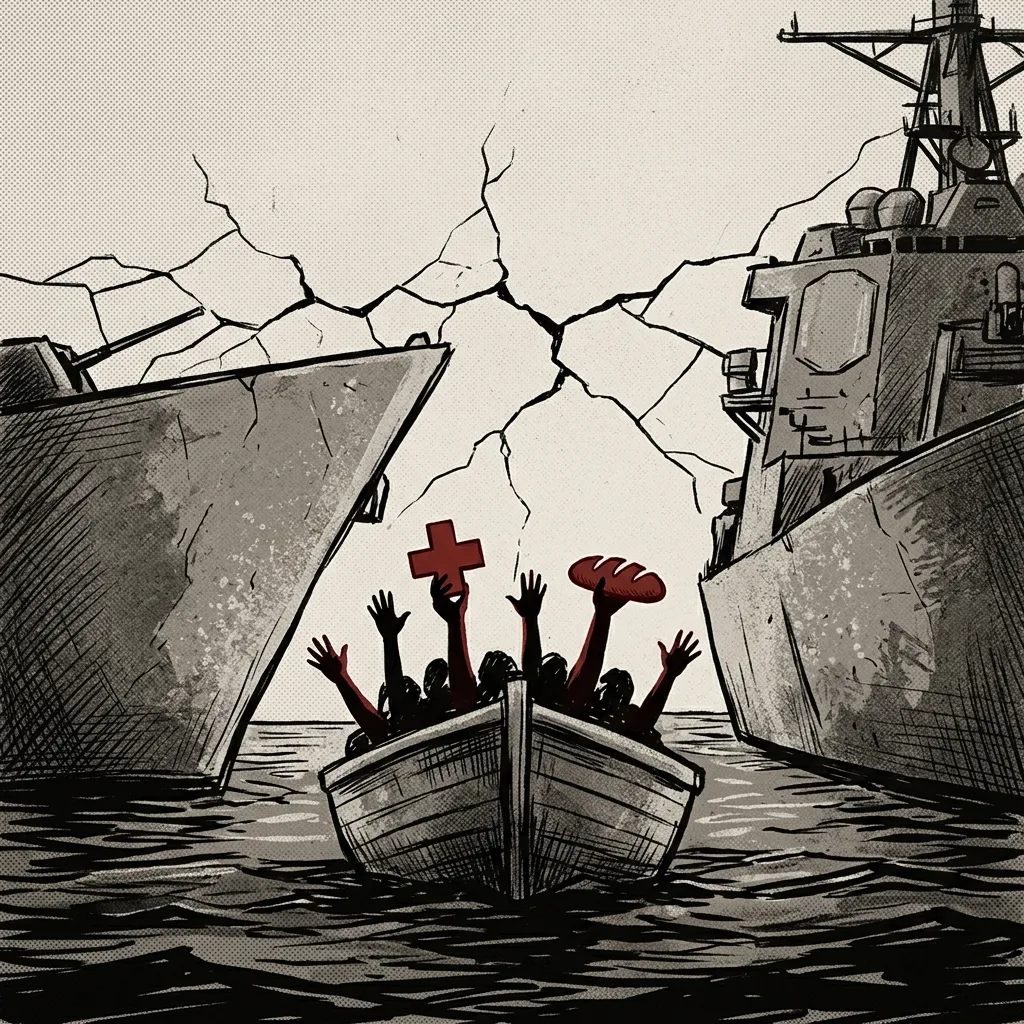
Israeli naval forces have intercepted a civilian flotilla attempting to deliver aid to the Gaza Strip, detaining activists on board. While most participants have been released in Greece, at least two individuals remain in Israeli custody for questioning. The incident has sparked international protests and sharply contrasting characterizations from the involved parties, highlighting the enduring tensions surrounding maritime access to the blockaded Palestinian territory.
The Hindu reports that Israeli authorities are taking two activists who led the flotilla to Israel for interrogation. The Indian publication notes that demonstrations supporting the flotilla participants erupted in several global capitals, including Rome, Athens, and Istanbul. This framing places the event within a context of international solidarity activism and public protest, emphasizing the widespread reaction beyond the immediate region. The report does not detail the nationalities of the detained leaders or the specific allegations against them, focusing instead on the procedural step of their transfer and the resultant global outcry.
Folha de S.Paulo provides more specific details on the detainees, highlighting the case of a Brazilian national, Thiago Ávila. The Latin American outlet states that Israeli officials announced they would question Ávila, who was captured along with other activists the previous Wednesday as they attempted to reach Gaza. The report specifies that while other activists were taken to Greece, Ávila and a Palestinian individual are being held. This framing centers on the fate of a specific citizen from the publication's region, giving the story a direct national relevance. The language used, such as "captured" and "maintains prisoners," carries a more pointed tone regarding the detention.
BBC News offers a broader overview of the aftermath, reporting that Israel has released all but two activists in Greece following the interception. The British broadcaster captures the diametrically opposed narratives from the two main sides. It notes that the organizing group, the Global Sumud Flotilla, condemned the Israeli action as an act of "piracy." Conversely, the report states that Israel's foreign ministry dismissed the entire effort as a "public relations stunt." This framing presents a balanced, he-said-she-said structure, clearly attributing the strong language to each party without editorializing on the validity of either claim.
Framing the Incident
The coverage reveals distinct regional and editorial priorities. The Hindu and BBC adopt a more detached, international-news style, with The Hindu focusing on the geopolitical reaction of protests and the BBC on the conflicting official statements. Folha de S.Paulo's reporting is more personalized and nationally focused, zeroing in on the detention of a Brazilian citizen as the core of the story. This difference illustrates how global news is often filtered through lenses of regional interest and diaspora concerns. Furthermore, while all sources report the basic facts of the interception and detentions, their chosen terminology varies. Descriptors range from the procedural "taking...for questioning" (The Hindu) and "captured" (Folha) to the highly charged accusations of "piracy" and "PR stunt" reported by the BBC.
The synthesis of these reports underscores that the event is not merely a naval interception but a symbolic clash over the narrative of humanitarian access and Israeli security. The detention of specific activists, particularly those with foreign citizenship, internationalizes the conflict and draws diplomatic attention. The protests reported from European capitals indicate the flotilla's role in mobilizing pro-Palestinian solidarity networks. Israel's decision to release most participants in Greece, rather than detaining them all, suggests a calibrated response aimed at managing international backlash while asserting its naval blockade. The enduring detention of two individuals signals an intent to pursue legal or investigative action against what it perceives as the organizers or more significant figures in the effort.
Ultimately, the incident reinforces the entrenched stalemate over Gaza. Aid flotillas have long served as tools to challenge the blockade and draw global media attention to conditions within the territory. Israel consistently frames such missions as breaches of its lawful security perimeter and potential conduits for smuggling weapons. The divergent media framings reflect this fundamental disagreement: is this a story about humanitarian activists being detained, or about a state enforcing its security protocols against a provocative stunt? The answer depends largely on the source, highlighting the deep political fissures that continue to define the conflict.