
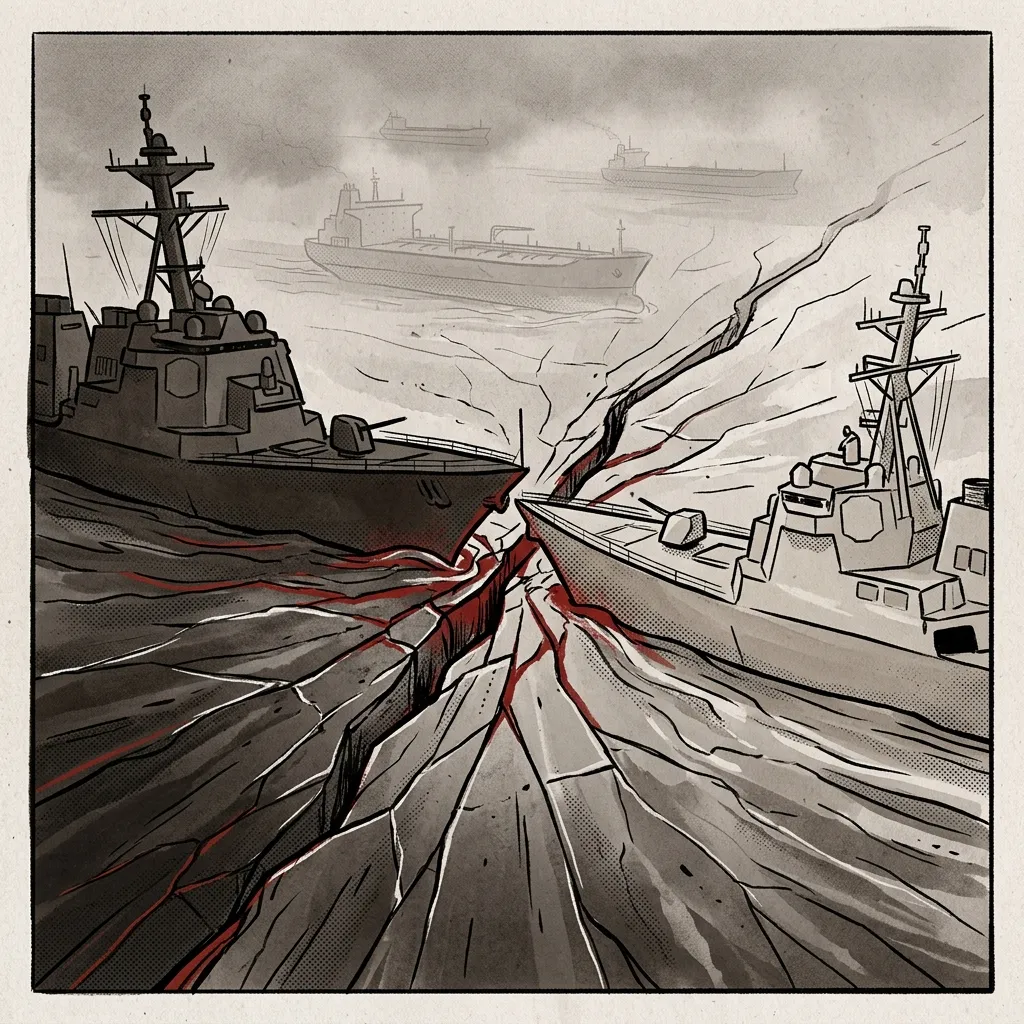
A maritime confrontation in the Strait of Hormuz has sparked a war of words between Iran and the United States, with each side offering contradictory accounts of an alleged naval clash. The incident occurs against a backdrop of heightened regional tensions and a new U.S. initiative aimed at securing the critical waterway, threatening to derail broader diplomatic efforts. Reports from regional and international sources present starkly different narratives, focusing on claims of Iranian naval action, American denials, and the strategic implications for global oil transit.
According to a report from Al Jazeera, Iranian authorities assert that their naval forces successfully compelled a U.S. warship to alter its course and retreat from the Strait of Hormuz. This narrative frames the event as a demonstration of Iranian sovereignty and military capability in its coastal waters. In direct contradiction, the same source notes that Washington has firmly rejected the claim of any such clash occurring, presenting the U.S. position as one of denial and dismissal of Tehran's account. This initial report centers the story on the immediate, disputed incident without extensive contextual background.
Broader coverage from Al Jazeera expands the frame to situate the naval allegation within escalating geopolitical friction. It reports that the U.S. military is actively encouraging commercial vessels to transit the strait, a policy presented as an effort to maintain freedom of navigation. Iran, however, counters this by stating it maintains full control over the strategic waterway. This framing sets up a fundamental conflict over the right to control and patrol the strait, characterizing the U.S. encouragement as a challenge to Iranian authority. Furthermore, another Al Jazeera report links the Strait of Hormuz tensions to a separate, ongoing conflict, noting that Israeli military actions have resulted in a significant number of casualties in Lebanon. While not directly about the U.S.-Iran clash, this inclusion implicitly contextualizes the strait incident within a wider regional atmosphere of violence and confrontation, suggesting interconnected fronts of instability.
Reporting from The Hindu introduces a significant new element: a formal U.S. policy initiative. The Indian publication states that former U.S. President Donald Trump announced a mission dubbed 'Project Freedom' via social media. The stated objective of this project is to facilitate the passage of vessels that are currently impeded from moving through the Strait of Hormuz. This framing presents the U.S. action not merely as a reactive military posture but as a named, strategic campaign with the explicit goal of opening the sealed waterway. The report also mentions that Iran has struck ships, directly attributing aggressive actions to Tehran as the cause for the maritime blockage that 'Project Freedom' aims to resolve.
Framing the Confrontation The sources collectively paint a picture of a crisis with multiple, conflicting layers. The core factual dispute remains unresolved: Iran claims a victorious naval engagement, while the U.S. denies it happened. Beyond this, the framing diverges significantly in scope and blame. Al Jazeera's coverage emphasizes a tit-for-tat exchange of threats and a struggle for control, while also weaving in the context of other regional conflicts, notably the Israel-Lebanon hostilities. This creates a narrative of a broadly destabilized Middle East. In contrast, The Hindu's report focuses on a specific U.S. policy response ('Project Freedom') to a problem it explicitly attributes to Iranian aggression ('Iran strikes ships'). This framing presents a more linear cause-and-effect story: Iranian actions create a blockade, prompting a defined U.S. counter-initiative.
The implications of these diverging narratives are profound for international perception and policy. If the incident is viewed primarily through the lens of Iranian provocation and U.S. counter-measures, it supports arguments for a more assertive Western military presence. If it is framed as one flashpoint in a complex web of regional wars and sovereignty disputes, it complicates unilateral action and highlights the risk of a broader conflagration. The introduction of a named U.S. 'Project' suggests a potential escalation from sporadic clashes to a sustained campaign, which Al Jazeera's reporting warns is pushing a fragile ceasefire 'to the brink.' The stability of global energy markets, dependent on the free flow of oil through the strait, hangs in the balance between these competing narratives of control, aggression, and response.