
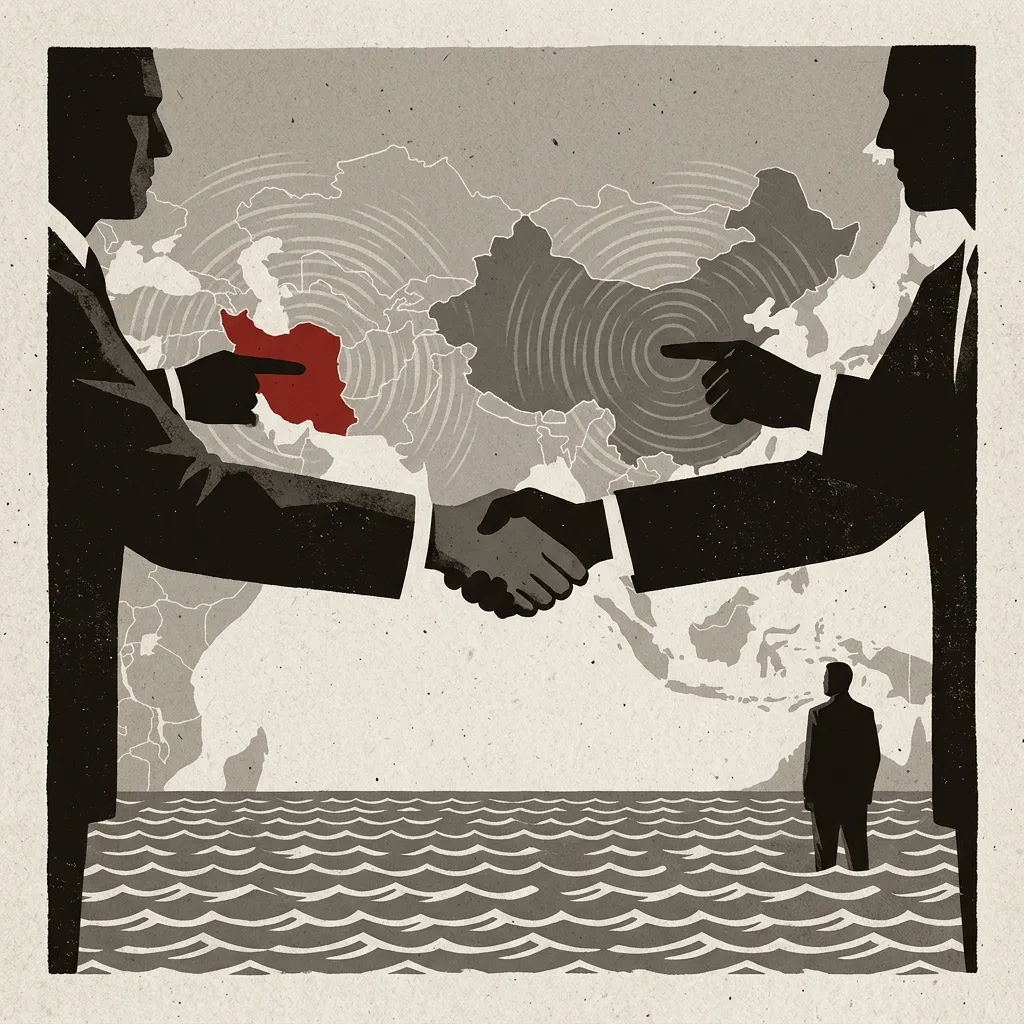
Iranian Foreign Minister Abbas Araghchi met with Chinese State Councilor and Foreign Minister Wang Yi in Beijing, with all reports noting the diplomatic encounter occurs one week before a scheduled visit to the Chinese capital by U.S. President Donald Trump. The timing of the talks, against a backdrop of regional tensions and major power diplomacy, has drawn international attention, though the available source material provides limited detail on the substance of the discussions.
Al Jazeera, a major Middle Eastern broadcaster, frames the meeting in a straightforward geopolitical context, highlighting the proximity to President Trump's upcoming trip. The report positions the encounter as a notable event in the diplomatic calendar, implicitly suggesting a connection between Iranian outreach to China and the shifting dynamics of U.S.-China relations. The framing is neutral but situates the story within the broader narrative of Middle Eastern powers navigating relationships with global superpowers.
The Hindu, an Indian mainstream publication, offers a similar factual baseline but provides slightly more granular detail, specifying the visit as a "one-day trip" and noting the exact dates of the planned Trump-Xi summit on May 14 and 15. This additional precision underscores the calculated timing of the Iranian diplomat's journey. The report's context, described as occurring "amid West Asia crisis," subtly links the meeting to ongoing regional instability, a framing that resonates with India's strategic interests in the area. The report maintains a factual tone but, by invoking the regional crisis, implies the talks likely covered security and diplomatic coordination.
Channel News Asia (CNA), an Asian mainstream source, headlines its brief report by emphasizing the Chinese foreign minister's role in initiating the meeting. This framing centers China's diplomatic agency, presenting Beijing as an active host managing multiple strategic relationships. While CNA's provided content snippet is minimal, its chosen headline suggests a narrative where China is proactively engaging with key partners like Iran amidst a busy period of great power diplomacy, rather than merely reacting to Iran's diplomatic overtures or the impending U.S. visit.
Framing the Encounter
Analyzing the framing differences reveals distinct regional emphases. Al Jazeera presents the meeting through a lens of global power diplomacy, where Iran's actions are interpreted in relation to U.S. movements. The Hindu injects a layer of regional security context ("West Asia crisis"), connecting the bilateral talks to immediate geopolitical tensions beyond just the U.S.-China dynamic. Channel News Asia, meanwhile, focuses on China's diplomatic posture, framing the event as part of Beijing's orchestrated engagement strategy. All sources agree on the core fact—a meeting timed ahead of Trump's visit—but their narrative starting points differ: one highlights Iran's agenda, another the regional backdrop, and the third China's active diplomacy.
In synthesis, the reports collectively depict a moment of calibrated diplomatic signaling. The convergence of Iranian and Chinese officials just days before a major U.S.-China summit suggests an effort to affirm bilateral ties and potentially coordinate positions ahead of discussions that will inevitably touch on issues like the Iranian nuclear file and regional security. While the public readouts are sparse, the timing itself becomes the primary message, indicating to Washington and other observers the strength and priority of the Tehran-Beijing relationship. This diplomatic choreography underscores how secondary bilateral meetings can serve as strategic markers within a more complex great power triangle, influencing perceptions and negotiations on the eve of high-stakes engagements.