
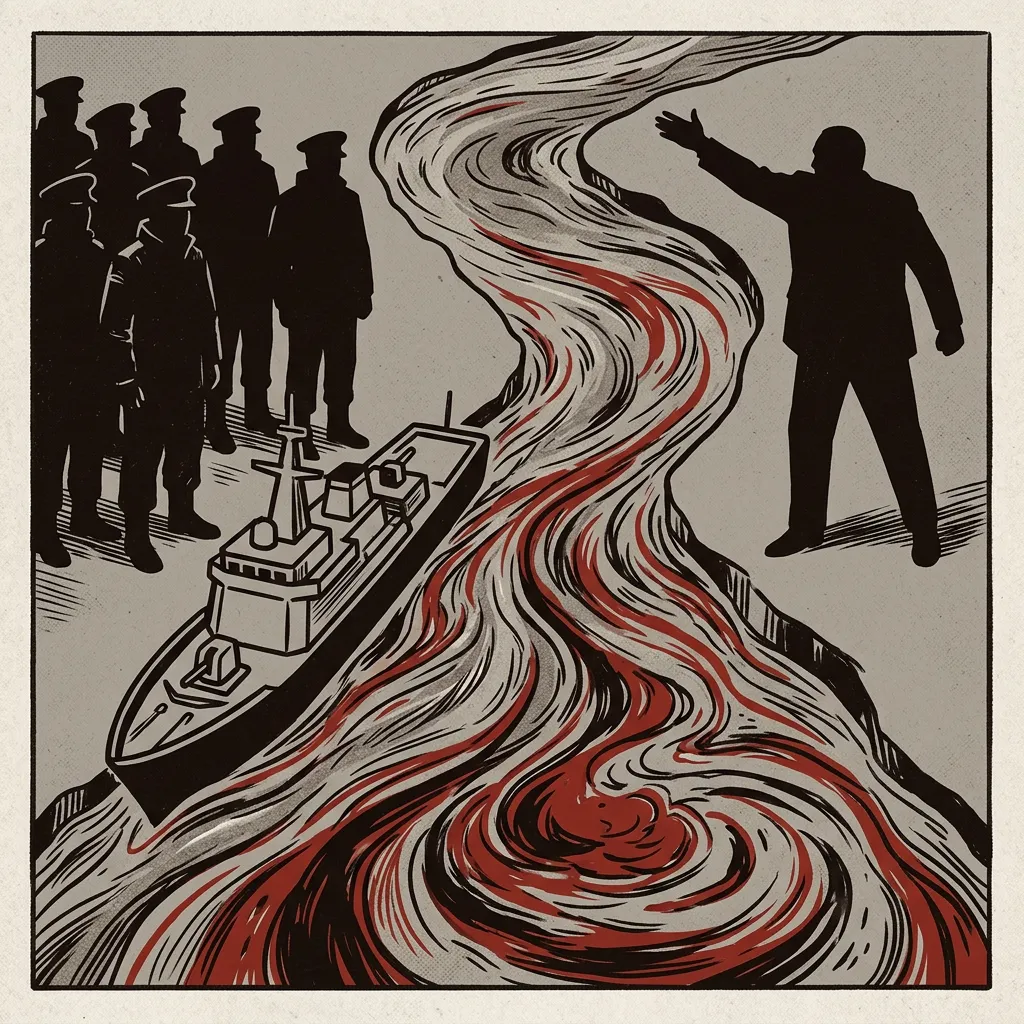
Tensions surrounding the strategic Strait of Hormuz have escalated, with the United States pursuing a new international coalition to secure the waterway while Iran asserts its own authority to impose "new rules." The standoff, driven by a spike in global oil prices and stalled negotiations, reveals sharply divergent narratives about the source of regional insecurity and the legitimacy of external military intervention.
Reports from Folha de S.Paulo and The Hindu confirm that the U.S. State Department is actively attempting to form a multinational coalition. This effort, detailed in a diplomatic cable obtained by Reuters, is framed as a response to soaring crude prices and the risk of prolonged supply disruptions. The initiative, referred to in other reports as the Maritime Freedom Construct (MFC), aims to "restore freedom of navigation" and protect the global economy from Iranian obstruction. The Hindu adds a critical military dimension, reporting that U.S. President Donald Trump is scheduled for a briefing on potential fresh military strikes against Iran, intended to pressure Tehran in nuclear negotiations.
In stark contrast, The Hindu's reporting on Iran's position, citing Mojtaba Khamenei, presents a counter-narrative. Iran vows to protect its nuclear and missile capabilities and frames the U.S. military presence as the "most important factor of insecurity" in the region. Tehran positions itself not as an obstructer but as the legitimate security guarantor for the Persian Gulf, announcing it will implement new rules to manage the Strait. This source also notes that Iran submitted a fresh proposal to reopen the strait, which was reportedly dismissed by Trump as not being in good faith.
The international response to the U.S. coalition-building effort is mixed, as reflected in regional coverage. Daily Maverick reports that Lithuania's president supports joining the U.S. freedom of navigation mission and will propose it to the country's defence council, indicating potential European participation. Conversely, RT provides a critical view of the U.S. plan, emphasizing that the proposed Maritime Freedom Construct explicitly excludes "adversaries" Russia and China. This Russian source frames the initiative as a "loosely defined" construct for "controlling" the strait, managed jointly by the State Department and the Pentagon, and characterizes it as an effort to "impose meaningful costs" on Iran.
A notable and symbolic event is reported by Folha de S.Paulo, which details that President Trump republished a social media image renaming the Strait of Hormuz the "Strait of Trump." This act, while not a policy declaration, adds a layer of personal and provocative rhetoric to the diplomatic and military maneuvering.
Framing the Conflict
The sources frame the core conflict in fundamentally different ways. U.S.-aligned and economic-focused reports (Folha de S.Paulo, Daily Maverick, The Hindu on U.S. actions) present the situation as a crisis of global economic security, necessitating a collective international response to counter Iranian actions that threaten freedom of navigation. The proposed coalition is framed as a defensive, stabilizing measure for the global economy.
Iranian and Russian-aligned sources (The Hindu on Iran's stance, RT) invert this narrative. They frame the U.S. and its allies as the primary agents of instability and escalation. From this perspective, U.S. coalition-building is an act of aggression and an attempt to exert control, which justifies Iran's move to assert sovereign management of adjacent waters. The exclusion of Russia and China from the U.S. plan is highlighted to frame it as a divisive, non-inclusive bloc strategy rather than a genuine global effort.
The synthesis of these reports indicates a dangerous deadlock. One side views coalition-led military pressure as a necessary tool to force diplomatic concessions on nuclear issues and secure trade routes. The other side views that same pressure as an existential threat that validates military preparedness and regional hegemony. The gulf between these narratives, compounded by provocative political rhetoric and the immediate economic shock of rising oil prices, leaves little apparent room for a negotiated off-ramp, setting the stage for further escalation in one of the world's most critical maritime chokepoints.