
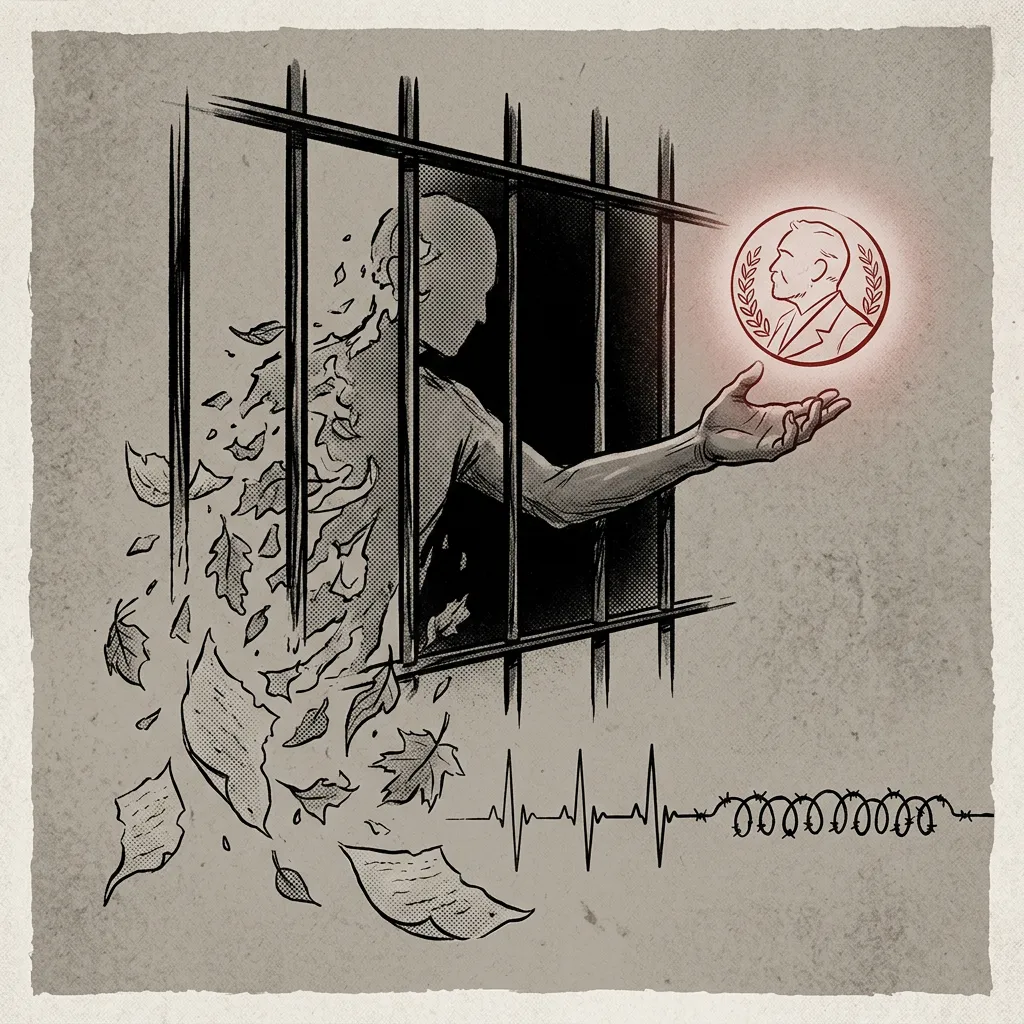
The deteriorating health of imprisoned Iranian Nobel Peace Prize laureate Narges Mohammadi has prompted renewed international scrutiny of Iran's treatment of political dissidents. Mohammadi, a prominent human rights activist, was transferred from prison to a hospital following what her family describes as a severe medical crisis. Reports indicate she has suffered significant weight loss, episodes of unconsciousness, and a cardiac event. Her family is urgently requesting her transfer to a hospital in Tehran for specialized care, highlighting concerns about the adequacy of medical attention in the provincial facility where she is currently held.
Latin American outlets provide detailed accounts of Mohammadi's physical decline. Clarin reports that the activist was detained in December for criticizing the Tehran regime and has since lost 20 kilograms. The source states she experienced two episodes of loss of consciousness and a cardiac crisis, framing her situation as a direct consequence of her imprisonment following political criticism. Similarly, Folha de S.P. Paulo describes her health condition as unstable and cites the foundation run by her family, which characterized the situation as a "catastrophic deterioration." This source explicitly lists the same specific medical incidents: two complete losses of consciousness and a severe heart crisis. Both Latin American sources emphasize the causal link between her detention for activism and the subsequent health emergency, presenting it as a grave outcome of state repression.
The BBC News report from Europe adopts a more measured tone, focusing on the expressions of concern rather than detailing the specific medical allegations. It notes that her family stated she was taken to a local hospital after a sharp deterioration in her health. The BBC does not enumerate the specific medical episodes reported by the Latin American sources, such as the weight loss or cardiac crisis, nor does it explicitly reiterate the reason for her initial detention. This framing presents the story as an update on a worrying situation concerning a high-profile detainee, without delving into the potentially contentious specifics of her medical state or the political context of her imprisonment.
Framing the Conflict
The reporting diverges primarily in the level of detail attributed to Mohammadi's family and associated foundations versus the more restrained presentation from established global news services. Clarin and Folha de S.P. Paulo actively incorporate the claims made by Mohammadi's support network, presenting them as factual descriptions of her condition. They use strong descriptors like "critical state," "catastrophic deterioration," and tie her health directly to her arrest for criticizing the government. This framing constructs a narrative of state responsibility for a humanitarian crisis. The BBC, while conveying the family's concern, reports the deterioration without adopting the same vivid terminology or explicitly linking it to the political nature of her incarceration. This difference suggests varying editorial approaches to handling claims from activist groups versus maintaining a more distanced reportorial stance.
A broader implication of these reports is the ongoing international spotlight on Iran's human rights record, particularly regarding the treatment of award-winning dissidents. Mohammadi's Nobel Prize status amplifies the story, ensuring global media coverage. The divergence in reporting detail may reflect regional editorial sensitivities or differing levels of access to sources close to the activist. Ultimately, all sources converge on the central fact of a serious health emergency requiring hospital transfer, but they paint contrasting pictures of severity and direct causation. This event underscores the challenges of reporting on imprisoned activists in jurisdictions where independent verification of medical conditions is difficult, leaving media reliant on statements from families and advocacy groups, which are then framed according to each outlet's editorial posture.