
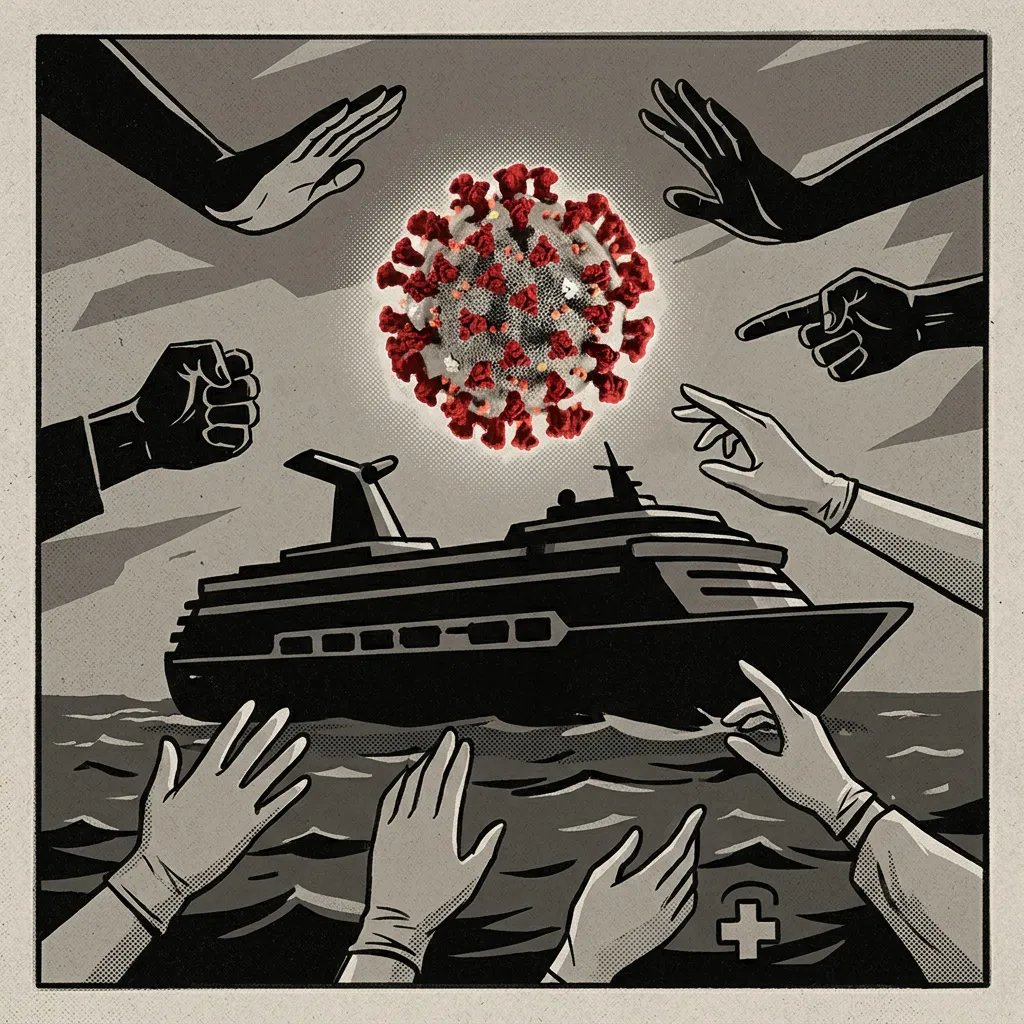
An outbreak of the Andes strain of hantavirus aboard the cruise ship MV Hondius has triggered a multi-national health response and exposed political tensions over port access. The incident, involving confirmed cases among passengers, has led to evacuations and prompted investigations into the virus's origins while global health authorities seek to balance public concern with assessments of limited pandemic risk.
Initial reports centered on the identification of the virus and its transmission potential. The Hindu and Le Monde provided specific virological details, noting that the Andes strain, primarily found in South America, had been identified in patients from the ship and is capable of human-to-human transmission via saliva droplets. Al Jazeera added a critical epidemiological link, reporting that Argentina was investigating a connection to three recent hantavirus deaths in South America, framing the ship's outbreak within a regional context of active cases. Meanwhile, BBC News focused on the immediate human impact and logistical response, reporting that a British national was among three symptomatic individuals evacuated from the ship off Cape Verde to the Netherlands for treatment.
The ship's intended destination became a flashpoint for political disagreement, as detailed by Le Monde. The report described a clash between the Spanish central government in Madrid and authorities in the Canary Islands over the decision to allow the MV Hondius to dock in Tenerife. Madrid framed its actions as a coordinated health operation with the European Union, while Canary Islands officials criticized the move as being imposed without local consultation, highlighting a tension between national crisis management and regional autonomy.
As the situation evolved, reporting diverged on the scale of the threat and the number of cases. Daily Maverick, with an emphasis on escalating concern, reported a new positive case on the ship, explicitly linking it to heightened fears about human-to-human transmission. In contrast, Africanews presented a calming narrative, highlighting health officials' efforts to downplay the global threat. Their report emphasized that the outbreak was considered far less contagious than COVID-19 and that experts assessed the chances of wider spread as low, directly addressing public anxiety about another pandemic.
Framing the Conflict The coverage reveals distinct narrative priorities. South American and detailed European sources (The Hindu, Al Jazeera, Le Monde) framed the story through a scientific and investigative lens, emphasizing the virus's characteristics, origins, and the unprecedented nature of an outbreak in a confined, mobile population like a cruise ship. European political reporting (Le Monde) framed it as a governance and sovereignty issue, focusing on the dispute between Madrid and the Canaries. African sources presented a split narrative: one (Daily Maverick) framed it as a developing crisis warranting vigilance, while another (Africanews) framed it primarily as a managed incident where reassurance was the key message. BBC News adopted a neutral, fact-based framing centered on the evacuation and patient nationality, typical of its breaking news coverage.
The broader implications of this event touch on global health preparedness, international travel protocols, and intergovernmental coordination during emerging biological threats. The incident serves as a real-time test of international health regulations, with the World Health Organization monitoring the situation. The political friction between Madrid and the Canary Islands underscores the challenges of implementing unified public health measures across different levels of government, especially when local economies dependent on tourism, like the Canaries, are affected. Furthermore, the varied media emphasis—from viral genetics to pandemic risk—reflects how regional perspectives shape the public understanding of a single health event, balancing technical detail against the need to prevent public panic.