
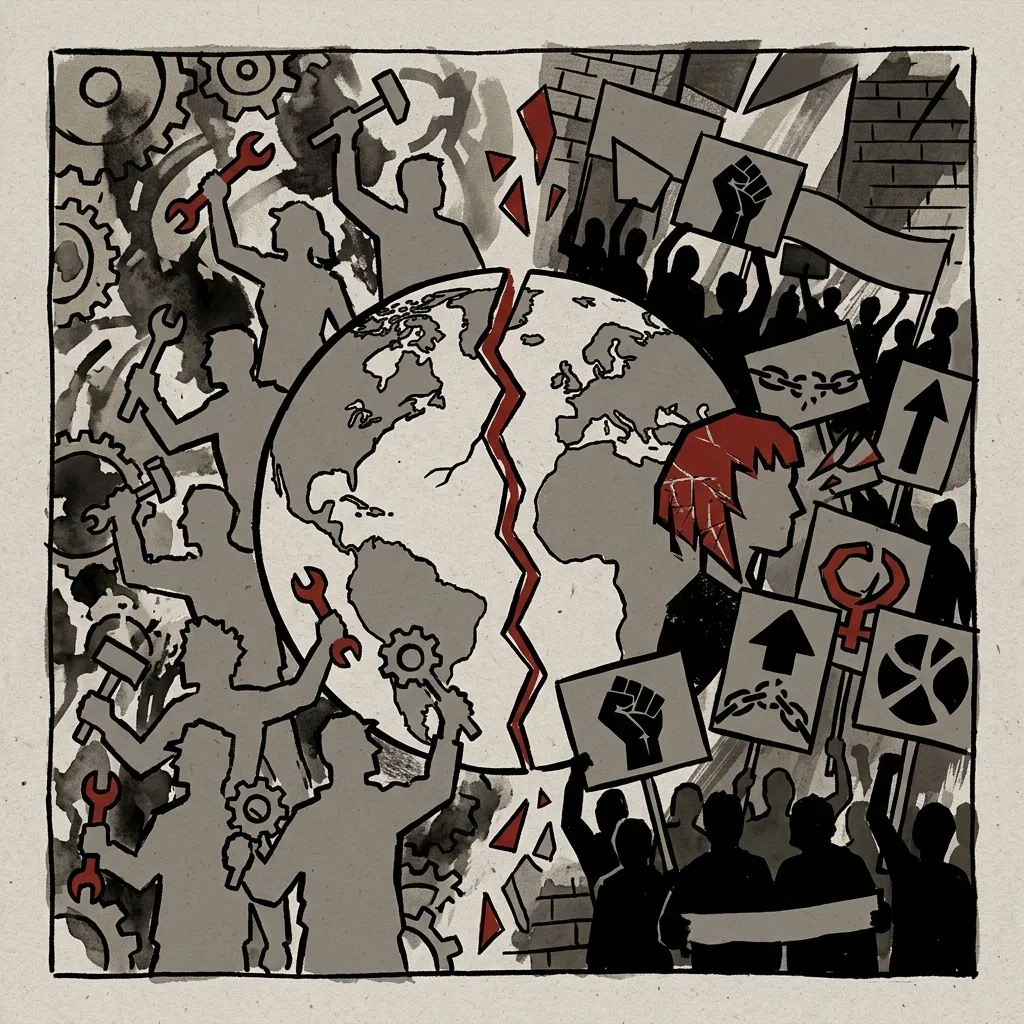
May Day demonstrations across the globe on Friday were marked by calls for improved labor conditions, protests targeting former U.S. President Donald Trump, and, in several nations, clashes with police forces. The events highlighted both traditional workers' rights themes and contemporary geopolitical tensions, with regional coverage emphasizing different aspects of the day's activities.
Latin American Perspective The report from Folha de S.Paulo presents a broad overview of international events, listing protests for better working conditions alongside banners opposing Donald Trump. It specifically notes that confrontations with law enforcement occurred in Turkey, Chile, and France. The framing is that of a global news roundup, cataloging incidents of unrest and political messaging in multiple countries without deep analysis of any single location. The mention of Trump appears as one element among several in a worldwide day of action.
Middle Eastern and Cuban Focus Al Jazeera's coverage centers exclusively on Cuba's May Day celebrations. It frames the event not merely as a workers' parade but as a display of national resolve, explicitly linking it to the recent announcement of additional U.S. sanctions against the island. The narrative suggests the marches served a dual purpose: commemorating International Workers' Day and demonstrating defiance in the face of perceived American threats. This source provides a focused, contextualized look at a single nation's activities, interpreting them through the lens of ongoing U.S.-Cuba geopolitical friction.
Framing the Day's Events The two sources offer complementary but distinct lenses on May Day. Folha de S.Paulo employs a wide-angle, multi-country summary that treats anti-Trump sentiment as a notable but non-dominant feature of a day defined by labor issues and sporadic violence. In contrast, Al Jazeera uses a tight focus on Cuba to craft a narrative of national unity against external pressure, where the worker celebration is intrinsically connected to resisting U.S. policy. One source catalogues global incidents, while the other provides a politically charged case study. The Folha report implies a diffuse, global expression of political discontent, whereas Al Jazeera depicts a centralized, state-aligned response to a specific adversary.
In synthesis, the coverage reflects how International Workers' Day continues to serve as a platform for both domestic socio-economic grievances and international political statements. The divergence in reporting underscores the selective nature of news framing—whether presenting a mosaic of global unrest or a deep dive into a singular event laden with historical and geopolitical significance. The protests and celebrations collectively illustrate how labor day observables remain a potent symbol, adaptable to local contexts and broader ideological conflicts.