
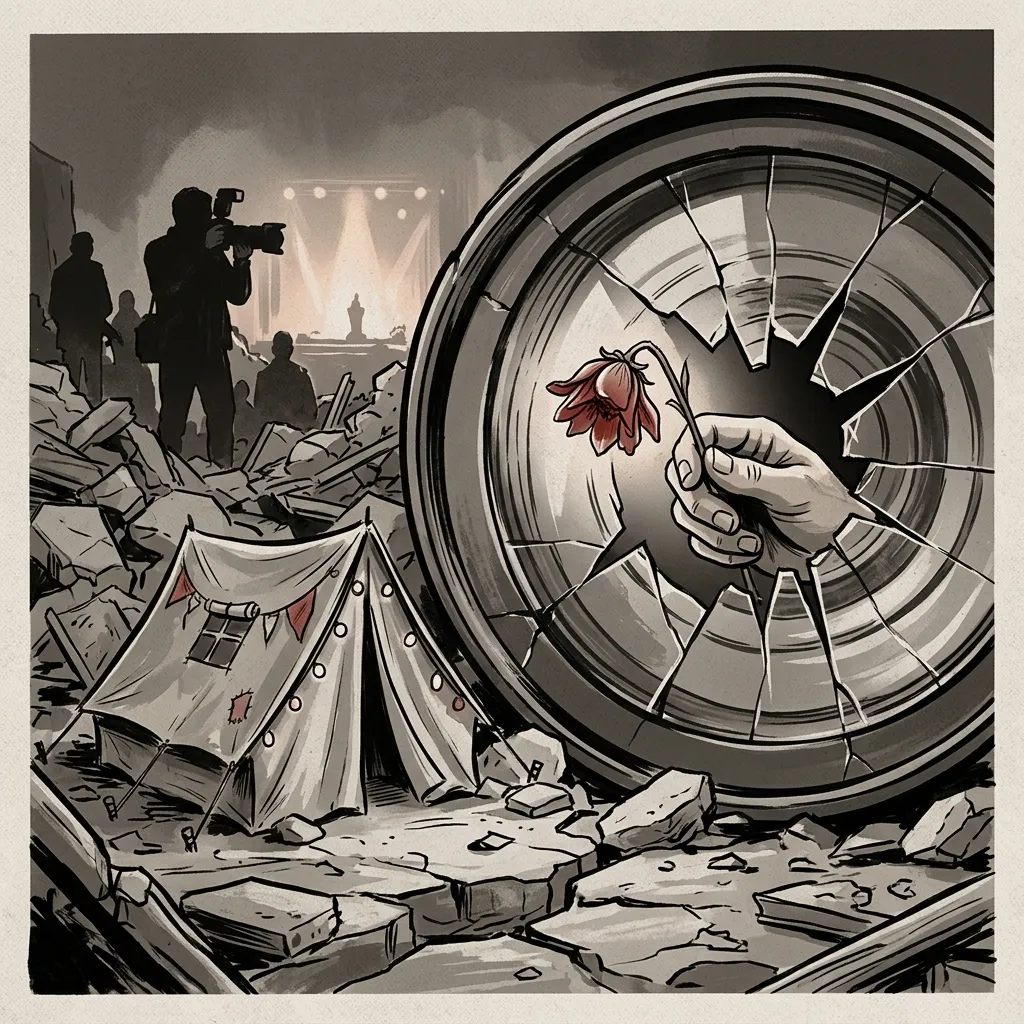
The ongoing conflict in Gaza continues to manifest in starkly different facets of daily life and global recognition, as reported by international media. Recent coverage highlights the profound impact on civilian routines, the immediate cost of violence, and international acknowledgment of the conflict's documentation. Al Jazeera reports on the erosion of social traditions and the lethal consequences of military strikes, while Folha de S.Paulo covers the prestigious award given to a Palestinian photographer for his work in the territory, illustrating a narrative split between ground-level suffering and professional achievement amid crisis.
Al Jazeera's reporting provides two windows into the human cost of the war. One feature details how the conflict, coupled with mass displacement and economic collapse, has fundamentally altered the social fabric. The outlet describes how couples are now forced to hold weddings in tents, with even the most basic ceremonies becoming financially out of reach for many. The report frames this not merely as a logistical challenge but as a profound loss of joy and cultural normalcy, stripping life's milestones of their traditional celebration. This narrative emphasizes the war's pervasive, grinding effect on civilian morale and social continuity beyond the immediate battlefield.
In a separate report, Al Jazeera covers a specific military incident, stating that an Israeli airstrike on a police station resulted in casualties. The report identifies a 15-year-old boy, Mahmoud Sahweil, as being killed in the attack. The language used is direct, attributing the action to Israel and specifying the victim as a child. This framing places the incident squarely within the context of civilian casualties and the lethal risks faced by the population, including minors, from ongoing military operations. The report does not provide context or justification for the strike from the Israeli perspective.
From Latin America, Folha de S.Paulo shifts the focus to international recognition of the conflict's chroniclers. The Brazilian outlet reports that Palestinian photographer Saher Alghorra, a contributor to The New York Times, has won the Pulitzer Prize in the Breaking News Photography category for his coverage in Gaza. The article highlights the professional achievement and the prestige of the award. This framing presents a narrative of resilience and professional excellence emerging from the conflict zone, focusing on the global platform and acknowledgment given to a Palestinian journalist's work. It introduces a dimension of external validation and the power of imagery to convey the realities of war to a worldwide audience.
Framing the Conflict: Suffering Versus Recognition The sources collectively paint a picture of Gaza through distinctly different lenses. Al Jazeera's dual reports are firmly anchored in the immediate, tangible suffering of Palestinians. The wedding story chronicles the slow erosion of hope and normalcy, a form of structural violence. The strike report documents acute, physical violence resulting in a child's death. Both frames emphasize victimhood and loss, constructing a narrative of unrelenting civilian hardship caused by the conditions of war and military action. In contrast, Folha de S.Paulo's report constructs a narrative of agency and global witness. By highlighting the Pulitzer win, it frames the conflict through the lens of international journalism and artistic merit, showcasing an individual's success in documenting the crisis. This narrative acknowledges the horror but centers on the professional triumph that arises from confronting it, offering a story of recognition rather than solely one of despair.
In synthesis, these reports illustrate the multifaceted reality of a prolonged conflict. On one hand, the war dismantles the foundational pillars of society—celebrations, economic stability, and child safety—as detailed by regional media deeply engaged with the humanitarian narrative. On the other, the very documentation of that devastation achieves the highest levels of global acclaim, as noted by international observers. This divergence underscores how the same geopolitical event generates parallel stories: one of intimate, daily loss and another of the world bearing witness to that loss. The recognition of a Palestinian photographer by a premier American institution adds a complex layer, suggesting that while life and tradition are under assault within Gaza, the images of that assault are securing a permanent place in the global historical record.