
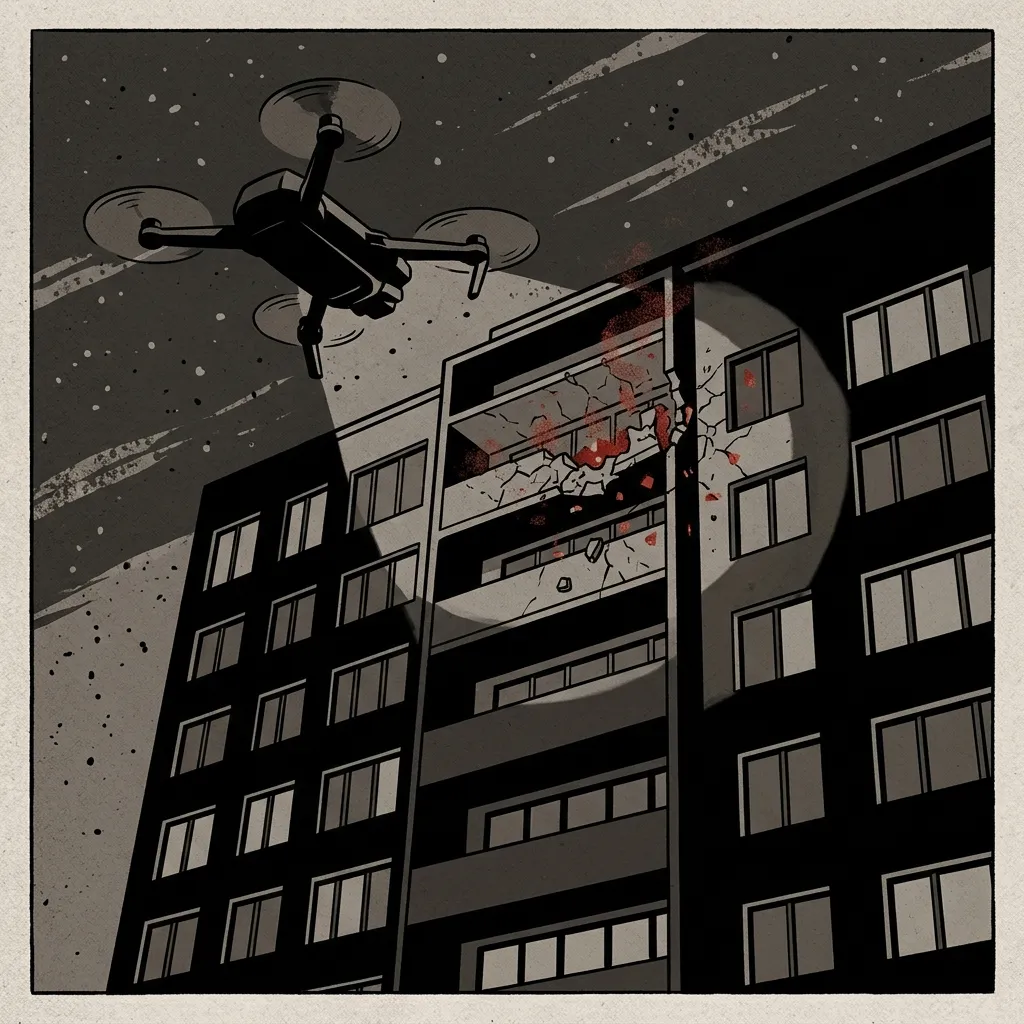
A Ukrainian drone struck a high-rise residential building in Moscow in the early hours of May 4, an attack occurring just days before Russia's annual Victory Day commemorations. The incident, which caused material damage but no reported casualties, has been framed by sources as a significant escalation in Ukraine's capacity to strike deep within Russian territory, while official Russian narratives emphasize effective air defense and the protection of civilians. The timing, ahead of a major patriotic holiday, adds a layer of symbolic tension to the military event.
BBC News frames the event within the immediate political and military context of the impending holiday. Its report highlights that Russia had declared a unilateral ceasefire for Victory Day celebrations and had issued a threat of a "massive strike" on central Kyiv should the event be disrupted. This framing presents the drone attack as a direct challenge to Russian authority and its declared ceasefire, implicitly setting the stage for potential retaliation. The BBC's description of the target as an "upmarket Moscow high-rise" conveys the strike's penetration into an affluent, civilian area of the capital, underscoring the breach of perceived security.
Meduza, an independent Russian news outlet, provides granular, forensic detail about the incident itself. Its reporting focuses on the mechanics of the attack and the official response. It specifies the target as the "House on Mosfilmovskaya," a residential complex located roughly seven kilometers from the Kremlin, and cites Moscow Mayor Sergey Sobyanin's statement that air defenses repelled two drones. Meduza meticulously details the aftermath: a "dull thud" heard by residents, damage to the building's facade, blown-out windows, and scattered debris. Crucially, it includes a claim from a Ukrainian Telegram channel, Exilenova+, that the drone was an FP-1 type strike drone, marking it as "the first recorded presence of Ukrainian strike drones in the immediate vicinity of the Kremlin in a very long time." This source presents a blend of official Russian statements (no casualties, air defense success) with on-the-ground witness accounts and claims from Ukrainian sources, creating a technically detailed narrative.
Framing the Conflict The divergence in framing between these sources is stark. The BBC contextualizes the strike primarily as a political and symbolic act, inextricably linking it to Russian ceasefire declarations and threats, thereby narrating it as an episode in a cycle of escalation. The attack is presented as a disruption to a state-managed narrative of security and control. In contrast, Meduza's reporting, while noting the proximity to Victory Day, focuses more on the operational facts of the event. It documents the physical impact on a civilian residential building and the logistical responses like airport restrictions, presenting a story about the war reaching Moscow's doorstep in a tangible, if limited, way. Meduza's inclusion of the Ukrainian source's claim about the drone type serves to independently verify and highlight the technical significance of the attack, an angle less emphasized by the BBC.
Both sources agree on the core facts: a Ukrainian drone hit a residential building in Moscow, causing property damage but no loss of life, shortly before Victory Day. However, their narrative emphasis diverges significantly. The BBC's lens is macro-political, interpreting the strike as a message within a high-stakes diplomatic and military standoff. Meduza's lens is micro-operational, providing a street-level view of the incident's execution and immediate consequences. This difference illustrates how the same event can be reported as either a strategic gambit in a broader conflict or as a specific security incident with local effects. The synthesis of these perspectives reveals an attack that is simultaneously a tactical demonstration of Ukrainian reach, a psychological blow against Russian domestic normalcy, and a potential catalyst for further military escalation, depending on the narrative frame applied.
In conclusion, the drone strike on Moscow underscores the evolving dynamics of the conflict, where attacks on symbolic dates and locations carry amplified weight. The reporting divergences highlight the challenge of separating the immediate physical event from its profound political and propaganda implications. While the material damage was contained, the successful penetration of Moscow's airspace so close to a national holiday represents a significant symbolic victory for Ukraine and a pronounced vulnerability for the Russian state, setting the stage for intensified rhetoric and potential retaliation in the days ahead.